Retail buyers rarely get a clean signal that says, “stock this next.”
Demand usually shows up in pieces. A product starts appearing more often in social feeds. Shoppers begin searching for a particular format. A familiar category suddenly gets new shapes, sizes, or collectible versions. Then similar products start turning up across specialty stores, gift shops, and larger retailers.
That is what makes trending toys to sell harder to identify than a bestseller list suggests. The useful question is not simply which individual toy is popular today. It is where shopper interest is building strongly enough to support an assortment.
In 2026, several of those signals are showing up around tactile interaction, collecting, food-inspired designs, fidgets, and screen-free play.
Table of Contents
Trending Toys to Sell Are Becoming More Interaction-Led
Some of the strongest toy ideas right now are easy to understand once they are in your hand.
Squeeze it. Stretch it. Spin it. Reveal something. Collect another version.
That immediate response matters because it works in more than one place. It can make a short product video satisfying to watch, but it also gives a shopper a reason to pick up the product in a store.
The Toy Association included Cozy Culture among its major 2026 toy trends, pointing to tactile materials, gentle interaction, and low-tech or no-tech play. That does not mean every tactile product will sell. It does suggest that hands-on interaction has become a broader retail theme rather than a feature limited to one toy category.
For buyers, the opportunity is to look at the interaction itself. Slow-rise foam, filled squeeze toys, mechanical fidgets, and other tactile formats may sit near one another on the shelf while giving shoppers very different experiences.
That distinction is explored more closely in our Sensory Toy Trends 2026 guide.
Small Collectibles Still Have a Retail Advantage
Collectibility continues to influence what shoppers come back for.
The appeal is not limited to traditional blind boxes. A product can encourage repeat purchases through different characters, expressions, colors, themes, or seasonal versions—even when the customer can see exactly what they are buying.
The Toy Association reports that 52% of parents surveyed had purchased a blind-box toy in the previous year, while its 2026 trend research continues to highlight self-expression, fandom, and collectible play.
For retailers looking at trending toys to sell, the important part is the repeat-purchase behavior behind the format.
One cute design may generate an impulse purchase. A recognizable family of designs gives the shopper a reason to look again.
That makes assortment planning especially important. Six products that differ only slightly may look like variety on a purchase order without giving customers six meaningful reasons to buy.
Food-Inspired Toys Are Finding New Forms
Food continues to be unusually adaptable in novelty and tactile toys.
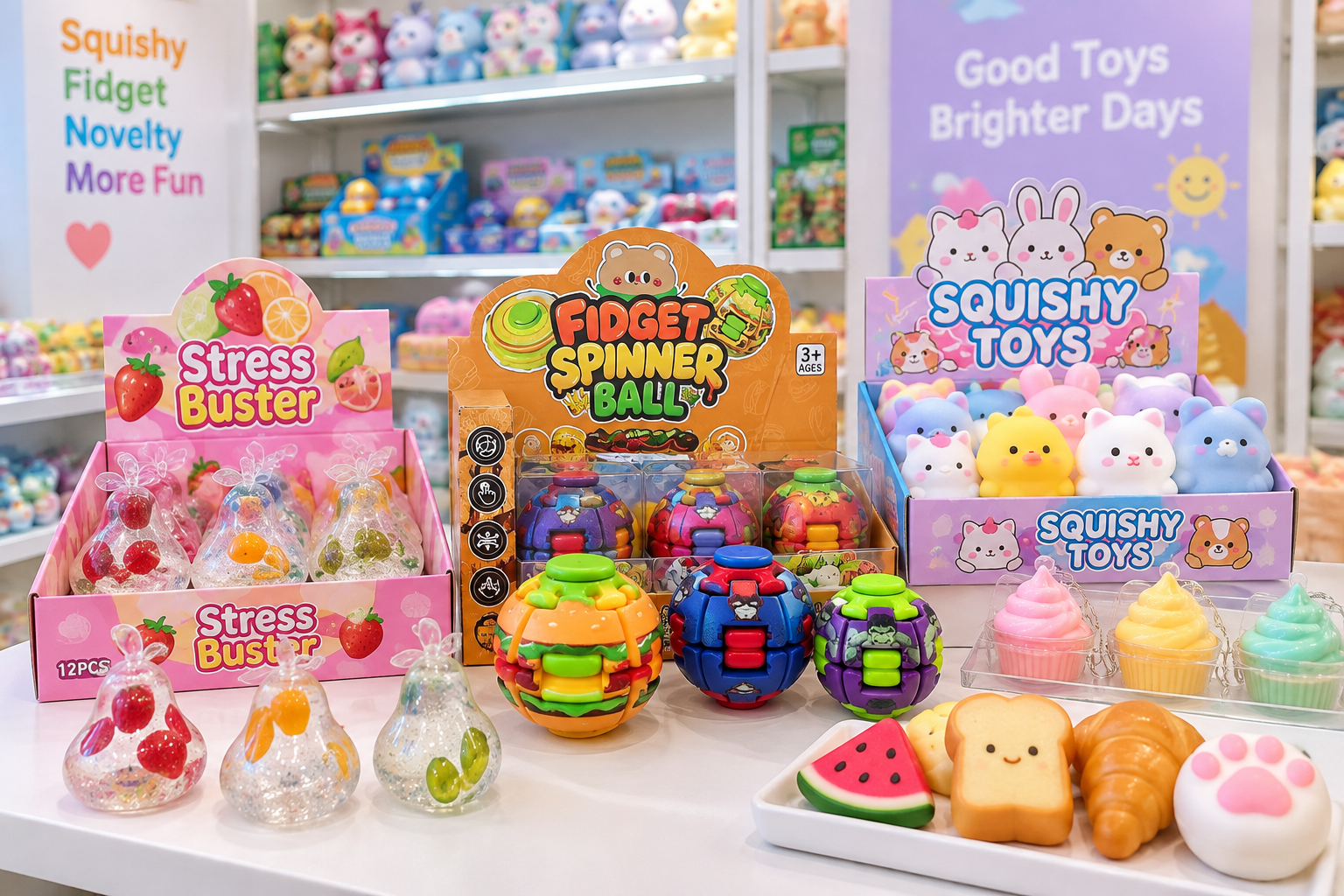
Dumplings, butter, cheese, desserts, drinks, and other familiar foods can become characters, squishies, collectibles, keychain-style items, or small novelty products. The idea works partly because the shape is recognizable before the shopper knows anything else about the toy.
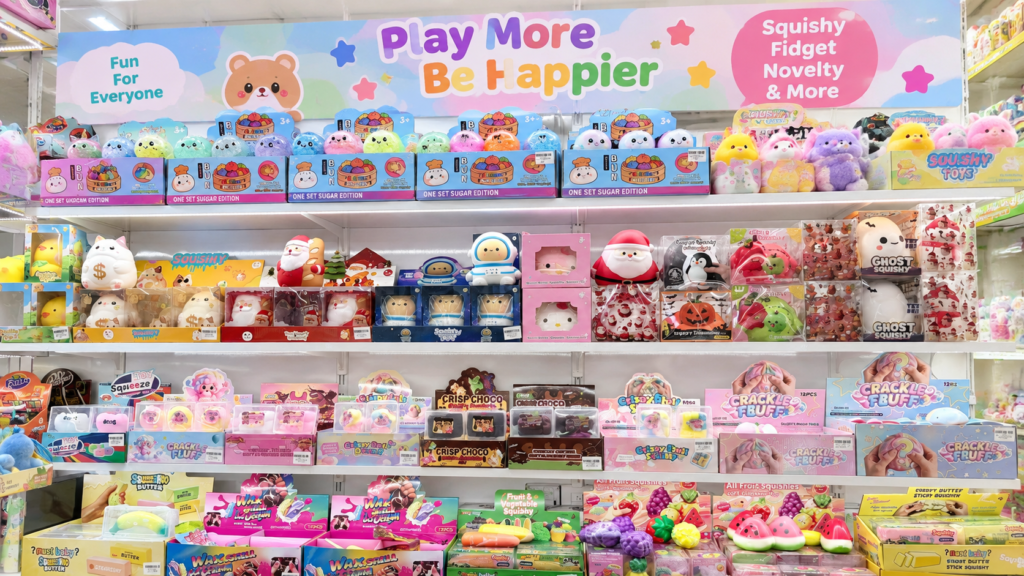
Recent wholesale search behavior offers another signal. Faire data reported by The Toy Book showed searches for squishies rising 185% over the previous quarter, with food-inspired forms including butter, cheese, croissants, cake slices, and dumplings appearing in the trend.
That does not mean a retailer needs an entire shelf of food squishies.
It does show why trending toys to sell in 2026 are often better understood as product directions rather than individual viral SKUs. A food theme can move across materials, sizes, price points, and interactions.
For a buyer, that leaves more room to build a recognizable assortment without depending on one design that may already be everywhere.
Fidget Play Is Splitting Into More Product Formats
“Fidget toy” no longer describes one obvious product.
The category can include press-to-spin mechanisms, rotating toys, click-and-press formats, compact desk toys, tactile squeeze products, and designs where the movement itself becomes the visual hook.
That variety gives retailers more flexibility, but it also makes category labels less useful when choosing products.
A mechanical spinning toy and a soft squeeze toy may both attract shoppers looking for something hands-on, yet they create completely different reasons to interact with the product.
This is where our Fidget Toy Retail Trends article goes deeper into assortment structure. For this broader look at trending toys to sell, the signal is simpler: fidget play is continuing to branch into different forms rather than depending on a single hero mechanism.
That creates room for retailers to mix interactions instead of stocking multiple products that effectively do the same thing.
Screen-Free Play Is Broader Than a Nostalgia Trend
Not every 2026 trend is about adding technology.
Spielwarenmesse identified Creative Mindfulness as one of its ToyTrends for 2026, focusing on tangible, hands-on activities and physical materials as a counterbalance to increasingly digital routines.
The interesting part for toy buyers is how broadly that idea can travel.
Screen-free does not have to mean traditional wooden toys or complicated craft kits. A tactile desk toy, a simple mechanical fidget, a collectible that encourages swapping, or a product built around repetitive hands-on interaction can all fit into a lower-tech play environment.
That gives trending toys to sell another useful dimension. Some products can feel current precisely because they offer a break from the screen rather than trying to compete with it.
For specialty retailers and gift stores in particular, that can create room for products that demonstrate well without batteries, apps, or lengthy instructions.
Not Every Trending Toy Belongs in Every Store
A trend can be real and still be wrong for a particular retailer.
A novelty shop may do well with humorous, inexpensive products that make sense immediately. A specialty toy store may need more depth in play value or age range. Gift stores may care more about presentation and how easily an item can be added to another purchase.
Online sellers face a different test again: the product has to communicate through photography and video before the customer can touch it.
This is why lists of the “hottest toys” only go so far.
The better question is whether a growing product direction fits the way customers already shop in that particular store.
For buyers evaluating trending toys to sell, category momentum is the starting point. Store fit still decides whether that momentum is useful.
Turning Toy Trends Into an Assortment
The strongest trend signals usually leave room for interpretation.
A retailer does not necessarily need the exact squishy, fidget, or collectible currently appearing in social feeds. The more useful opportunity may be the interaction, product format, price range, theme, or collecting behavior behind it.
That creates several paths for sourcing.
An existing product can be tested as part of a small assortment. A proven format can be developed in new colors or themes. Buyers with a clearer brand direction can move further into private-label packaging or custom OEM development.
At Vilora Toys, our work across squishy toys, fidget toys, and novelty toys gives buyers several ways to approach those decisions—from existing product formats to customized and private-label programs.
The goal is not to chase every spike in attention.
When evaluating trending toys to sell, look for the places where shopper interest, a clear product interaction, repeat-purchase potential, and the retailer’s own customer base begin to overlap.
That is usually a much stronger place to build an assortment than whatever happened to go viral this week.
Related Reading
Sensory Toy Trends 2026: What Retail Buyers Should Know Beyond Squishies
Fidget Toy Retail Trends: What Buyers Should Watch in 2026
Squishy Toy Retail Trends: How the Category Is Changing in 2026
Looking for Products for Your Next Toy Assortment?
Vilora Toys supplies and develops squishy, fidget, and novelty toys for retailers, distributors, and private-label programs, with options ranging from existing product formats to custom OEM and ODM development.