

A shipping carton can arrive intact while the squishy toys inside reach the shelf with crushed clear boxes or persistent pressure marks. The opposite is also possible: a scuffed outer carton may have protected every retail unit. Toy packaging transit testing should therefore evaluate the product and its complete packaging arrangement together. For a U.S. buyer importing soft toys, the useful question is whether the proposed pack protects the approved product through the actual distribution route and preserves the presentation the retailer expects.
Table of Contents
Build toy packaging transit testing around the proposed order
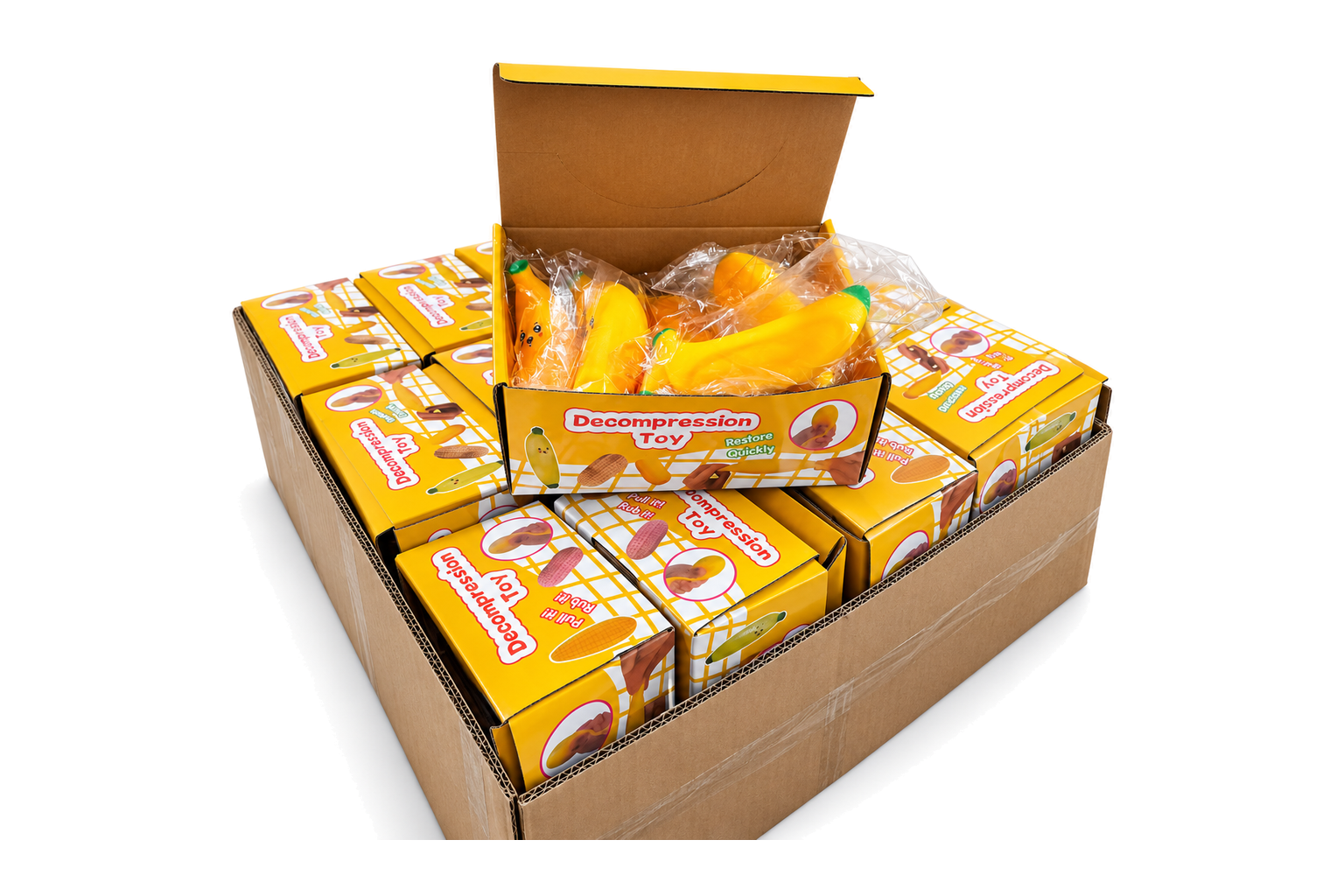
Start toy packaging transit testing with the finished product variant and intended individual pack, display carton and shipping carton. Record the quantities and arrangement at each level, including inserts, dividers, closure and any protective material. A convenient sample carton with extra padding is not representative if production will omit that padding. Photographs should make the packing sequence reproducible.
For example, Vilora’s boxed panda squishy has a clear unit-box presentation and a display arrangement. Protection must account for the body as well as the clear box and display header. A wrapped butter-style toy presents different contact surfaces. Neither arrangement should inherit another SKU’s approval just because the master-carton dimensions happen to be similar.
Freeze the packaging revision before drawing conclusions from toy packaging transit testing. Record the materials and construction information needed to identify it, without assuming that all cartons described by the same size perform alike. If the supplier later changes an insert, pack count or box construction, ask whether the evidence still applies. The retail packaging guide is a starting point for presentation choices, not a substitute for validation.
Choose the procedure around the journey
Before toy packaging transit testing, describe the expected route to the packaging specialist or testing provider: parcel delivery, palletized freight and warehouse transfers. Ask for a suitable procedure and its coverage. The published ISTA 1A overview describes non-simulation integrity testing, while the ISTA 3A overview describes general simulation for parcel shipments within its scope. These public summaries are not full procedures or automatic recommendations for this order; confirm the applicable current procedure with the provider.
Agree on the sample selection, sequence and acceptance criteria before testing. Separate commercial presentation criteria from product function and any safety requirements. Avoid publishing a universal drop height, carton strength or compression load as a rule for all squishy toys. The appropriate test and limits depend on the route, package and product; confirm those details with a qualified provider.
Document the actual pack and test conditions in the report. If a preliminary trial uses a substitute box or an incomplete display, label the limitation clearly. It may help development, but it is not equivalent to validating the production configuration. Do not describe a photographed shipping carton as tested or certified when no supporting record exists.
Unpack as the retailer and customer will
After toy packaging transit testing, inspect each packaging level against the agreed criteria. Record crushing, rubbing, loose closures, displaced inserts and any contact between packed toys. Then examine the products for agreed appearance and functional criteria. For soft bodies, note whether deformation remains after the agreed preparation rather than judging only the instant the lid opens. Keep recovery expectations specific to the construction.
Review shelf readiness separately. A toy may still function while a clear box is too distorted to display neatly or a printed area is no longer legible. Photograph both the affected unit and its position in the pack. That connection helps determine whether to change the local support, pack arrangement or outer protection instead of adding material indiscriminately.
Approval following toy packaging transit testing should identify the tested configuration and the decisions it supports. Keep the report, sample photographs and packaging revision together, then use them when checking the first production pack. If an arrangement fails, revise the suspected cause and confirm the relevant checks again. The goal is a reproducible protective pack, not merely an impressive-looking carton or an unsupported transit-testing claim.
Read More