
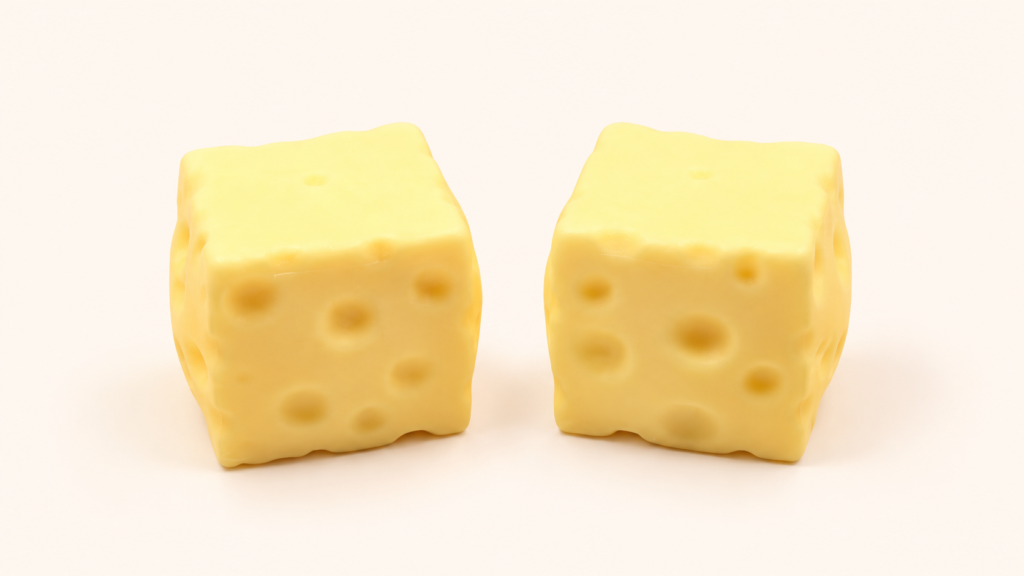
One supplier quotes “40 density.” Another offers a heavier sample and calls it an upgrade. Neither statement gives a buyer enough information to compare the materials.
PU squishy foam density measures mass per unit volume. It does not tell you, by itself, how easily a toy squeezes or how slowly it returns to shape. Before accepting a number on a quotation, establish its units and what the supplier actually measured.
That conversation can reveal a simple misunderstanding—or prevent two suppliers from pricing different specifications under the same description.
Table of Contents
Put Units Beside the Number
A useful PU squishy foam density specification needs a unit, commonly kilograms per cubic meter, written as kg/m³. U.S. foam references also use pounds per cubic foot, or lb/ft³.
These are different scales. A density of 40 kg/m³ is approximately 2.50 lb/ft³. Comparing “40” with “2.5” without checking the units would make equivalent values appear dramatically different.
The Polyurethane Foam Association’s explanation of foam properties distinguishes density from firmness. Density describes mass relative to volume; firmness describes resistance to compression. A higher density figure therefore cannot serve as an automatic instruction to make a toy harder.
For PU squishy foam density discussions, ask the supplier to replace shorthand with a complete statement: the value, unit, specimen description, and measurement method.
If the development question is primarily about squeezing resistance or recovery, Vilora’s guide to what affects squeeze toy softness addresses those characteristics separately. Keeping them separate makes the request clearer: you can specify a density target without assuming it defines the entire tactile experience.
A Finished Toy’s Weight Can Give the Wrong Answer
Consider an illustrative rectangular foam specimen measuring 10 × 10 × 5 centimeters. Its volume is 500 cm³, or 0.0005 m³.
If that specimen weighs 20 grams:
Density = 0.020 kg ÷ 0.0005 m³ = 40 kg/m³
Those figures demonstrate the calculation. They are not a recommended density or an acceptance limit for squishy toys.
Now imagine a decorated animal-shaped product that also weighs 20 grams and fits inside the same rectangular space. Its ears, curved body, and spaces between features do not fill that entire box. Dividing its weight by the box volume would underestimate its density.
This is where PU squishy foam density comparisons often become unreliable. Maximum product dimensions are useful for packaging, but they do not necessarily provide the foam volume needed for the calculation.

Finished weight introduces another question: what else is on the scale? Paint, coatings, attached accessories, and packaging can contribute mass. A cut foam specimen and a complete decorated toy should not quietly become interchangeable measurements.
For an irregular molded design, ask the technical team which specimen and volume method it uses. Agree on that basis before comparing results. Do not improvise a water-displacement test without considering whether liquid absorption or trapped air would distort the reading.
Confirm the material first, too. Vilora’s Stretchy Squishy Cube is listed as a TPR product; its rectangular appearance does not make it suitable for this PU foam calculation.
Compare Like Specimens Before Comparing Prices
Suppose two quotations both state the same PU squishy foam density. One refers to a cut specimen from the foam interior. The other comes from a finished molded item, including its surface.
The matching numbers do not yet establish a matching specification.
Ask each supplier to identify the specimen source, whether surface material was included, how dimensions or volume were determined, and whether the reported figure is a nominal target or a measured result. A stated tolerance also needs a clear basis: ask whether it applies to individual specimens or an average.
The PFA’s overview of foam test methods identifies separate methods for evaluating foam properties. If a supplier cites a standard, request the specific procedure used and confirm that its specimen requirements fit the proposed measurement.
If the immediate decision concerns PU squishy foam density, establish comparable density data first. Evaluate squeeze resistance, recovery, and resistance to damage separately rather than treating density as a substitute for every performance requirement.
A heavier sample might reflect a larger design, different decoration, or a different measurement basis. Conversely, a matching density does not establish that two formulations will behave identically.
There is no single density number buyers should copy into every purchase order. The useful specification is one that can be traced to an identified specimen and a repeatable measurement—not simply the largest number offered.
Once that basis is clear, PU squishy foam density becomes a meaningful part of a supplier comparison instead of an ambiguous claim about quality.
Read More