
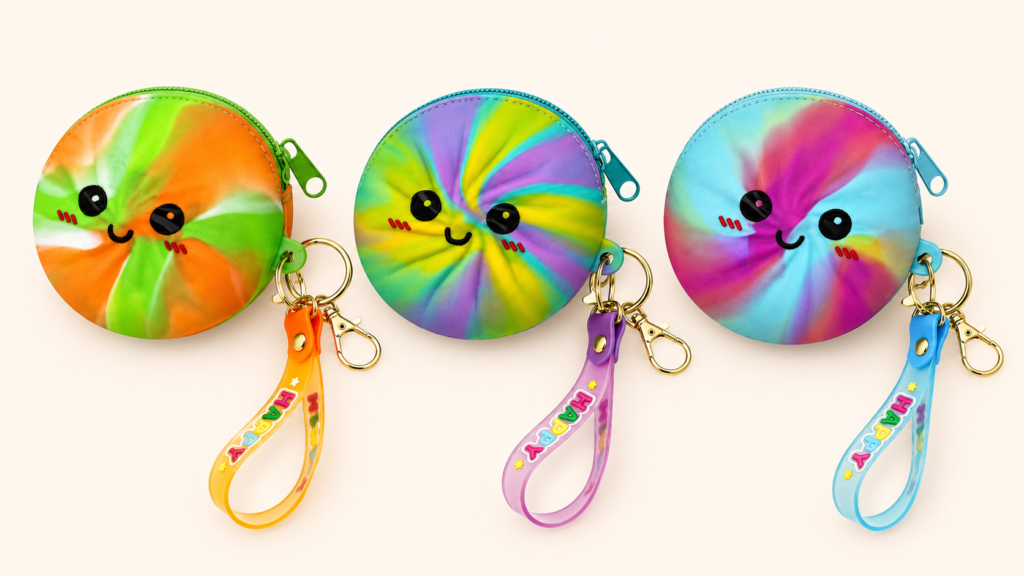
A closed metal ring tells you very little about the soft toy hanging beneath it. The ring may stay intact while a connector pulls free, a cord slips, or the surrounding material tears.
Squishy keychain attachment strength depends on the complete assembly. That includes the hardware, any intermediate loop or chain, and the point where the attachment enters the body. Looking at those parts separately can miss the weakest connection.
For buyers developing a hanging accessory, the first useful question is straightforward: when force reaches the attachment, where does it go next?
Table of Contents
Follow the Connection Into the Soft Body
Ask the supplier to show the connection from the outer clasp to its anchor inside or through the toy. Request a close-up drawing, assembly photograph, or section view where appropriate. The outside may look neat while the retention method remains unclear.

Start a squishy keychain attachment strength review by identifying the actual construction. Is there a molded loop, a textile cord, an embedded connector, or another arrangement? Which parts are permanent, and which are designed to open?
Next, examine the surrounding body. Note the attachment’s distance from a seam, filling closure, narrow projection, or thin section. Ask the developer how the local geometry and material support the proposed connection.
This does not mean every attachment should simply become thicker. A change may affect appearance, flexibility, assembly, or how the product can be manufactured.
When browsing Vilora’s squishy toy collection, distinguish the listed squeeze-toy configuration from any proposed hanging version. Adding hardware creates another connection to evaluate.
Record the toy’s dimensions and weight too. A larger hanging body can change the demands on the attachment during movement. Results from a smaller version should not automatically establish squishy keychain attachment strength for a larger one.
Identify What Actually Separated
If a sample breaks, keep the pieces. Photograph the connector and surrounding material before anyone repairs or replaces them.
A useful squishy keychain attachment strength report identifies the failure location rather than stopping at “failed pull test.”
| What you observe | What to investigate |
|---|---|
| The ring opens; the body remains intact | Hardware dimensions, closure, and assembly |
| The connector slips out without an obvious tear | Retention method and assembly consistency |
| Material tears around the anchor | Local geometry, material, processing, and attachment position |
| A cord breaks or slips | Cord specification and fastening method |
| A seam opens near the attachment | Whether force is being transferred into the closure area |
These observations guide an investigation; they do not establish the root cause on their own.
For example, replacing an open ring may address a hardware problem. It will not necessarily prevent the body from tearing around an anchor. Likewise, a stronger cord may simply move the failure to another part of the assembly.
Photograph early damage as well as complete separation. A growing tear, an elongated opening, or a connector that gradually shifts may help the developer understand how failure begins.
The purpose of reviewing squishy keychain attachment strength is to find that weak point before approving a change—not merely to choose a tougher-looking clasp.
Ask for a Method, Not Just a Passing Result
“Passed” is useful only when both teams know what was tested.
Request the gripping points, force direction, loading procedure, duration, sample quantity, and acceptance criteria. The report should identify the product revision and describe any damage observed before or after separation.
SGS’s toy-testing services include tensile, torque, fatigue, and durability assessments. Which procedures belong in the evaluation depends on the product and the requirements being assessed. www.sgs.com
There is no single force value in this guide that establishes acceptable squishy keychain attachment strength for every construction or age group.
For products covered by small-parts requirements, CPSC’s guidance explains that pieces released during applicable use-and-abuse testing can count as small parts. An informal hand pull cannot replace the prescribed assessment. www.cpsc.gov
Keep development observations separate from regulatory test conclusions. “The connector moved during handling” is an observation; whether the product meets an applicable requirement needs the appropriate assessment.
Attach the agreed connection details and test reference to the squishy toy specification sheet. If a revision changes the hardware, anchor, surrounding material, or assembly method, identify which results need to be checked again.
A useful squishy keychain attachment strength report lets the buyer answer three questions: what was tested, where damage occurred, and whether the proposed correction addressed that failure.
Read More