

The sample looks right until someone squeezes it. A fine line appears across the painted area. On another piece, the finish lifts at an edge. A third leaves a faint colored mark on its packaging.
Calling all three problems “bad paint” does little to explain what happened.
A squishy surface coating has to work on a moving surface. Its appearance at rest is only part of the story. How it stays attached, accommodates deformation, and reaches its intended cured condition can matter just as much.
Table of Contents
First, Establish Whether There Is a Coating
A shiny surface does not necessarily have a clear coat. Gloss may come from the molded material itself. A matte appearance can also exist without an additional finishing layer.
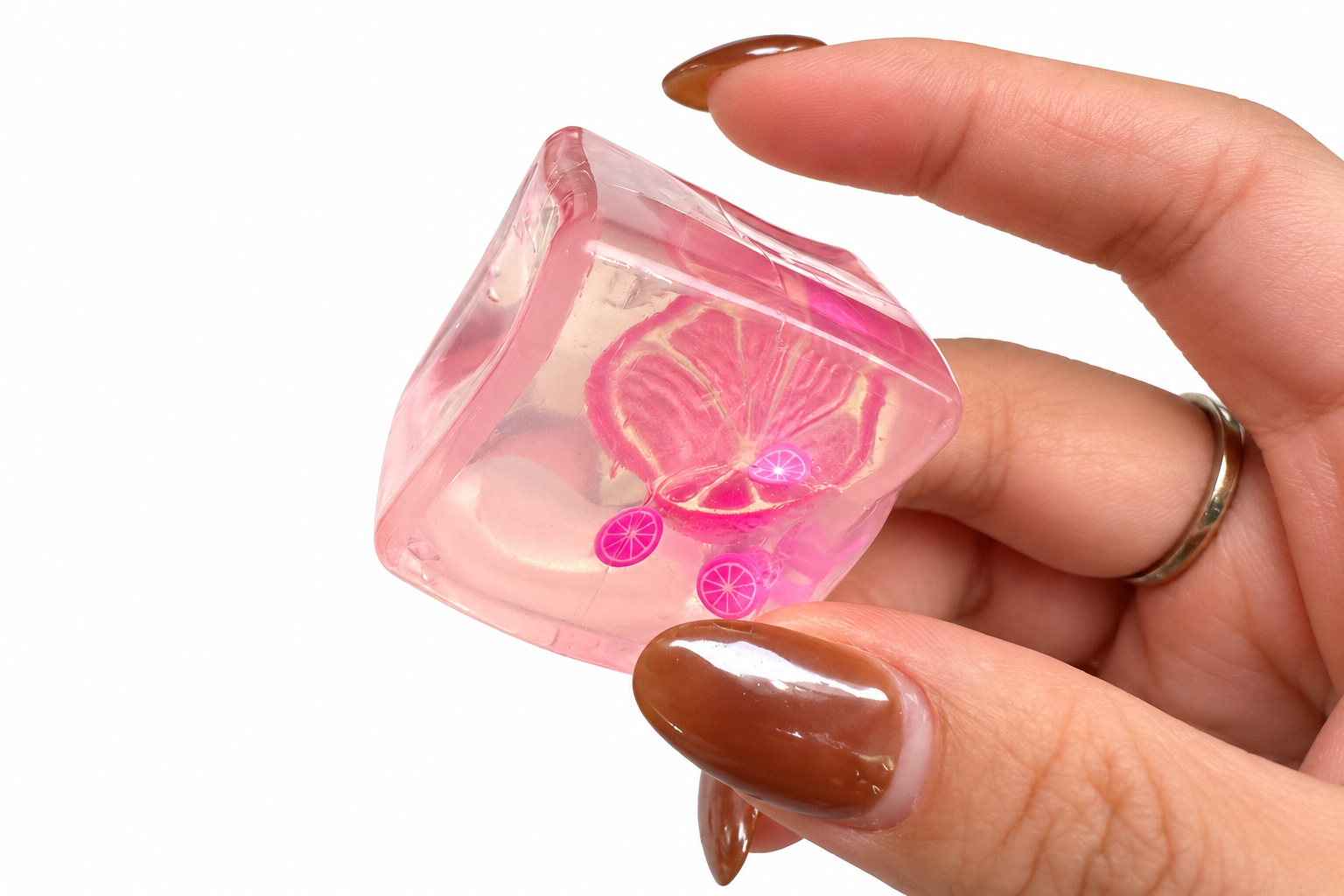
Before discussing a squishy surface coating, ask which parts of the finish are actually applied. Is there paint over the body? Printed decoration? A clear layer over those details? Or is the visible surface simply the molded material?
The answer determines what needs to be investigated later. A crack in an applied finish is different from a tear in the body beneath it.
Keep this description brief and specific to the product. “Painted face over a tinted body, with no additional clear coat” is more useful than “premium soft-touch finish.”
The color-matching guide explains how body colors and surface decoration can require separate references. Here, the question is narrower: which layer is moving, and what lies directly underneath it?
A Finish Must Stay Attached While the Body Changes Shape
Adhesion and flexibility describe different jobs.
Adhesion concerns the bond between the finish and the surface beneath it. Flexibility concerns how the finish bends or stretches with the product. A squishy surface coating needs the right combination for the intended movement; one property does not guarantee the other.
Smooth-On’s UreCoat technical information provides an industrial example of a coating designed to flex with specified rubber and foam substrates. It illustrates the principle, rather than establishing suitability for a particular toy.
The underlying material matters. A finish that performs well on one foam or rubber should not automatically be transferred to another. BYK’s surface-additive guidance discusses substrate wetting and related coating behavior, reinforcing why the surface beneath the finish belongs in that conversation.
Curing introduces another distinction. A coating may become tack-free before it reaches full cure. Smooth-On lists those as separate stages for its product; other systems have their own conditions.
For a squishy surface coating, “it feels dry” is therefore an incomplete production reference. Ask the team to identify when the actual finish is ready for handling, packing, and evaluation under its specified process.
Do not assume a failed sample merely needed more drying time. The cause could involve material compatibility, application, curing, or another factor that requires investigation.
Describe the Failure Before Naming the Cause
Imagine receiving three samples with surface changes after ordinary handling. A useful report distinguishes what happened to each one.
A fine line appears during compression. Record whether it closes when the toy recovers, remains visible afterward, or exposes the material underneath. Note its location and the movement that produced it.
An edge lifts away from the body. Photograph the boundary and identify the affected area. Avoid pulling at it to create a larger defect unless an agreed evaluation method requires that action.
Color appears on the packaging. Identify the contact surface, storage conditions, and whether the mark comes from printed decoration or another coated area. A transfer mark alone does not establish why it occurred.
These observations give a squishy surface coating investigation a clearer starting point than “paint quality is poor.” They also help distinguish finish damage from damage to the toy itself.
Vilora’s squishy toy inspection guide addresses the broader shipment review. A coating issue needs more focused evidence: the affected layer, location, handling conditions, and visible result.
Keep an unchanged comparison piece where possible. Photograph the affected sample both relaxed and compressed, using the same lighting. Those views can show whether a line follows a fold, crosses a decorated boundary, or remains after recovery.
The most useful conclusion about a squishy surface coating is a specific one: where it changed, when the change appeared, and how it differed from the agreed finish. That gives production a problem it can investigate—and gives the buyer a clearer basis for deciding whether the correction worked.
Read More