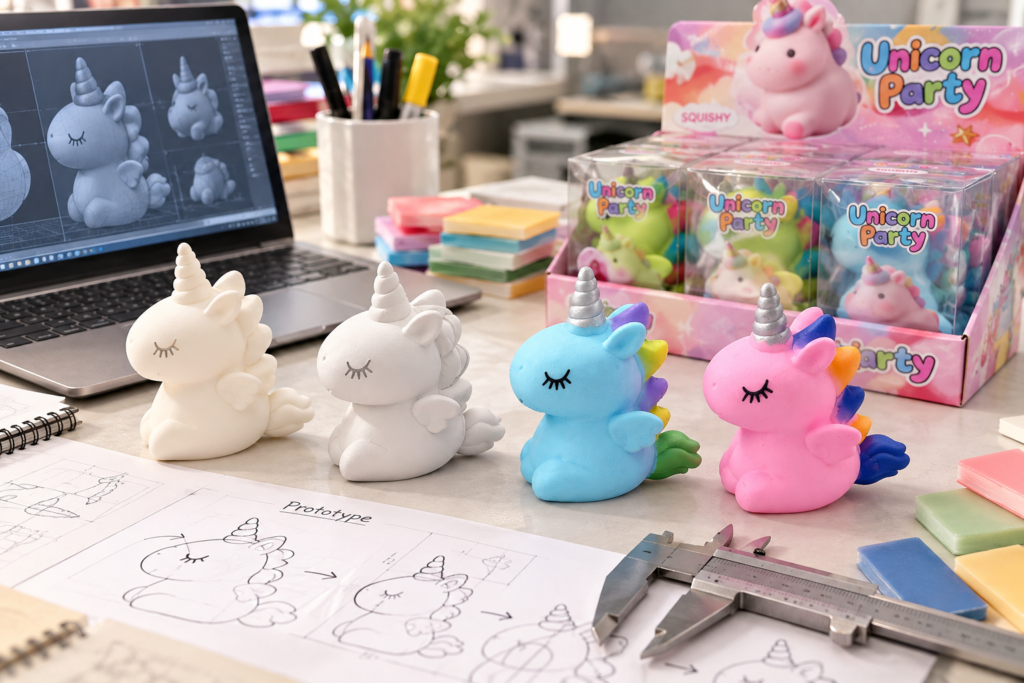
A prototype does not need to prove everything about a toy at once.
An early character model may only need to show whether the proportions feel right in the hand. A desktop fidget prototype may need to confirm that a mechanism moves as intended. A squishy toy may require a different physical version before anyone can judge softness, recovery or squeeze behavior.
That distinction matters in toy prototype development because a prototype can look convincing while still being the wrong model for the question being asked.
Before requesting the most realistic version possible, buyers should decide what they actually need to learn from it.
Table of Contents
Start With the Question, Not the Prototype Type
It is tempting to begin by asking whether a prototype should be 3D printed, hand-made or produced in another material.
Start one step earlier: what is still uncertain about the product?
Perhaps a character looked balanced in a rendering but its head feels too large once held. Maybe two moving parts interfere with each other. A fidget toy might look compact in CAD but take up more usable desk space than expected. Or a squeeze product may have the right external shape while its physical behavior remains unresolved.
Different questions may require different prototypes.
Research published in Design Science found that the fidelity of physical toy prototypes can affect the type of feedback children provide. The researchers recommend considering the purpose of the test before deciding how the prototype should be made.
For a commercial buyer, the same principle is useful even before formal user testing: write down the question the prototype is supposed to answer.
Toy Prototype Development Does Not Always Need High Fidelity
More realistic does not automatically mean more useful.
An early prototype that accurately communicates size and proportion may be enough to decide whether a character should become taller, wider or easier to hold. Spending additional time reproducing final decoration would not necessarily improve that decision.
The opposite is true when appearance itself is the unresolved question. If the buyer is evaluating facial details, surface treatment or the relationship between several visible components, a rough shape model may no longer provide enough information.
The Design Science study separates prototype fidelity into form and function—essentially how closely a model looks like the intended product and how closely it works like it.
The right level of fidelity is simply the one needed to make the next decision.
That can also keep toy prototype development from becoming unnecessarily expensive. There is little value in perfecting details that may disappear after the next design revision.
A Shape Prototype Cannot Prove How a Squishy Will Feel
This limitation becomes especially obvious with soft toys.
Suppose a buyer is developing a new squishy character. A rigid 3D-printed model could be useful for checking the silhouette, facial proportions, overall dimensions and whether small sculpted details look right.
But squeezing that model tells the buyer almost nothing about the final squeeze experience.
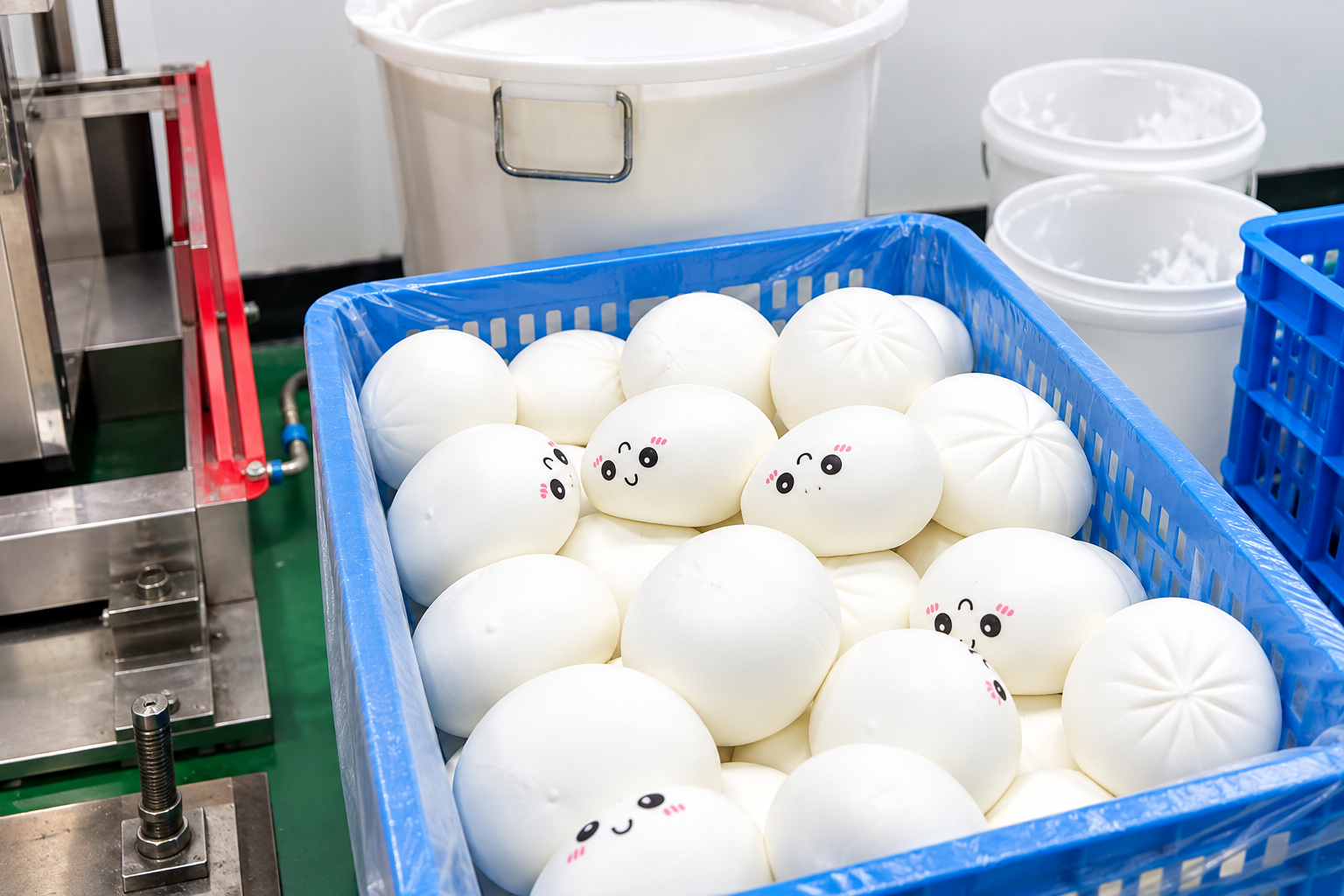
Softness, wall behavior, filling, recovery and the way the product changes shape under pressure depend on the intended construction and materials. A model made through a different process should not be treated as evidence that those characteristics have already been solved.
The same principle applies beyond squishies. A visual prototype of a spinning toy does not automatically prove spin performance. A static mock-up of an articulated character does not prove joint movement.
This is why buyers should record not only what a prototype proves, but also what it was never designed to test.
Form, Fit and Function Can Be Separate Decisions
For products with multiple parts, another question appears: do the components actually work together?
A prototype may need to verify that one component fits inside another, that a rotating part has enough clearance, or that an assembled toy reaches the intended overall dimensions.
This is where physical models can expose problems that are difficult to notice on screen. Protolabs notes that tolerances are tied to a part’s form, fit, function and intended use, and that overly loose or overly restrictive tolerances can create performance or manufacturing problems.
But form, fit and function do not always need to be evaluated with the same prototype.
Consider a small novelty toy with a molded body and a moving internal component. An early model might settle the outside dimensions first. Another version could concentrate on the moving assembly. A later version can bring those decisions together.
For toy prototype development, separating those questions makes feedback more useful than simply saying, “The prototype doesn’t feel right.”
Change One Important Thing, Then Check It Again
Prototype review becomes messy when too many changes are made without recording why.
Imagine the first model feels too large. At the same time, the buyer changes the face, shortens the body, enlarges a moving component and changes the grip area.
The second prototype may be better, but it becomes harder to know which change solved the original problem—or whether one of the other revisions created a new one.
A simple revision record can prevent that. For many toy projects, something this simple is enough:
Prototype 1: overall shape review → body too wide
Prototype 2: body width reduced → proportion approved
Prototype 3: mechanism added → clearance needs adjustment
The point is to preserve the reasoning between versions.
That also makes conversations between the buyer, designer and manufacturer clearer. Instead of reviewing each prototype as a new object, everyone can see what changed and why.
Know When a Prototype Has Finished Its Job
A prototype should lead to a decision.
That decision might be to keep the dimensions, change the proportion, revise the mechanism, try another material approach or move one unresolved question into the next physical sample.
What buyers should avoid is an endless sequence of prototypes with no defined reason for producing the next one.
This is also where toy prototype development should remain separate from production sample approval.
A prototype can show that the concept, shape or mechanism is moving in the right direction without proving that the factory can reproduce the final toy exactly as specified in mass production.
That later question requires a different level of sample and production reference. Keeping those stages separate prevents an early development model from becoming the standard for characteristics it was never intended to represent.
Once the major product decisions are resolved, buyers can move from prototype questions toward OEM development and production planning.
A Better Prototype Produces a Better Decision
The most useful prototype is not necessarily the one that looks closest to a finished retail product. It is the one that resolves an important uncertainty.
For one toy, that may mean holding a simple physical model and realizing the body should be 10% smaller. For another, it may mean discovering that two moving components need more clearance. For a squishy, it may mean confirming the sculpt first and leaving squeeze behavior for a version capable of representing it.
Good toy prototype development starts with a question and ends with a documented decision.
Before approving the next version, buyers should be able to answer two things clearly:
What did this prototype prove?
And just as importantly:
What did it not prove?