Spinning toys are one of those product categories that can look almost too simple on a wholesale catalog page. A shopper presses, twists or launches something, the toy starts moving, and the basic idea is understood within seconds.
That simplicity can be useful at retail. A product that demonstrates itself quickly does not need a long explanation from store staff or complicated instructions on the package. But for buyers comparing wholesale spinning toys, the purchasing decision involves more than whether a product spins.
The way the toy starts, how smoothly it moves, how it feels in the hand, how it is packaged and where it fits within an assortment can all affect whether it deserves space in a retail program.
Table of Contents
A Spinning Toy Should Make Sense Quickly
Some novelty toys need a demonstration before the customer understands what makes them interesting. Spinning products have an advantage when the interaction is immediately visible.
That does not mean every spinning mechanism is equally effective. Buyers should look at what actually starts the motion. Is the toy pressed, twisted, pulled or launched? Can a first-time shopper figure it out without assistance? Once it starts moving, is there enough visual change to make someone want to try it again?
This fits a broader shift toward simple, screen-free and tactile play. The Toy Association’s 2026 trend research identifies growing interest in low-tech play that combines sensory engagement with gentle interactivity. For a retailer, that makes the quality of the interaction more important than adding unnecessary features.
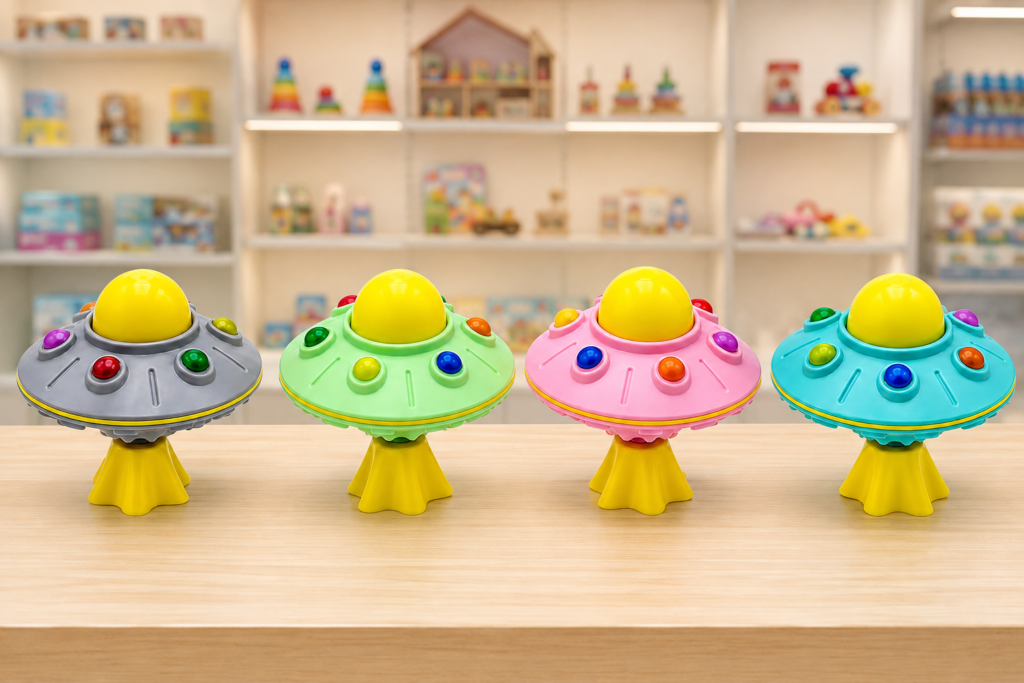
A product such as the UFO Gyroscope Spinning Toy is a useful example. Its basic play pattern comes from rotating motion on a flat surface, so the interaction can be understood without turning the product into something complicated.
What to Check When Evaluating Wholesale Spinning Toys
The first few seconds may attract attention, but buyers should also consider what happens after that first interaction.
When evaluating samples, try the product repeatedly rather than judging it from one demonstration. Does the mechanism still feel consistent after repeated use? Does the toy remain balanced on the surface where it is intended to spin? Are there loose parts or areas that begin to feel different after repeated handling?
These questions become more important for products intended for toy stores, gift shops, prize counters or other environments where display samples may be handled frequently. A product can photograph well and still be frustrating if the real interaction is inconsistent.
Material and construction matter here too. Plastic spinning toys, metal desk spinners and products with internal mechanisms should not automatically be evaluated the same way. Current wholesale listings show spinning products ranging from inexpensive plastic tops to precision metal kinetic toys, with very different materials, mechanisms, price points and minimum order quantities.
For a buyer, the useful comparison is not simply which one spins longest. It is whether the construction and play experience make sense for the intended customer and retail price.
Color and Assortment Can Do More Than Add Variety
Spinning toys often lend themselves naturally to color assortments. For retailers, that can create visual variety without requiring several completely different products.
The question is how that assortment will actually arrive.
Before ordering wholesale spinning toys, buyers should confirm whether colors are individually selectable, packed in a fixed ratio or shipped randomly. If a display contains several colors, it is also worth knowing whether the assortment is balanced throughout the carton rather than only in the sample set.
This becomes especially relevant when a retailer is testing a new SKU. Four colors of one proven mechanism may be easier to evaluate than four unrelated spinning products with different packaging, play patterns and price points.
The UFO design currently offered by Vilora Toys, for example, is available in green, pink, blue and gray. That kind of color variation gives a buyer assortment flexibility while keeping the core product consistent.
This is a small distinction, but it matters. Variety does not always require adding more SKUs.
Packaging Has to Work After the Demonstration Ends
A spinning toy may be easy to understand when someone is demonstrating it. On a shelf, however, the packaging has to do more of the work.
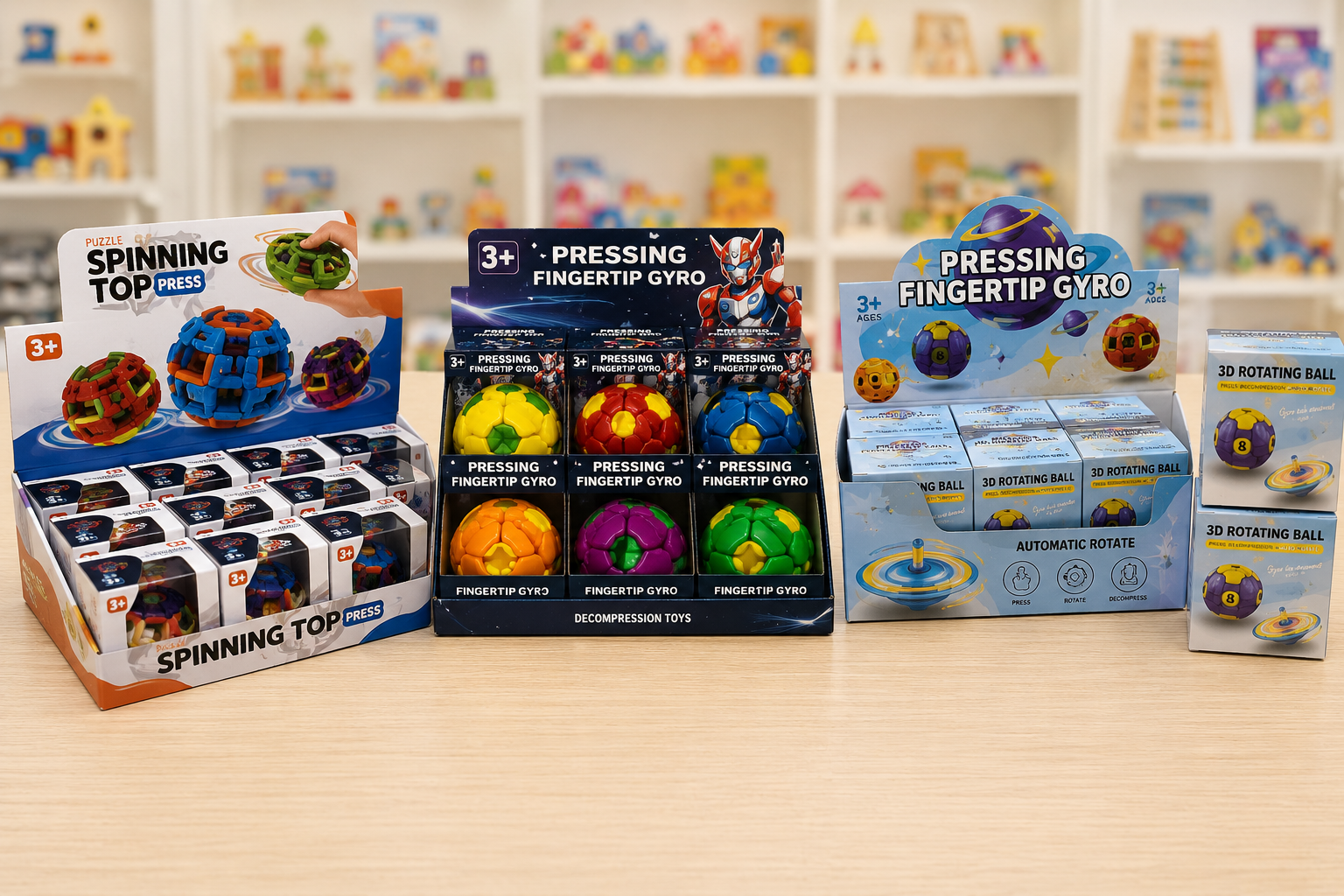
Buyers should consider whether the product can be seen clearly, whether the package communicates the interaction and whether the format fits the intended display. A countertop display, individual color box and hanging package solve different merchandising problems.
Current wholesale spinner listings illustrate that difference. Some products are sold individually on blister cards, while others are supplied in multi-piece retail displays. Neither format is automatically better; the right choice depends on where and how the retailer plans to sell the product.
For private-label programs, packaging decisions also extend to logo placement, colors, barcode requirements, warnings and other market-specific information. Those details should be discussed before production rather than treated as an afterthought once the toy itself has been approved.
Test the Product Before Expanding the Assortment
One of the easiest mistakes in novelty buying is assuming that a visually interesting product needs a large assortment immediately.
It usually does not.
A smaller opening test can tell a retailer which colors shoppers choose, whether customers understand the interaction, where the product performs best in the store and whether the retail price feels appropriate. Those observations can be more useful than adding several similar products before the first one has generated any sales evidence.
Samples are particularly valuable when the mechanism itself is part of the appeal. A photograph can show color and shape, but it cannot fully communicate resistance, balance, movement or how the product feels after repeated use.
This is why wholesale spinning toys should be evaluated as physical products, not just catalog images. Buyers considering a larger program can use the first approved product as a reference point and then decide whether the assortment needs another color, another mechanism, another size or a completely different design.
That is a more controlled way to build a novelty category than ordering broadly simply because several products look interesting online.
Wholesale Spinning Toys Should Earn Their Place in the Assortment
The strongest spinning toy is not necessarily the one with the most complicated mechanism. In many retail environments, simplicity can be part of the appeal.
For buyers, the better questions are practical ones: Can shoppers understand the interaction quickly? Does the product perform consistently? Does the color assortment add useful choice? Will the packaging work in the intended display? And is there enough evidence to expand the order after the initial test?
Those questions make it easier to compare wholesale spinning toys as retail products rather than isolated novelty items.
For wholesalers, retailers and private-label brands building a broader novelty assortment, spinning products can also sit alongside other tactile and interactive toys without requiring the entire category to follow the same play pattern. The goal is not to fill a shelf with products that all do the same thing. It is to give shoppers several clear reasons to stop, pick something up and interact with it.
Read More : Buying Guide · Industry News · OEM Guide