Squishies are starting to show up in stores that would not have been obvious destinations for the category even a year ago. Recent wholesale data from Faire shows the products spreading into hardware stores, convenience stores, pharmacies and grocery stores. In several of those channels, squishies now represent more than 60% of kids-item orders, while retailer searches for “squishy” on the platform increased more than 18,000% year over year.
For toy buyers, the rise of squishy retail channels is not simply about popularity. It is that a product usually associated with toy stores is beginning to work in retail environments where toys make up only a small part of the overall assortment. That makes squishy retail channels worth looking at as a merchandising and product-planning question, rather than just another sign of a fast-moving toy trend.
The shift also raises a practical question for retailers and wholesalers. If an existing product can reach new customers simply by appearing in a different retail setting, growth may not always require another round of product development. In some cases, the bigger opportunity may be finding a better place, format or reason for the customer to buy what already exists.
Table of Contents
Why Squishies Can Work Outside the Toy Aisle
Squishies have several characteristics that make them unusually easy to move between retail environments. The interaction is immediate: a shopper can see the product, pick it up and understand what it does without reading instructions or watching a demonstration. Most formats are also compact enough for countertop or checkout displays, while their colors and recognizable shapes can attract attention without requiring much shelf space.
That flexibility is one reason squishy retail channels can extend beyond traditional toy stores. In a specialty toy store, a squishy may be positioned as a sensory or fidget product and sit within a larger assortment. In a gift shop, the same item can work as a small novelty gift, while a convenience store may treat it primarily as an impulse purchase. A pharmacy or lifestyle retailer may find that certain tactile products fit naturally alongside desk, stress-relief or everyday novelty items.
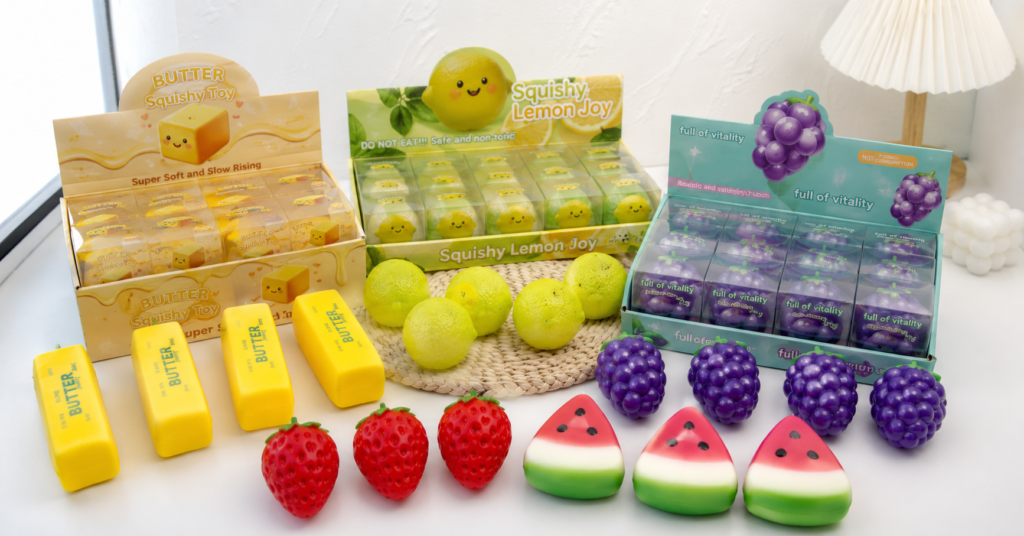
Faire’s wholesale squishy marketplace provides some context for how broad the category has become. Its current assortment includes more than 200 brands and over 3,000 products, ranging from stress balls and slow-rise figures to food-shaped squishies, mystery assortments and sensory fidget products. Typical wholesale packs are around 12 units, and many brands use opening-order minimums of roughly $100 to $150, making the category relatively accessible for independent retailers that want to test demand without building a full toy department.
For buyers, this is a reminder not to treat “toy” as the only retail identity a squishy can have. The product itself may remain almost identical while the purchase occasion changes around it. That distinction is important because expanding squishy retail channels does not necessarily require expanding the product line at the same pace.
New Retail Channels May Need New Packaging, Not New Products
As squishy retail channels expand, packaging, case quantities and retail presentation become more important parts of the buying decision. A squishy designed for a traditional toy-store shelf may not need the same presentation in a convenience store, gift shop or pharmacy. In many cases, the core product can remain unchanged while the packaging and display strategy are adapted to fit the environment.
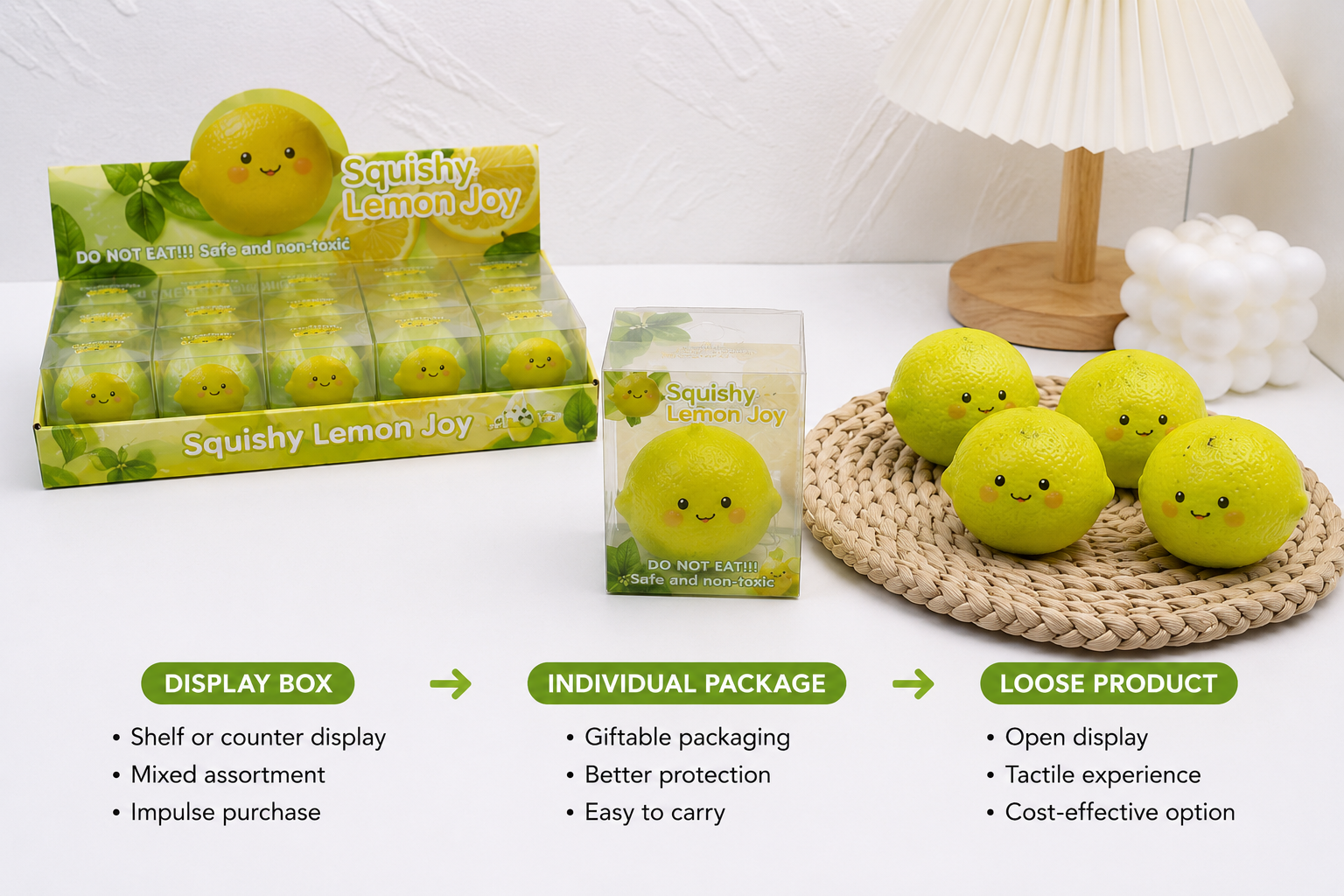
A checkout location, for example, may benefit from a compact mixed countertop display that lets shoppers see several colors or shapes at once. A gift retailer may place more value on individual presentation and packaging that makes a low-cost product feel giftable. A specialty toy store may prefer a deeper coordinated assortment that can be replenished by style, while a general retailer may want a tighter case containing only a few proven designs.
Price positioning can change with the channel as well. A small impulse item has to make sense as an easy addition to a larger purchase, whereas a bigger format or more carefully packaged version may support a higher gift-oriented price point. Case packs also matter: a retailer testing squishies as a secondary category may have very different inventory needs from a toy store that already knows the category and expects regular reorders.
For buyers sourcing wholesale squishy toys, these decisions are worth making before packaging is finalized. Instead of treating packaging as something added after product development, it can be planned around the retail setting from the beginning. Display format, individual packaging, case quantities, color mixes and assortment structure all become part of the same channel strategy.
This is also where OEM and private-label development can become more efficient. A buyer entering a new channel may not need a completely new mold or mechanism; the more practical change could be a different display box, pack configuration, graphic treatment or product mix. That allows an existing concept to be tested in a new retail environment before committing to a larger development program.
Recognizable Shapes Can Help Products Cross Retail Boundaries
Product design still matters, particularly when a squishy needs to make sense outside a dedicated toy section. Faire’s first-party wholesale data shows the category becoming noticeably less generic. Generic squish products represented 89% of squishy GMV on the platform in mid-2025, but by June 2026 that share had fallen to 37% as more recognizable concepts, including dumpling and butter shapes, gained ground.
The useful takeaway is not that every buyer should rush into whichever food shape happens to be rising this month. What matters is that a recognizable concept reduces the amount of explanation a product needs. A shopper already understands a dumpling, piece of fruit, dessert or other familiar object before touching the product, which can make the item easier to notice and merchandise in a store where customers are not specifically browsing for toys.
This is one reason food-shaped squishies can move naturally between toy, gift and impulse environments. Their visual identity gives them novelty value in addition to their tactile appeal, while other clearly recognizable shapes can achieve the same effect without being food related. We discussed the broader movement toward food, jumbo, collectible and seasonal formats in our Squishy Toy Retail Trends 2026 analysis; from a channel perspective, the important point is that shape can influence not only what a product looks like, but also where it makes sense on the shelf.
That does not mean every unusual shape deserves its own SKU. Buyers still need to consider whether a concept fits the intended customer, price point and retail environment. A recognizable product idea is most useful when it makes the buying decision easier rather than simply adding another design to an already crowded assortment.
Test the Channel Before Adding More SKUs
When demand rises quickly, adding more products can feel like the obvious response. Buyers may expand into additional colors, shapes and sizes because a growing category appears to justify a larger assortment. Sometimes that is the right move, but adding SKUs is not the only way to test where the next stage of growth might come from.
An existing product can be moved closer to checkout, placed in a mixed display, introduced through a gift retailer or tested with a more compact packaging format before another mold is approved. Those relatively small changes can reveal how a product performs across different squishy retail channels. A retailer may discover that mixed assortments move faster than individual styles, that recognizable shapes perform better in a particular channel, or that simpler packaging makes an impulse price point easier to maintain. Testing different squishy retail channels can also show whether an existing SKU needs a new product design at all, or simply a better retail format.
These are useful retail signals because they come from actual buying behavior rather than assumptions about what should work. They can help a buyer decide which designs deserve additional inventory, which packaging format should be repeated and whether a new channel is strong enough to justify a customized version. For private-label programs, that information can be particularly valuable before committing to tooling, packaging quantities or a much larger assortment.
Testing squishy retail channels also gives buyers another way to manage trend risk. Instead of responding to rapid category growth by immediately developing ten more SKUs, an existing line can first be tested across different placements and retail environments. If the product continues to move, the next development decision is being made with better information.
The Next Squishy Opportunity May Be a New Purchase Occasion
No fast-growing toy category stays at peak momentum forever, and squishies will be no exception. Buyers still need to be careful about chasing every viral shape, carrying too many similar products or assuming that today’s search growth will continue indefinitely. The expansion of squishy retail channels, however, points to something broader than the performance of any single trending SKU.
Consumers are becoming comfortable encountering squishies in more types of stores, and each new retail environment creates another possible purchase occasion. A child may notice one while shopping with a parent, a customer may add a small novelty gift near checkout, or someone may discover a tactile desk item in a store they never entered with the intention of buying a toy. Those situations expand the category by changing when and why the purchase happens.
For buyers, channel expansion is therefore worth treating as a testable retail strategy rather than simply a side effect of the current squishy boom. Before adding another round of products, it may be more useful to see whether an existing SKU performs differently with a new display format, package, price point or retail setting.
If those tests work, the next phase of squishy growth may come as much from creating new purchase occasions as from creating new products.
Read More: Industry News · Customization Guide · OEM Guide