Gyroscope toys are easy to notice because movement is the main part of the play experience. Some spin across a tabletop, some respond to pressing or twisting, while others combine rotating motion with tactile buttons and compact novelty designs. From a catalog image, many of these products can look fairly similar.
For buyers sourcing gyroscope toy wholesale products, however, the visible spinning action is only the beginning. Differences in mechanism, construction, size, packaging and finish can affect how the toy performs, how it is merchandised and how suitable it is for a particular retail program.
Before moving from a sample to a larger order, buyers should evaluate the product as a complete retail item rather than comparing unit price alone. A clear specification, an approved sample and a defined packaging plan can make later discussions around MOQ, customization and production much more straightforward.
Table of Contents
Start With the Actual Play Mechanism
The term “gyroscope toy” can describe several different types of products, so the play mechanism should be one of the first details a buyer confirms. Some products use a press-to-spin action, while others depend on balance, internal rotation or a manual launch. What matters most is whether the intended customer can understand the interaction quickly and repeat it without unnecessary explanation.
A sample is the best way to evaluate that. Buyers should activate the toy repeatedly rather than judging it from a short supplier video or a single demonstration. The motion should start consistently, the product should remain stable during normal use, and the mechanism should continue to feel the same after repeated handling.
This kind of simple physical interaction also fits the broader interest in tactile and screen-free play. The Toy Association’s 2026 trend research has highlighted low-tech play, sensory experiences and gentle interactivity as areas of continued interest. For retailers, that makes the quality of the interaction more important than adding unnecessary complexity.
When a buyer is comparing broader categories of wholesale spinning toys, the same principle applies: the strongest product is often the one whose play pattern is easy to understand and satisfying to repeat.
What to Compare in a Gyroscope Toy Wholesale Sample
A low unit price is not especially useful if buyers are not comparing the same specification. For a gyroscope toy wholesale order, basic information should include material, dimensions, weight, available colors, play mechanism and packaging format. These details can influence carton quantity, freight, retail presentation and the final landed cost.
The sample itself should also be reviewed beyond appearance. Buyers can check how closely the parts fit together, whether the surface finish is consistent, whether moving components feel secure and whether the toy performs the same way after repeated use. If the product is intended for a retail environment where shoppers may handle samples frequently, durability during repeated interaction becomes particularly important.
Color assortment is another detail that should be clarified before production. Product photography may show several attractive color options, but that does not necessarily mean every carton will contain an equal ratio. Buyers should ask whether colors are fixed, randomly packed or customizable, especially when visual variety is part of the intended retail display.
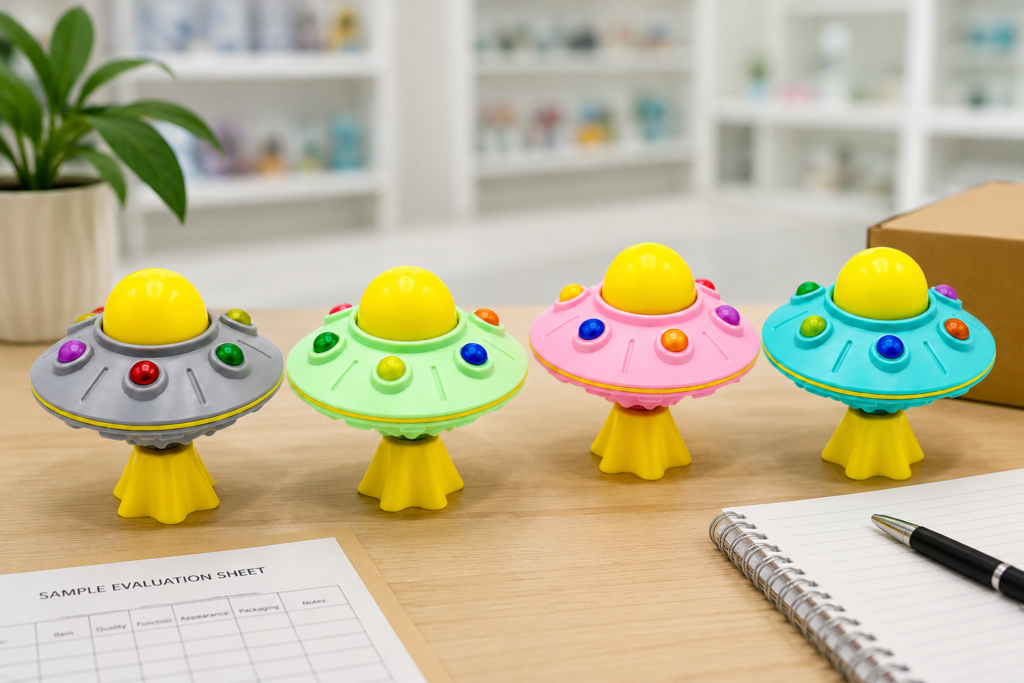
This is also where the UFO Gyroscope Spinning Toy can be used as a practical example. A buyer evaluating a product like this can compare the spinning action, construction, available colors and retail presentation before deciding whether the design fits a larger novelty assortment.
Gyroscope Toy Wholesale Packaging and Customization
Once the physical product has been approved, packaging becomes part of the wholesale decision rather than a separate finishing detail. An individual retail box may work well when the toy needs its own shelf presence, while a countertop display can be more practical for lower-priced novelty products sold near a register or high-traffic area. The right format depends on where and how the retailer expects the product to sell.
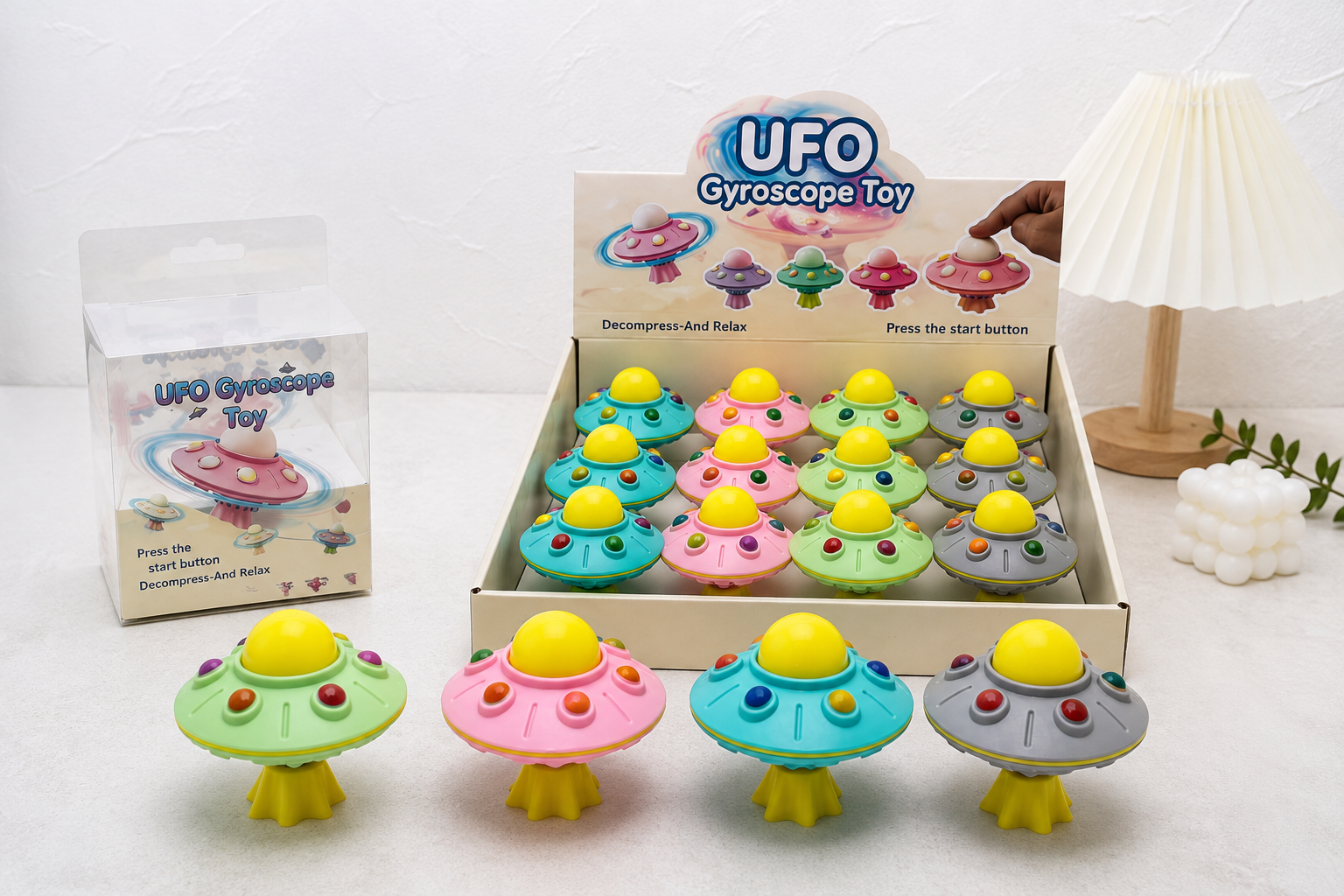
Packaging can also change the economics of the order. Carton dimensions, units per case, printing, labeling and assembly can all affect cost and logistics. Buyers should therefore confirm whether a quoted price includes the toy only, standard factory packaging or fully customized retail packaging, because those are three different purchasing scenarios.
Customization should be approached in the same practical way. Not every private-label program needs a completely new mold. For many first orders, changes to color, logo placement or packaging can create enough differentiation without changing the basic product structure.
For buyers looking for custom gyroscope toys, it is more useful to define exactly what needs to change than to ask whether customization is available in general. Custom colors, branded packaging, barcodes, hang tags, artwork or deeper product changes can each have different effects on MOQ, sampling and lead time. The clearer the customization scope is at the beginning, the easier it becomes to build an accurate quotation.
Compliance Depends on the Destination Market
Toy compliance should be considered before production begins, particularly when the product is intended for children. In the United States, ASTM F963 forms part of the federal toy safety requirements, and applicable children’s toys generally require third-party testing by a CPSC-accepted laboratory together with a Children’s Product Certificate.
The exact requirements depend on the product itself. Materials, construction, accessible components, age grading and the way the toy functions can affect which provisions apply. That is why a supplier’s general statement that a product is “safe” should not replace a discussion about the actual destination market and intended age group.
For a gyroscope toy wholesale program, buyers should tell the supplier where the product will be sold before the order is finalized. This gives the testing, labeling and documentation discussion a clear starting point and helps prevent compliance questions from appearing only after production is already complete.
Requirements also differ between markets. A product prepared for the United States should not automatically be assumed to meet EU, UK or other international requirements without reviewing the relevant standards and documentation for those destinations.
Define the Product Before Requesting a Final Quote
A useful wholesale quotation starts with a clearly defined product. Before requesting final pricing, buyers should know the design, color assortment, packaging format, estimated quantity, destination market and any customization requirements. Without those details, two quotations may appear comparable even when they are based on different product configurations.
For gyroscope toy wholesale sourcing, the sample and specification stage should narrow those variables before quantity becomes the only point of discussion. Once the product has been defined, buyers can compare MOQ, pricing, lead time, packaging and production options on the same basis.
This approach is particularly useful for retailers and private-label brands that plan to build a product line over time. A clearly documented first order creates a reference point for later reorders, new color programs or additional packaging formats without requiring the entire product to be redefined.
For that reason, choosing a gyroscope toy is not simply a question of finding a product that spins well. The stronger wholesale decision comes from understanding how the toy performs, how it will be presented, what needs to be customized and whether the final specification is appropriate for the target market.
Read More:Buying Guide · OEM Guide · Customization Guide