Choosing a novelty toy supplier is not only about finding a factory that can produce the right shape, color or price. For retailers, wholesalers and private-label brands, the more important question is whether the supplier can turn a product idea into a repeatable order with clear specifications, reliable production and the right documentation for the destination market.
That becomes especially important with novelty products because the category can include very different materials, mechanisms, packaging formats and retail price points. A supplier may be strong in one product type but less experienced in another, even when both products appear under the same broad “novelty toy” category.
Before sending a serious RFQ, buyers should look beyond the product photos and compare the supplier’s product fit, customization capabilities, sample process, quality controls and communication. A strong novelty toy supplier should make it easier to define the order, not create more uncertainty around it.
Table of Contents
Start With a Novelty Toy Supplier That Fits the Product
A supplier does not need to manufacture every type of toy to be useful. In fact, a narrower product focus can make evaluation easier because buyers can see whether the supplier already works with similar materials, mechanisms and production processes.
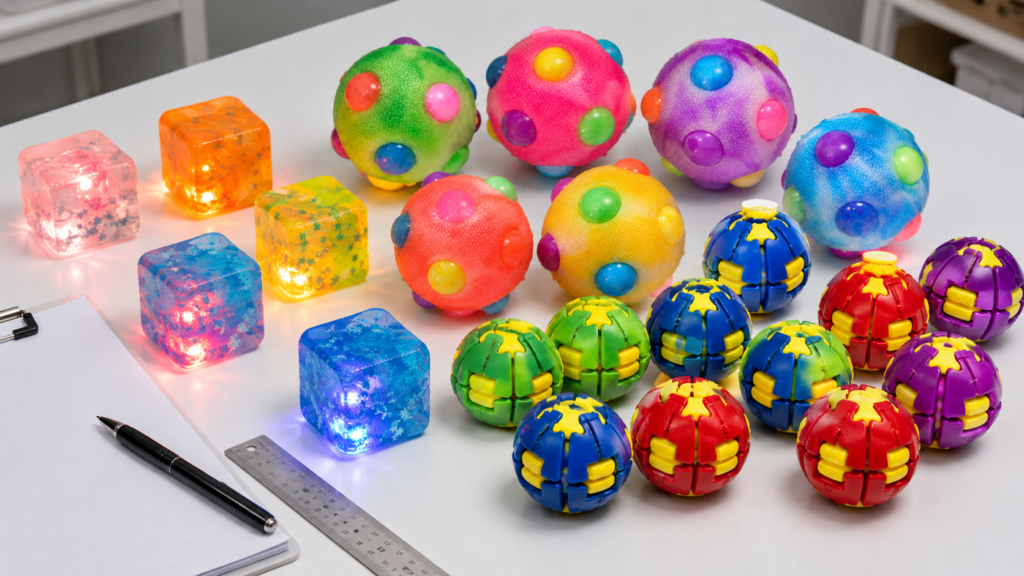
For example, a retailer sourcing tactile squeeze toys, spinning novelty products or simple fidget items should look for evidence that the novelty toy supplier understands those product types rather than relying only on a large catalog. Similar production experience can affect mold development, material selection, surface finish, assembly and how quickly a sample can be adjusted when something does not feel right.
The buyer should also check whether the supplier is offering existing designs, full OEM development or both. An existing mold may be practical for a fast private-label launch, while a new product concept may require design work, tooling and a longer development cycle. These are different sourcing paths, and the supplier should be able to explain what each one involves before quoting.
A useful first conversation therefore starts with the product itself: what it does, how it should feel, how it will be sold and how much customization is actually needed.
Check What the Novelty Toy Supplier Can Customize
“Customization available” can mean almost anything unless the scope is clearly defined. One supplier may mean a logo on standard packaging, while another may support changes to color, materials, product shape, packaging structure and tooling.
For buyers comparing a novelty toy supplier, the practical question is which parts of the program can be changed without starting from zero. Existing products may often support custom colors, private-label packaging, printed branding, barcodes or display formats with less development than a completely new mold.
The difference matters because every added customization can affect MOQ, sample cost, lead time and final pricing. A buyer requesting a custom color and logo should not assume the same requirements will apply to a project involving a new mechanism or custom product shape.
Clear customization boundaries also make quotations easier to compare. If Supplier A prices an existing mold with custom packaging while Supplier B prices a fully custom product, the unit prices are not describing the same project even if the product concept sounds similar.
Use Samples to Define the Order Before Production
A sample is where a sourcing conversation becomes a real product decision. It gives the buyer a chance to check dimensions, materials, colors, surface finish, play action and packaging before the order moves into production.
For novelty toys with moving, squeezing, spinning or tactile features, physical evaluation is particularly useful because those characteristics are difficult to judge from photos alone. A sample may look correct but feel different from what the buyer expected, or a mechanism may work well for a few demonstrations but feel inconsistent after repeated handling.
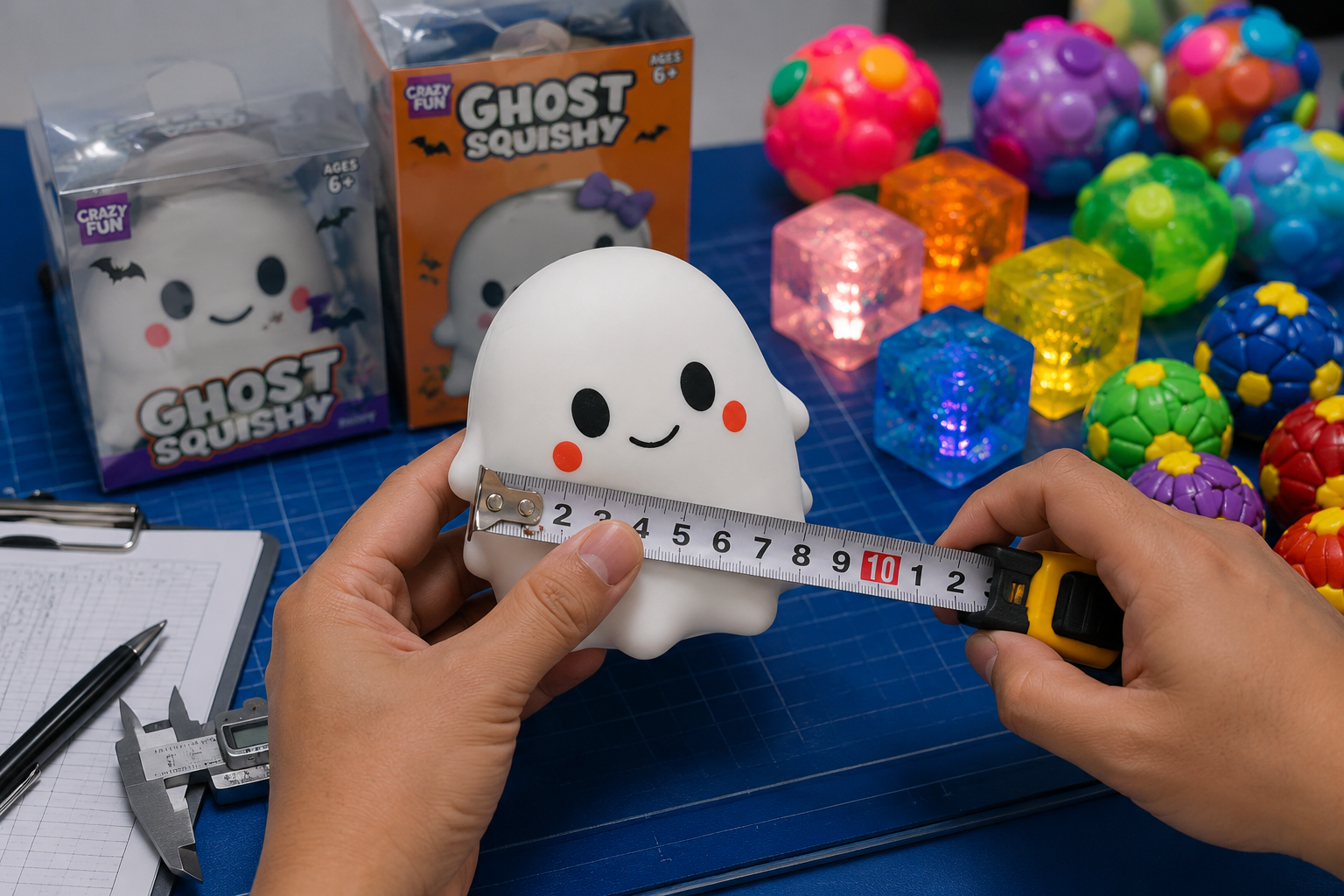
The approved sample should therefore become part of the product specification. Buyers should document any changes made after the first sample, including color adjustments, logo placement, packaging artwork or material changes, so the final production reference is clear.
Independent quality-assurance companies use the same broader principle throughout toy supply chains. Intertek describes toy auditing and quality programs that examine supplier systems and processes, while SGS lists product specification verification, factory audits, production inspections and materials testing among its toy quality-assurance services.
Quality Control Should Extend Beyond the First Sample
Approving a good sample does not automatically guarantee that every production unit will match it. Once an order moves into mass production, buyers need to think about consistency as well as initial quality.
A capable novelty toy supplier should be able to discuss how production is checked, what happens when defects are found and how the approved specification is communicated to the production team. Depending on the size and complexity of the order, buyers may also use third-party inspections before shipment.
Toy inspection programs commonly examine workmanship, function, assembly, labeling and physical performance. QIMA, for example, lists checks such as malfunction, stability, wrong or missing parts, workmanship defects and barcode verification in its toy inspection criteria, while its toy testing services cover performance, small-parts verification and other destination-market requirements.
For buyers, this does not mean every order needs the same inspection plan. A first private-label order, a repeat order and a simple stock-product purchase may carry different levels of risk. The important point is that quality control should be discussed before shipment rather than only after a problem appears.
Compliance and Documentation Need to Match the Market
Toy requirements vary by destination market, age grading and product design, so buyers should not treat compliance as a generic certificate that applies to every SKU.
A supplier may have experience with U.S., EU or other international requirements, but the buyer still needs to identify where the product will be sold and what documentation is required for that specific program. Materials, accessible components, electronics, magnets, packaging and age grading can all change the applicable testing requirements.
Testing and inspection organizations reflect that market-specific approach. SGS notes that toy quality programs can include product and material testing, factory audits, production inspections and guidance on legal requirements, while QIMA lists standards and regulatory frameworks including ASTM/CPSIA, EN 71 and other regional requirements across its toy-testing services.
For a buyer evaluating a novelty toy supplier, the useful question is not simply “Do you have certificates?” It is whether the supplier can support the testing and documentation needed for the actual product and destination market.
A Better RFQ Starts With Better Information
The quality of the supplier’s quotation often depends on the quality of the buyer’s request. A message that says “Please quote 5,000 novelty toys” leaves too many variables open and usually leads to several rounds of clarification.
A stronger RFQ should include the product or reference design, estimated quantity, target market, packaging preference, customization requirements and any known compliance needs. If the buyer already has artwork, dimensions or a target retail format, including those details can make the first quotation much more useful.
The supplier’s response is also part of the evaluation. A good novelty toy supplier should be able to identify missing information, explain which requirements affect MOQ or tooling and separate standard product pricing from custom-development costs.
That is ultimately what buyers should look for before building a longer-term sourcing relationship. The goal is not simply to find someone who can send a price quickly, but a supplier that can help turn a defined product into a consistent, retail-ready order.
Read More:Buying Guide · OEM Guide · Customization Guide