A custom fidget toy can look completely different from the product it started with and still offer essentially the same play experience.
The opposite can happen too.
A seemingly small change to the shape, button position or moving parts can make the product feel noticeably different in the hand.
That is why custom fidget toys should not begin with a list of colors, logos and packaging options.
They should begin with one simpler question:
What is the hand supposed to do with this toy?
Press it. Spin it. Rotate it. Squeeze it. Click it.
Once that interaction is clear, customization becomes easier to evaluate because every proposed change can be compared against the part of the product that makes people want to pick it up again.
Table of Contents
Custom Fidget Toys Should Start With One Physical Action
Put several fidget toys on a table and ignore their characters and colors for a moment.
One responds to pressure from a thumb. Another spins between the fingers. Another is squeezed and released. Some designs combine movements.
Those actions are not decoration. They are the product experience.
For a buyer developing custom fidget toys, identifying the primary action early gives the project an anchor. Color, character and packaging can change without losing sight of the product’s purpose.
Consider a press toy. The position of the button, the amount of movement and the way the product sits in the hand all affect repeated use.
A rotating toy creates a different set of constraints. The moving section needs enough clearance to work, while the user still needs a comfortable place to hold the product.
A New Shape Still Has to Work in the Hand
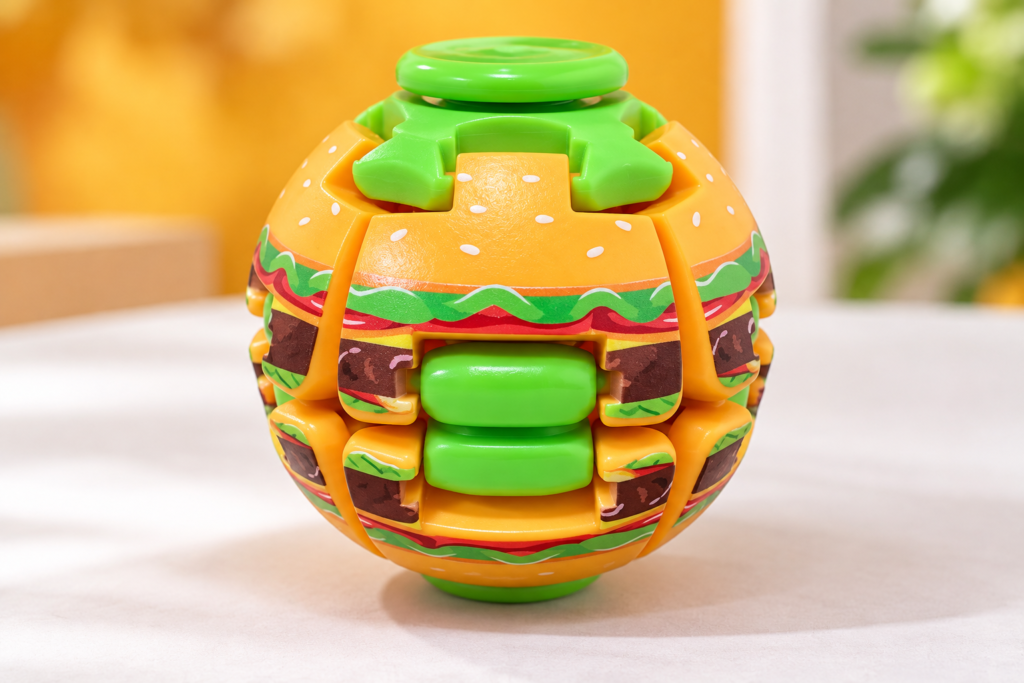
Characters are an obvious way to make a fidget toy more distinctive. A round mechanism might become a burger, an animal or a seasonal character. A simple press toy might become part of a themed collection.
But a shape that works in artwork does not automatically work in the hand.
Adding ears, wings or other decorative details can change where fingers naturally rest. Making the body wider may affect how easily a button can be reached. Shrinking a design may improve portability while leaving less room around moving components.
This is where a physical sample becomes more useful than another rendering.
Pick it up from different directions. Operate it several times. Hand it to someone who has not seen the design brief and watch how they instinctively use it.
For custom fidget toys, the question is not simply whether a factory can manufacture the requested shape. The finished shape still has to support the interaction that made the product interesting in the first place.
Some Changes Are Visual. Others Change the Feel.
Color is usually easy for a buyer to judge on sight.
A new palette can connect a fidget toy to a seasonal collection or brand identity. Printed graphics can add another visible difference.
Surface and physical response need a different kind of review.
A texture can change grip. A softer component can respond differently under pressure. A finish that looks attractive in a rendering may feel different after the product has been handled repeatedly.
Separate visual and physical checks during sample approval.
First look at the color, printing and finish. Then stop looking at the product and use it.
Does the button respond consistently? Does a rotating section move freely? Is the product comfortable to hold in the positions people naturally choose?
A sample can be visually correct and still need work in the hand.
Packaging Should Reveal What Is Interesting About the Toy
Some fidget toys explain themselves immediately. A soft squeeze product in an open display invites someone to press it.
A rotating or mechanical product can be harder to understand while it is sitting still.
Imagine a UFO Gyroscope Spinning Toy on a retail counter. Its value is not simply the UFO shape. The interesting part is what happens when the mechanism is activated.
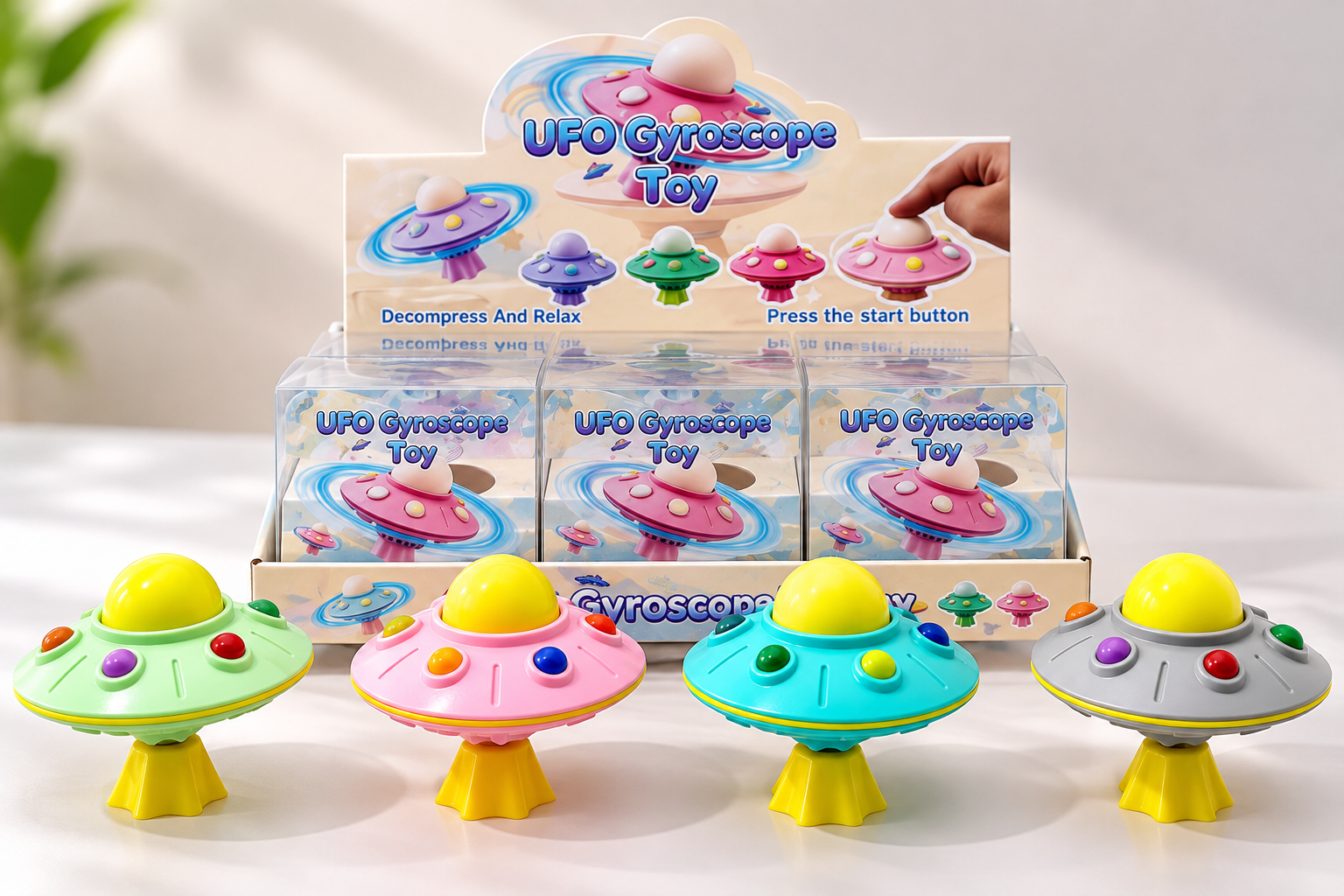
If the product is enclosed in packaging that hides the mechanism and the shopper cannot tell what it does, an important part of the selling proposition disappears.
Not every package needs detailed instructions. Sometimes a clear product view is enough. In other cases, use imagery or a display that exposes the interactive area can do more than decorative graphics.
For custom fidget toys, packaging should help shoppers discover the action rather than compete with it.
A Custom Idea Can Eventually Become a Development Project
An existing fidget design may already have the right mechanism, proportions and hand feel. Changing colors, graphics or packaging can create a different retail SKU without changing the underlying construction.
A completely new shape can be different.
If a concept changes molded components, dimensions or the physical arrangement around a mechanism, it may require tooling and additional development rather than a straightforward visual customization.
Identify that boundary before finalizing too much artwork.
A character sketch can look simple while requiring a different internal layout once translated into a physical product. Confirming how the mechanism fits inside the proposed shape can save unnecessary revision later.
Structural changes can also affect which safety requirements apply to the finished toy. In the U.S., CPSC guidance notes that the applicable sections of ASTM F963 depend on the toy and its features, rather than every provision applying identically to every product.
The final sample therefore needs to represent the product that will actually be manufactured—not an earlier version that behaved differently.
In the end, custom fidget toys still have to earn the repeat interaction that defines the category.
Before approving custom fidget toys, mentally remove the character graphics, logo and display box.
Press it. Spin it. Rotate it. Squeeze it.
If the action is still worth repeating, the customization has something solid to build around.
If it is not, adding more decoration is unlikely to fix the product.
Read More