Walk through a toy store and a piece of butter, a dumpling or a block of cheese can suddenly look perfectly normal sitting beside animals and cartoon characters.
That familiarity is part of the appeal.
Shoppers do not need much time to recognize a hamburger, strawberry or slice of cake. The shape already carries meaning before anyone touches the product. But for retail buyers, recognition is only the beginning.
The growing variety of food shaped squishy toys shows how the same visual idea can lead to very different products. One design may be soft and slow-rising. Another may stretch, crunch or reveal a filling when squeezed. Even products built around similar food themes can feel noticeably different once someone picks them up.
Food gets the product noticed.
What happens after someone picks it up is what defines the toy.
Table of Contents
Food Shaped Squishy Toys Start With Instant Recognition
A toy shaped like an unfamiliar character may need packaging, branding or a demonstration before shoppers understand what they are looking at.
A dumpling usually does not.
Neither does a stick of butter or a wedge of cheese.
That recognition can be useful in novelty and impulse-oriented retail because the shopper has less visual information to process. The surprise comes from seeing an ordinary object turned into something squeezable, oversized, miniature or otherwise unexpected.
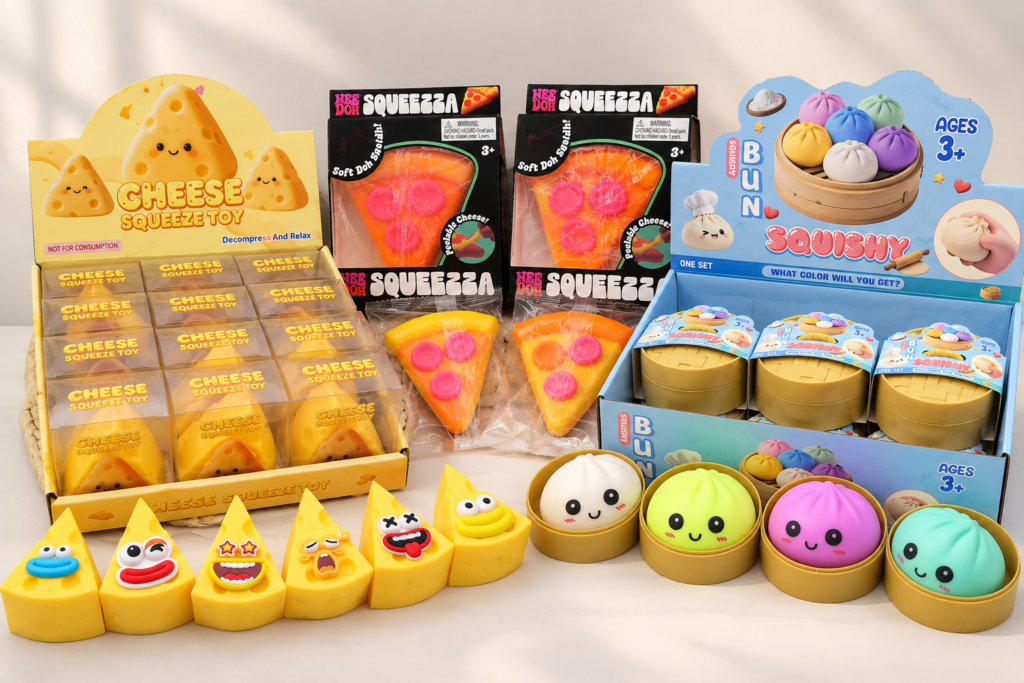
The theme is easy to see in today’s wholesale market. Food squishy assortments now stretch across hamburgers, butter, watermelon, cupcakes, cheese and other recognizable forms.
But recognition alone does not explain why one food toy feels different from another.
Put a butter squishy and a dumpling squishy beside each other. Their themes are related, but the experience does not have to be.
That is where buyers need to look past the shape.
The Same Food Theme Can Create a Different Toy
Imagine four products on a sample table: a slow-rising cake, a soft dumpling squeeze toy, a filled cheese cube and another food design with a noticeably different squeeze or recovery.
They all borrow from food, but that may be the least important thing they have in common once someone starts handling them.
The cake may be about compression and recovery. The dumpling may emphasize softness. A filled design can make the movement inside the product part of the attraction. Another construction may feel firmer, stretch differently or create a more immediate tactile response.
This is why food shaped squishy toys should not be evaluated only as a group of cute designs.
A buyer building an assortment can ask a more useful question:
If the food shape disappeared, would these products still offer different ways to interact?
If the answer is no, a display containing ten different foods may still feel repetitive in the hand.
If the answer is yes, the food theme can visually connect products that offer genuinely different experiences.
That distinction becomes especially useful when buyers compare samples. Two designs may photograph equally well and sit comfortably within the same theme, yet one can bring something genuinely new to the assortment while the other simply changes the silhouette.
The difference is difficult to judge from a catalog page alone.
Sometimes you have to squeeze the product.
Familiar Shapes Still Need Product Personality
Recognition does not require realism.
A strawberry can look realistic, exaggerated or cartoon-like. A dumpling can have a face. A butter stick can borrow cues from grocery packaging or become deliberately oversized. A piece of cheese can be bright yellow and playful rather than trying to reproduce real food perfectly.
That gives buyers and product developers more room to decide what food shaped squishy toys should do beyond simply looking familiar.
A gift shop may lean into humor, while an impulse display needs a shape shoppers can read quickly. In a coordinated range, the priority may be different again: several foods can share the same facial style, color treatment or packaging language without looking like copies of one another.
Scale can change the personality too.
A miniature food design can feel collectible or easy to add to a small display. Make the same concept dramatically larger and the appeal may shift toward visual impact, gifting or the physical experience of squeezing it.
Expressions make another difference. A realistic dumpling and a smiling dumpling may begin with the same basic shape, but they are not necessarily speaking to the shopper in the same way.
This is also where custom development becomes more interesting. Changing a food concept does not always mean choosing another shape. Color, finish, expression, scale, tactile response and packaging can all change how familiar—or how surprising—the finished product feels.
The strongest food concepts usually have both.
They are recognizable enough to understand quickly, but distinctive enough that the product does not stop at the reference.
Food Shaped Squishy Toys Can Build Variety Without Losing the Theme
There is a practical assortment advantage here.
Retailers often want enough variation to keep a display interesting without making the section look random. Food provides a visual thread shoppers understand immediately.
A display might combine dumplings, butter, cheese, fruit and desserts while still feeling coherent.
But coherence should not become sameness.
Current wholesale squishy assortments show how broad the category has become, from realistic hamburgers and watermelon to butter, popsicles, cupcakes and cheese. The range is wide enough that buyers can build around a food theme without relying on one construction or one visual style.
The useful question is not how many foods can fit into one range.
It is what each one contributes.
One SKU might provide a soft squeeze. Another brings a visible filling or a different surface feel. Another works because of an unusual scale. Some food shaped squishy toys may earn their place because the packaging makes them particularly effective on a counter or in a compact display.
Packaging matters here because food already comes with visual associations shoppers recognize.
A butter-shaped toy can borrow cues from supermarket packaging. A dumpling can sit in a basket-style presentation. A candy-inspired squeeze toy can use a display carton that feels closer to confectionery than a conventional toy box.
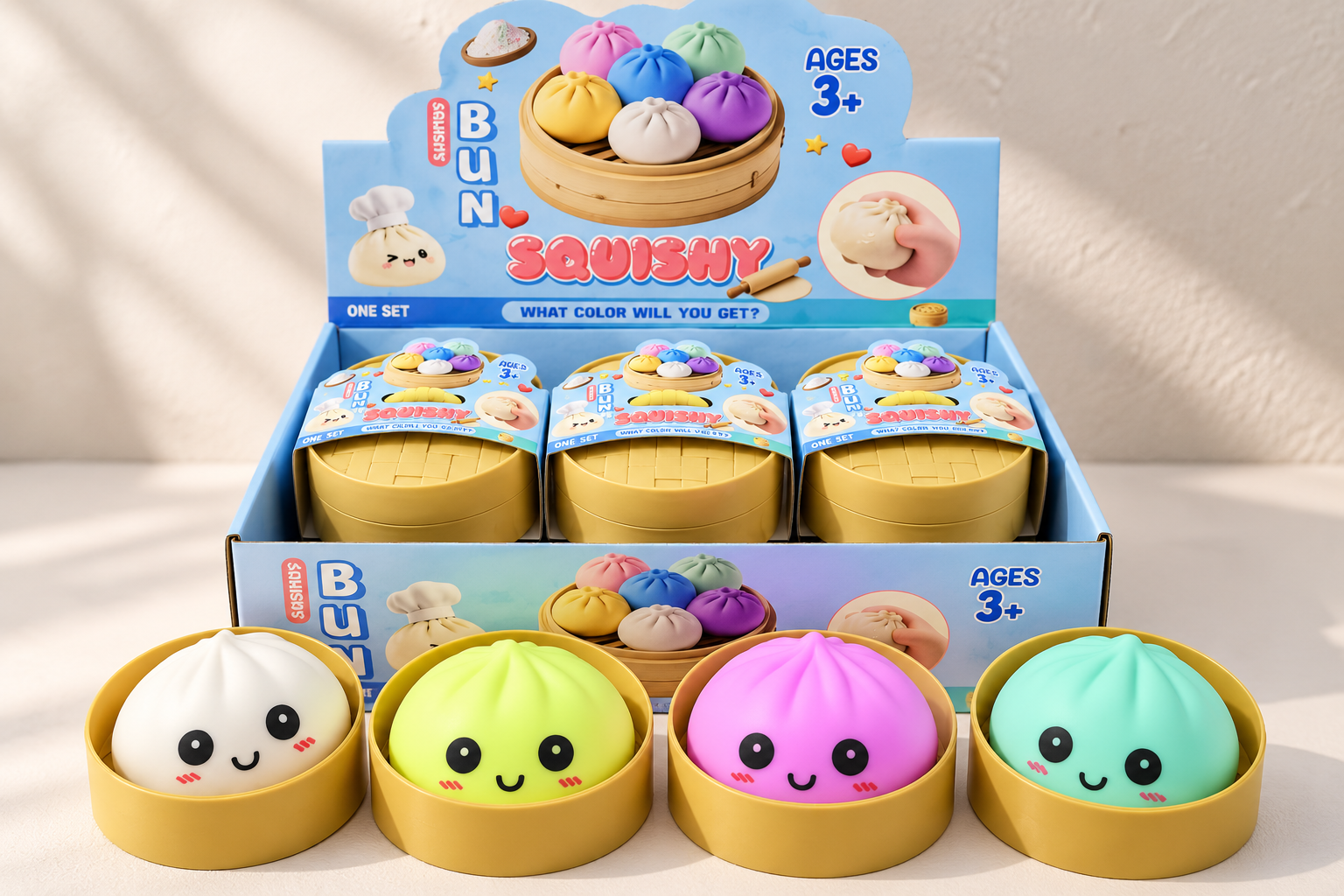
The package still has a practical job to do. Buyers need enough visibility to understand what is inside, enough protection for handling and transport, and a format that works in the intended shelf or display space.
But packaging can also extend the product idea.
With food shaped squishy toys, the package does not always need to explain what shoppers are looking at. Instead, it can reinforce the familiar reference or create a small surprise around it.
That can make several different products feel connected on the shelf without requiring every item to look or feel the same.
A strong assortment gets both sides right: enough consistency to read as a group and enough difference to make each SKU worth considering on its own.
What Should Buyers Look for Beyond the Shape?
When several food shaped squishy toys arrive as samples, the easiest reaction is often to choose the cutest ones.
Try handling them before making that decision.
Does each product create a noticeably different experience?
Does the shape recover well after repeated squeezing?
Do painted or printed details still look convincing when the product is compressed?
Does the package make the food concept easier to understand, or simply add more visual noise?
And if several designs are going into one assortment, do they look better together than they do individually?
There is another useful test: put the samples together without their packaging.
If the products still feel varied, the assortment probably has more going for it than graphics and presentation. If they suddenly feel almost identical, adding more food shapes may not create as much variety as the SKU count suggests.
These questions move the buying decision beyond “Which food is trending?”
Individual shapes will change. One food design may move quickly for a season while another works better with a particular retailer or customer base. Buyers do not need every trending shape if those products all perform the same role.
The stronger food shaped squishy toys give the familiar shape something else to work with: a distinctive feel, an interesting squeeze, a strong presentation or a clear place within the assortment.
People already know what these objects are.
The product developer’s job is to give them something unexpected to do with them.
Related Reading
Trending Toys to Sell: Where Retail Demand Is Building in 2026
Squishy Toy Retail Trends: How the Category Is Changing in 2026
Novelty Toy Trends 2026: How the Category Is Expanding at Retail