A buyer searching for a squeeze toy manufacturer may find factories producing stress balls, slow-rise foam toys, filled TPR products and novelty squeeze toys under the same broad category. They may all be squeezed by hand, but they are not necessarily made with the same materials or production steps.
That difference matters before a buyer asks for a quote. A foam stress ball with a printed logo, a translucent filled toy and a novelty design with a moving feature can require very different manufacturing capabilities.
The useful question is not simply whether a factory makes squeeze toys. It is whether that factory already understands the construction that makes your product work.
Table of Contents
Start With What Happens When the Toy Is Squeezed
Before discussing colors or packaging, describe the physical action.
Should the body compress slowly and recover? Should a filling move visibly through a transparent shell? Does part of the toy bulge outward under pressure? Is stretching part of the play pattern, or should the product mainly compress in the hand?
Those answers tell a squeeze toy manufacturer much more than an inspiration photo alone.
Two products can look similar on a screen yet behave very differently. One may get its feel from the body material itself. Another depends on the relationship between an elastic shell and its filling.
Once that mechanism changes, the questions around molding, wall thickness, filling, closure and inspection can change with it.
Material Experience Should Match the Construction
“Soft” is not a material specification.
PU foam is commonly used for slow-rise squishy formats, while flexible materials such as TPR can be used for other squeeze constructions, including filled products. Even within one material family, formulation, dimensions and product geometry can change the finished hand feel.
For buyers, the practical test is whether the factory has made something structurally comparable.
If the project is a filled TPR toy, ask to see a filled TPR reference rather than an unrelated foam squishy. If the design depends on a translucent shell, look at clarity and surface appearance on a comparable product. If recovery behavior defines the SKU, evaluate that behavior on a physical reference instead of approving it from specifications alone.
A squeeze toy manufacturer does not need to have produced your exact shape before. Relevant process experience is more important than a catalog item that merely looks similar.
Pay Attention to the Hardest Part of the Shape
A 3D rendering does not show how every feature will behave in the hand.
Thin ears, narrow necks, projecting tails and abrupt changes in shape can respond differently from the main body when the product is compressed or stretched. Decorative details can also become harder to mold or print as the geometry becomes more complicated.
This is where manufacturing feedback is useful early.
Rather than asking whether a design is simply “possible,” ask what part of it is most difficult to reproduce. A squeeze toy manufacturer should be able to identify features that deserve attention during development and sampling.
For a simple rounded product, the challenge may be consistency of feel. For a detailed character, it may be small molded features. For a novelty squeeze design, the difficult part may be the moving section rather than the outside appearance.
Filling and Closure Need Their Own Review
Filled squeeze toys should be evaluated as complete constructions.
The shell may look good before filling, but the amount and type of filling can change weight, movement and squeeze response. Closure quality matters because the finished product will be repeatedly compressed during normal handling.
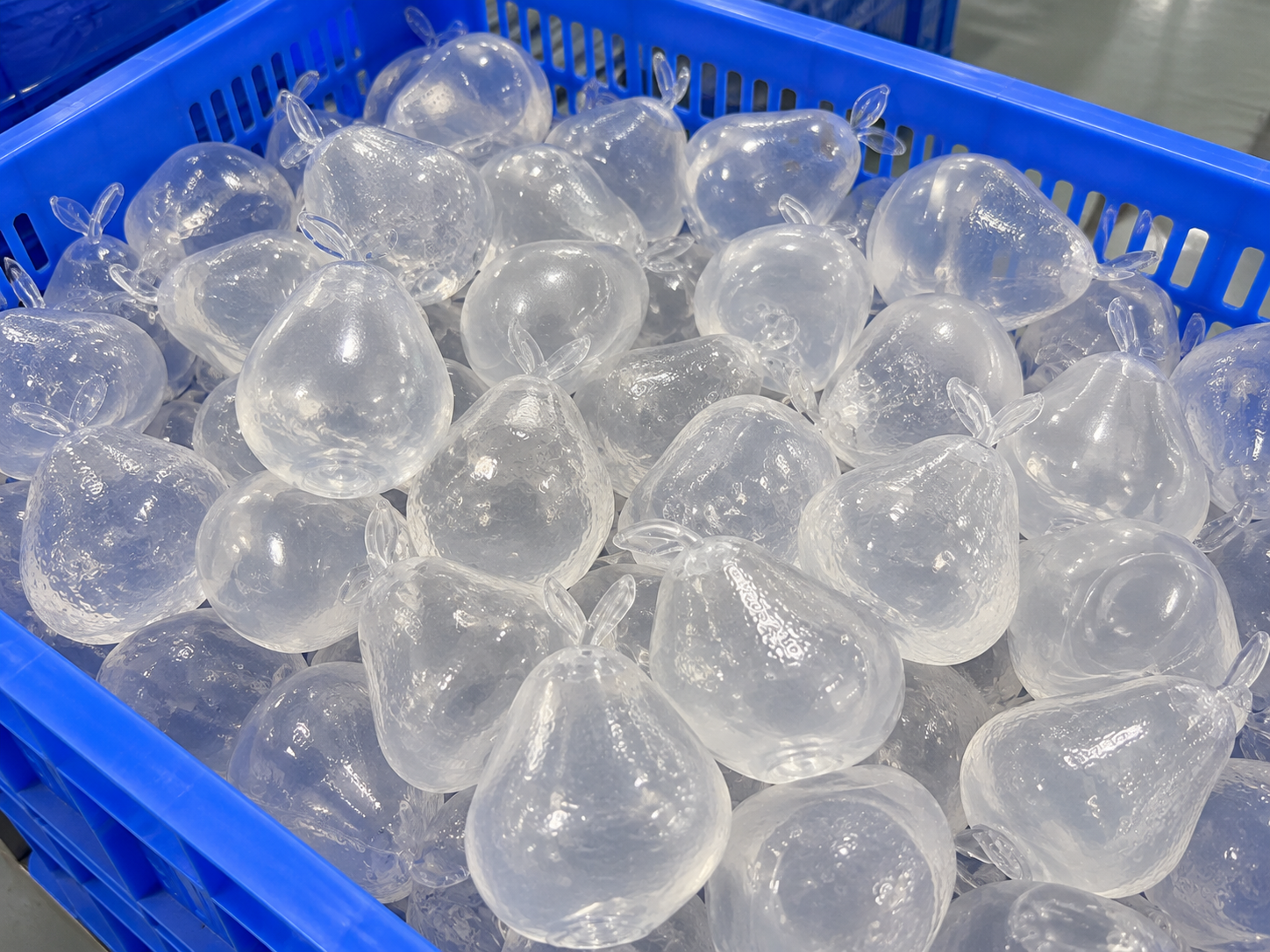
That means buyers should not approve the outer shape and assume the rest will follow automatically.
Ask the squeeze toy manufacturer to prepare the sample with the intended fill amount and construction. Then squeeze the finished sample the way a customer would. Look at how the material moves, whether the toy returns to its intended form and whether the closure area behaves differently from the rest of the body.
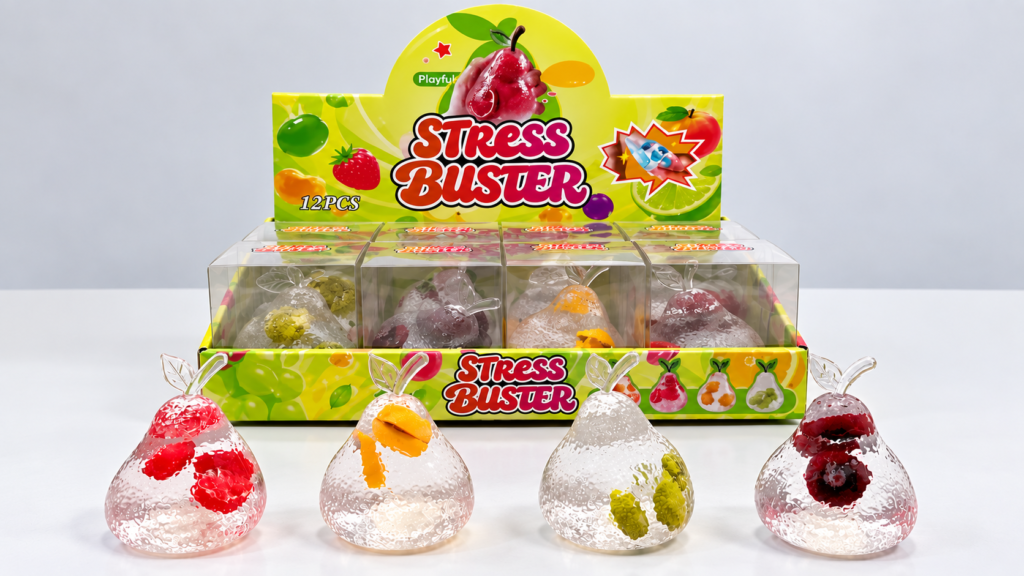
This is also where a real product can be more informative than a material swatch. A finished TPR novelty product gives buyers something physical to compare when discussing feel, dimensions and packaging rather than relying only on abstract descriptions.
Decoration Has to Work on a Flexible Surface
Graphics on a squeeze toy do not sit on a rigid surface.
Eyes, facial details, text and logos may be applied to areas that curve or distort when handled. Artwork that looks centered in a flat file can appear different once it is placed on the molded product.
For branded projects, confirm the printable area and orientation on the sample. Check the product from the angles shoppers are most likely to see, not only from the front.
A squeeze toy manufacturer with relevant decoration experience should also be willing to flag artwork that is too detailed, too close to an edge or poorly positioned for the available surface.
The goal is not to make every design simpler. It is to make sure the decoration still reads correctly on the real object.
Plan U.S. Safety Requirements Around the Finished Product
Safety requirements depend on the finished product and its intended market, not simply on the fact that it belongs to a broad “squeeze toy” category.
For the U.S., CPSC states that toys intended primarily for children 12 and under must be third-party tested by a CPSC-accepted laboratory and certified in a Children’s Product Certificate for applicable children’s product safety requirements. CPSC also identifies ASTM F963 as the toy safety standard incorporated into the federal requirements; ASTM F963-23 applies to children’s toys manufactured on or after April 20, 2024.
For a buyer, the practical point is to define the product, age grading, materials and destination market before treating testing as a final shipping task. Testing requirements vary with the product and applicable rules, and CPSC acceptance of laboratories is specific to the testing scope.
A squeeze toy manufacturer can support the testing process and provide product information, but the applicable requirements should be tied to the actual SKU rather than a generic statement that the factory “has ASTM.”
Give the Factory a Useful Product Brief
A reference photo is a good start. It is not a complete sourcing brief.
Include approximate dimensions, intended squeeze behavior, preferred construction or material if known, color direction, important decoration, packaging format, estimated quantity and destination market. If the toy contains a filling or moving feature, describe what that feature is expected to do.
This does not mean the buyer has to engineer the product. The purpose is to give the squeeze toy manufacturer enough information to identify the relevant process and the questions that need to be resolved during sampling.
That first conversation becomes much more productive when both sides are discussing the same product behavior instead of interpreting a photo differently.
Match the Manufacturer to the Product, Not the Category Name
“Squeeze toy” is useful as a retail category, but it is too broad to prove manufacturing fit.
The better comparison starts with the feature that defines the SKU. Is it slow recovery? A filled transparent body? A flexible molded shape? A printed promotional surface? A moving novelty mechanism?
Once that is clear, buyers can look for evidence that the factory has experience with the material, construction and production challenge that actually matters.
The right squeeze toy manufacturer is not necessarily the one with the largest catalog. It is the one whose production capabilities line up with the way your product is supposed to feel, move and perform.
Read More