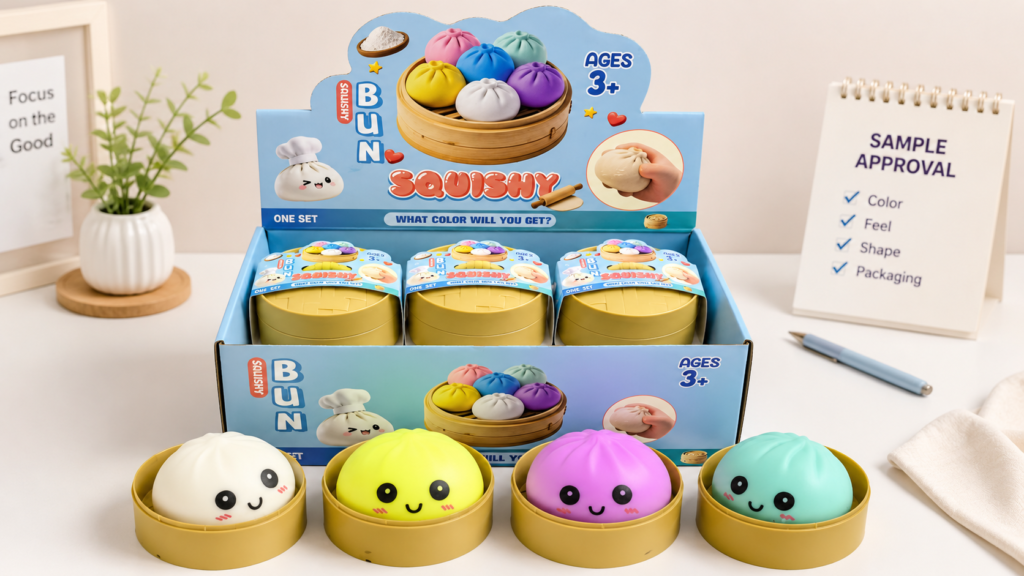
A squishy sample can look completely acceptable in a photo and still feel wrong the moment you squeeze it.
That is why squishy toy samples should not be treated as a simple visual approval step. For buyers, the sample stage is where the product needs to stop being an idea and become a production reference.
With squishy products, that reference has to cover more than shape and color. Softness, recovery speed, surface feel, print position and packaging pressure can all affect how the final product is perceived.
A useful approval should answer one question clearly: if production matches this sample, will the buyer be satisfied with the order?
Table of Contents
Start With the Feel, Because Photos Cannot Show It
The first thing to check is compression behavior.
Press the sample several times, not once. Some squishies feel soft at first but become noticeably firmer after repeated squeezing. Others recover well from a light press but show creases after deeper compression.
When reviewing squishy toy samples, it helps to separate three things that are often described with one word: softness, resistance and recovery speed.
They are not the same.
A product can be very soft and still recover quickly. Another may feel denser but rise more slowly. If slow recovery is part of the selling point, the approval should describe the behavior the buyer actually wants rather than simply saying “soft enough.”
Surface feel is worth checking too. If the sample feels tacky, attracts dust easily or develops an oily feel after handling, that should be noticed before production.
Check It Again After the Sample Has Rested
A soft product may not look the same immediately after shipping.
Samples can arrive compressed after spending several days inside a bag or small carton. The first shape you see after opening the package may not be the final shape.
Photograph the sample when it arrives, then leave it uncompressed and check it again later.
This is especially useful for slower-recovery or larger squishies. A temporary shipping dent may disappear. A persistent deformation is a different issue.
The same principle applies to packaging. If a product comes out of its retail box slightly flattened but returns to the approved shape after resting, that may be acceptable. If it stays distorted, the package may be too tight.
That kind of observation is much more useful than simply writing “sample looks good.”
Measure the Finished Product, Not the Name
Terms such as mini, regular, large and jumbo are useful in conversation, but they are not precise enough for production.
If the approved product is supposed to be 8.5 cm, measure the actual sample. If it is a 15 cm version, measure that one too.
For squishy toy samples, I would record the dimensions at the widest points and keep those measurements with the approval photos.
Weight can also be useful. Two samples may have similar dimensions but feel very different because of material density or construction.
Exact size becomes even more important when the product needs to fit into a retail box or countertop display. A difference that seems minor in hand can create a packaging problem when 12 or 24 pieces need to fit neatly together.
Color and Print Need Physical Approval
Color is one area where phone photos can cause unnecessary problems.
Pale yellow, cream, peach and light pink can shift under warehouse lighting, daylight or phone-camera processing. A buyer may approve a photo believing the sample is one shade and later find that the physical product looks different.
For custom squishy toy samples, physical color approval is safer when the shade matters.
Printed details should also be judged as part of the whole design, not only by measuring position.
On a simple character face, moving the eyes, cheeks or mouth a few millimeters can noticeably change the expression. The print may technically be in the correct area and still look wrong from the front.
This is particularly important for squishies with simple graphics, because there are fewer visual elements to hide a small positioning error.
Packaging Approval Means Testing the Real Product Inside
An empty packaging mockup can look perfect.
The more useful test is what happens after the finished squishy has been sitting inside it.
Put the real product into the intended package, close it the way it will be packed in production and leave it there for a period of time.
Then open it again.
Does the box press into the sides? Does the bag flatten part of the shape? Does the product recover after removal?
For soft products, packaging pressure can affect appearance much more than it does with rigid toys.
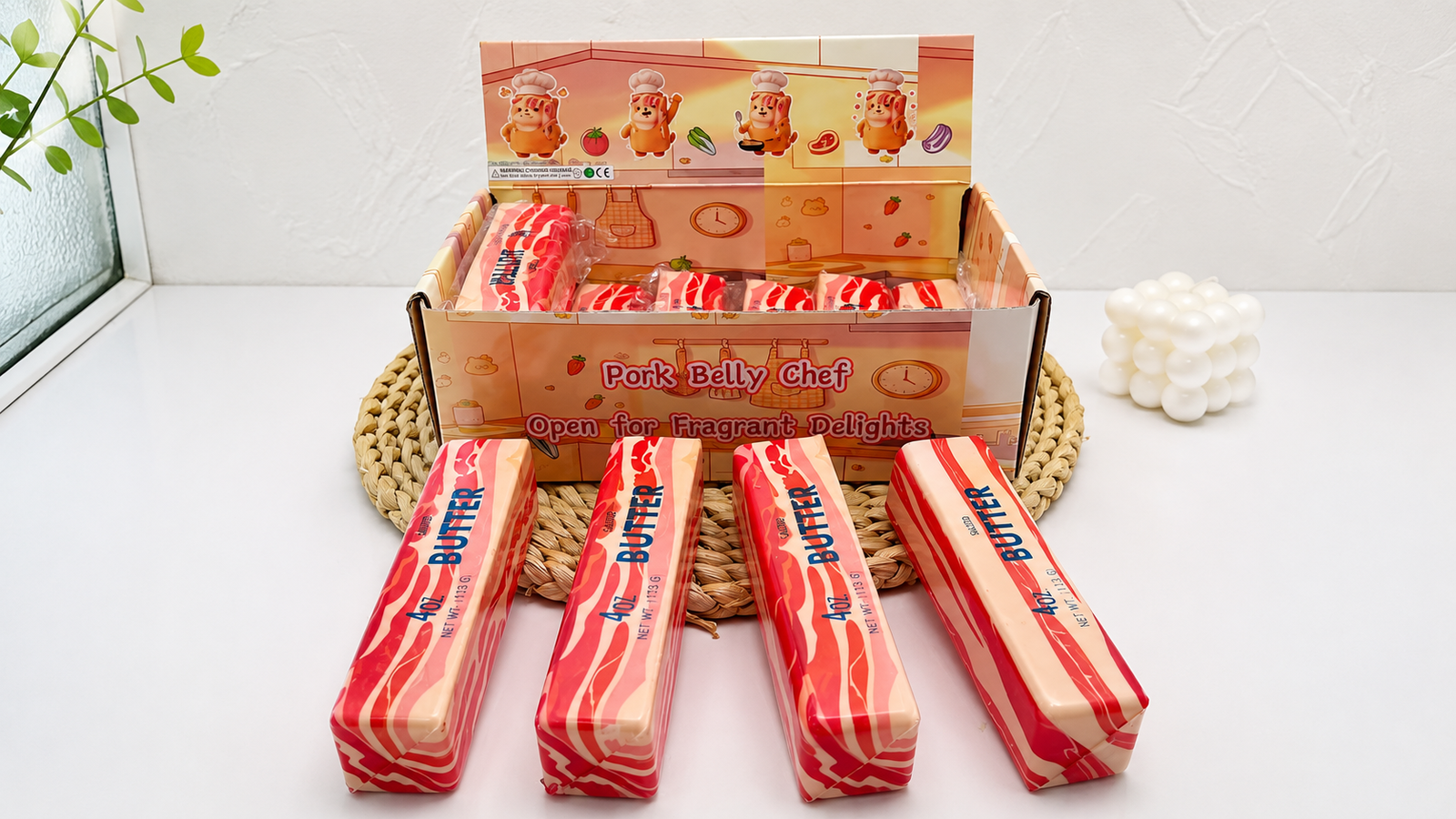
That is why squishy toy samples and packaging samples should be approved together.
If the product will also go into a countertop display, test that configuration too. Check how the products sit when the display is full and how it looks after several units have been removed.
Our novelty toy packaging guide covers packaging formats in more detail, but the sample stage is where the fit should be tested physically.
Do Not Let Sample Versions Get Mixed Up
Custom projects often go through several sample rounds.
That creates a common sourcing risk: version confusion.
Sample 1 may have the correct shape but the wrong color. Sample 2 corrects the color but still needs a print adjustment. Sample 3 fixes the print and becomes the approved version.
If production later refers back to Sample 2, an old problem can return.
Final squishy toy samples should therefore be identified clearly with a date, sample code or version number.
Save front, back and side photos. Record the changes that were approved. If an older sample is no longer valid, mark it that way.
For custom projects, I would separate approval into three parts:
Visual approval — shape, color and printing.
Tactile approval — softness, resistance and recovery.
Packaging approval — fit, compression and presentation.
That creates a much clearer production reference than a general “approved.”
Ask Whether It Is a True Production Sample
Not every sample is made exactly the same way as the final order.
An early prototype may be hand-finished. Printing may be applied differently. Color may be mixed in a small quantity. Some details may be adjusted manually just to demonstrate the concept.
That does not automatically make the sample unsuitable.
The buyer simply needs to know what will change when mass production begins.
Before approving squishy toy samples, ask whether the item is a development sample, pre-production sample or final production reference.
Our custom squishy toy guide covers the wider OEM/ODM process, but this is the stage where the design needs to become something the factory can repeat consistently.
Sample approval also does not replace product testing. For toys intended for the U.S. market, buyers can review applicable requirements through the CPSC, while independent laboratories such as Intertek provide toy testing services covering mechanical, physical, chemical and performance characteristics.
Final Approval Should Leave Little to Interpretation
A good sample approval is specific.
The final record should make the expected size, color, softness, recovery behavior, printed details and packaging format clear.
Anything still open should remain marked as open. Anything approved should be tied to one final sample version.
That is what turns squishy toy samples from attractive prototypes into useful production references.
Read More: Buying Guide · Customization Guide · OEM Guide