
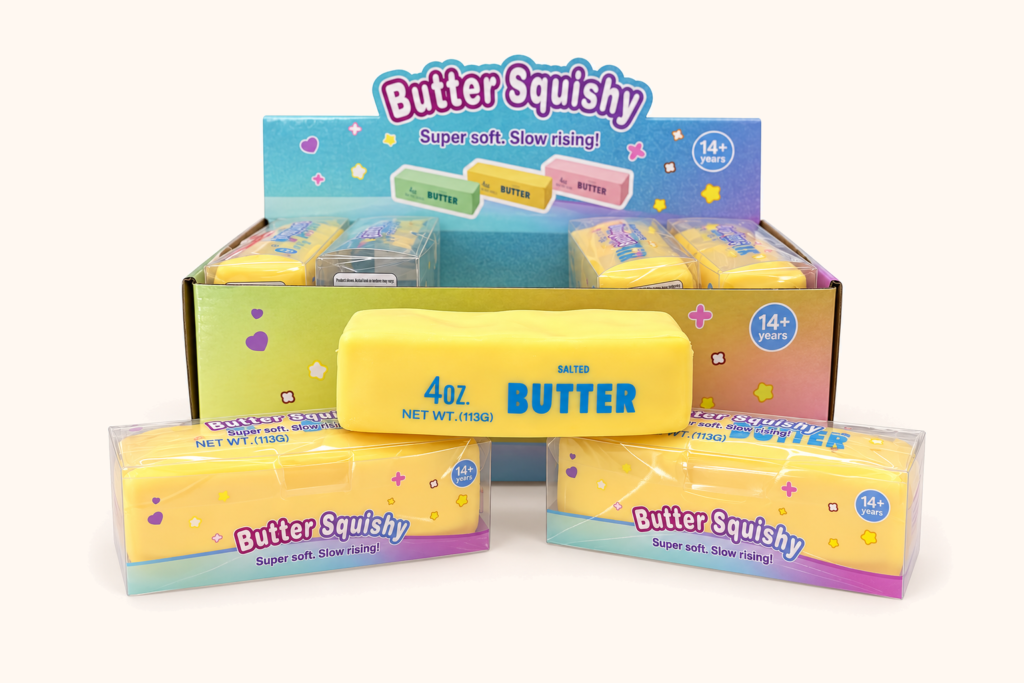
The first toy out of a sample box looks flattened, while the supplier’s loose reference has a full rounded face. That difference does not immediately identify a product defect or prove that the packaging is harmless. Squishy toy packaging compression needs a controlled comparison. A retail buyer should establish how the approved construction behaves outside the pack, then examine what changes when the same product is held in its proposed packaging. The result should guide clearance and presentation decisions before a bulk order.
Table of Contents
Compare squishy toy packaging compression with matched samples
Evaluate squishy toy packaging compression with matched pieces of the same variant and sample revision. Keep a reference outside the proposed pack and place the comparison pieces in the actual arrangement, following agreed conditions. Record their starting appearance and orientation. Comparing an older loose sample with a newly made boxed variant introduces differences that the packaging trial cannot explain.
Construction matters. A slow-recovering foam body and a filled elastomer toy may respond differently to sustained contact. Vilora’s realistic butter-stick squishy is currently described as TPR; it should not be treated as PU foam because its name or handling description sounds similar. Confirm the actual construction before interpreting recovery or selecting a trial method.
Use photographs with the same angle and reference position. Record which areas touch the pack and whether the closure presses on a projecting face or detail. A photo showing many units inside an open shipping box does not reveal the pressure on a closed retail pack. Recreate the proposed packing sequence rather than relying on a supplier’s loose display photograph.
Examine clearance at the pressure points
To investigate squishy toy packaging compression, check usable internal dimensions, inserts, folded seams and closures. The available space can be smaller than the outer dimensions imply. Ask whether the toy is intended to be held in place, loosely contained or visibly compressed. Those are different design choices, and the buyer should approve the intended presentation rather than discovering it during unpacking.
The squishy packaging guide covers format choices, while texture consistency considers how a product feels across samples. A compression trial connects those decisions at the actual contact points. If a lid creates a mark on one character feature, a local clearance change may be more relevant than increasing the entire box size.
Do not use a supplier’s recovery video as a universal promise. Request the conditions behind it: the product variant, how it was compressed and what happened before filming. ECQA’s quality-control overview discusses appearance and functional checks, but it does not supply a recovery time for every construction. Agree on meaningful commercial criteria for the sample under review.

Review the unpacking sequence and the remaining change
Observe squishy toy packaging compression by inspecting the comparison pieces when unpacked and at the agreed observation points. Note appearance, surface contact marks and function separately. A short-lived change that is expected for the approved construction should not be described as permanent damage. Conversely, a photograph taken after extensive hand reshaping cannot establish that the product recovered unaided inside normal retail handling.
If squishy toy packaging compression appears to change the packed pieces relative to the loose reference, record where and how. Repeat a targeted trial with the proposed revision, keeping other conditions as comparable as practical. A temperature study addresses a different variable; use the existing temperature-testing brief when that is the concern rather than mixing several unexplained changes into one packaging comparison. The same discipline helps avoid unnecessary redesigns.
Accept the pack only with a clear account of the presentation it produces. Retain a reference arrangement and the trial record so production can reproduce the approval. Squishy toy packaging compression is most useful as a question about a particular body, pack and handling history. It should end in an informed packaging choice, not a blanket statement that every soft toy can be tightly packed without consequence.
Read More