The market for wholesale novelty toys is crowded with products designed to look unusual, feel different or create an immediate reaction. That variety gives retail buyers plenty of choice, but it also makes product selection harder. A toy can look exciting in a catalog or trade-show booth and still struggle once it reaches the shelf.
The broader U.S. toy market remains strong. Circana reported that toy dollar sales increased 17% in the first half of 2026, the industry’s strongest first-half performance in six years. That growth does not mean every new product deserves more inventory, but it does show that consumers are still willing to spend when a product gives them a clear reason to engage.
At ASD Market Week this August, The Toy Book highlighted products with strong sell-through potential and enough visual or experiential appeal to make shoppers stop and take notice. For novelty buyers, that is a useful distinction. Being different may earn the first look, but a successful retail product also has to be easy to understand, easy to merchandise and practical enough to test without creating unnecessary inventory risk.
Table of Contents
The Best Novelty Toys Are Easy to Understand
Novelty products rarely get much time to explain themselves. In a gift shop, specialty toy store or checkout area, an unfamiliar product may receive only a few seconds of attention before the shopper moves on. Toys with a simple and visible interaction can therefore have an advantage because spinning, squeezing, bouncing, pressing or transforming communicates part of the play value immediately.
That does not mean every product needs a complicated mechanism. In many cases, the simplest interactions are the easiest for shoppers to understand and for retailers to demonstrate. Buyers can start with a practical question: can someone seeing the product for the first time understand what makes it fun without needing a long explanation?
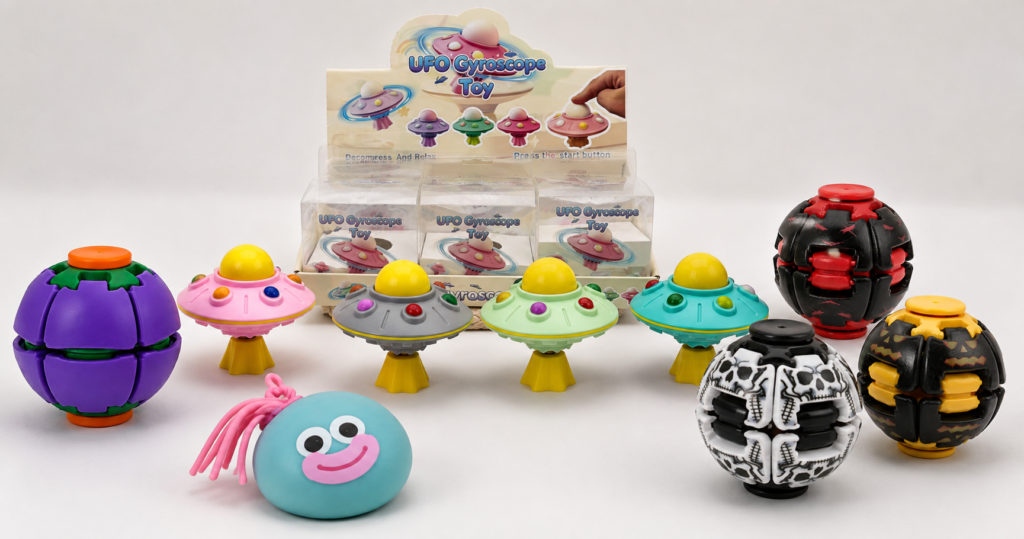
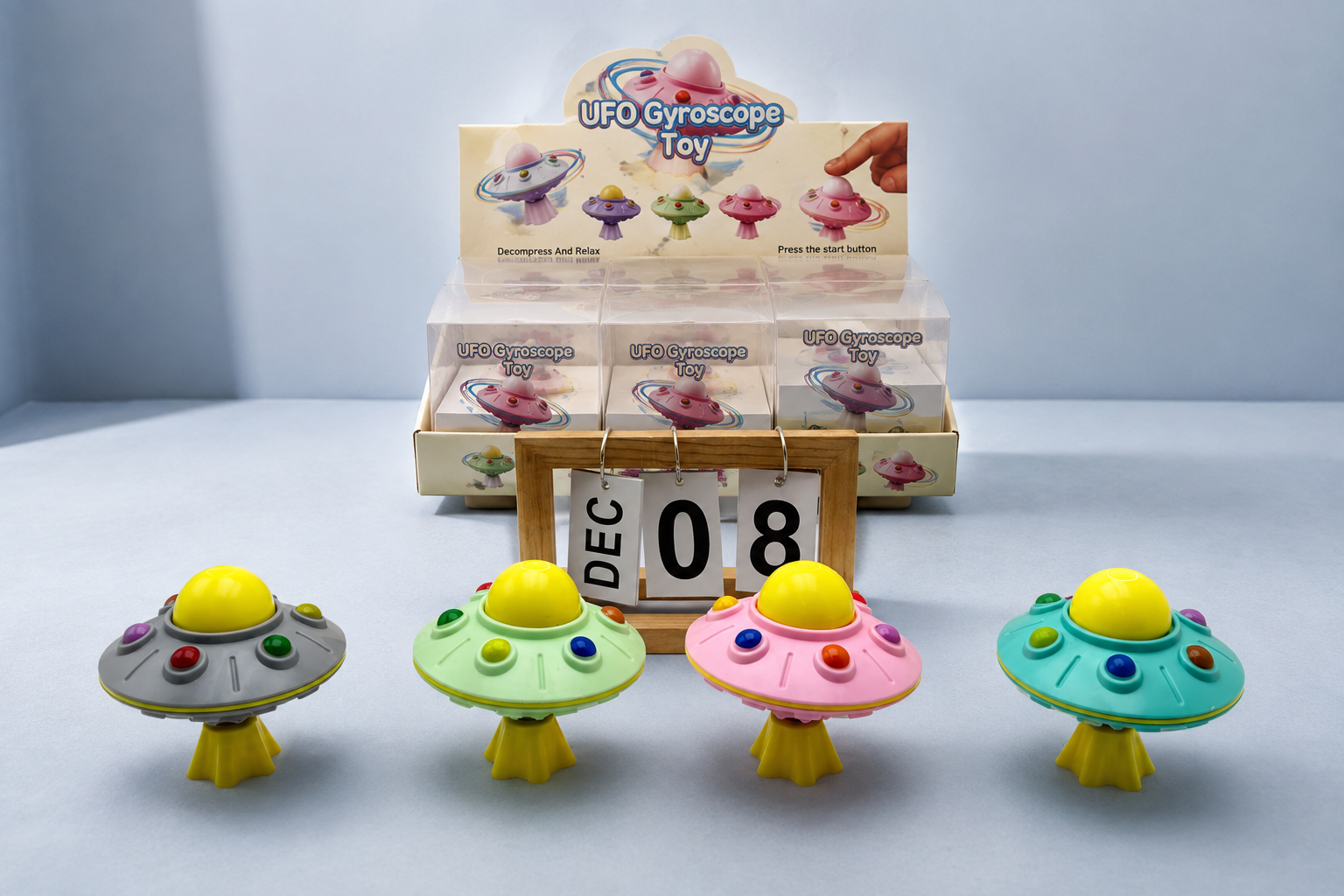
A product such as the UFO Gyroscope Spinning Toy is one example of that kind of interaction. Its spinning motion communicates the basic play pattern quickly, while the different color options give retailers some assortment variety without changing the core product. This makes the product useful as an example of what buyers can look for when evaluating wholesale novelty toys, rather than as a reason to add complexity simply for the sake of novelty.
A Good Novelty Product Still Has to Fit the Shelf
A product can be entertaining and still be difficult to merchandise. Packaging size, display format, shelf footprint and price point all influence whether a retailer is comfortable testing an unfamiliar SKU. This is especially important for independent stores, gift shops and specialty retailers that may not want to dedicate a large amount of floor space or inventory budget to one new product.
For wholesale novelty toys, the retail format should therefore be part of the product evaluation. A compact countertop display may work well when several variations need to be seen together, while an individually packaged product may be better when giftability is part of the appeal. Some products make sense near checkout because the interaction and price are easy to understand quickly, while others need more shelf presence to communicate their value.
The buyer should be able to picture where the product belongs before deciding how deeply to buy it. If the likely shelf position, display method or purchase occasion is unclear, adding more inventory may only amplify the merchandising problem.
Variation Only Helps When Shoppers Have a Reason to Choose
Novelty products often come in multiple colors, characters, shapes or designs. That can make a retail display more attractive, but variation by itself does not guarantee additional demand. The important question is whether customers perceive a meaningful choice between the options.
A spinning toy offered in four visibly different colors gives shoppers an easy preference decision. A food-inspired squishy family may create choice through recognizable shapes, while seasonal graphics can refresh a familiar product without requiring an entirely new mechanism. In each case, the variation has a clear purpose that a customer can understand.
This is where buyers should separate assortment strategy from SKU count. Adding ten nearly identical versions can create more inventory complexity without creating much additional retail value. When sourcing wholesale novelty toys, a smaller set of clearly differentiated options may be easier to display, easier to test and easier to replenish based on actual customer preference.
Novelty Can Win the First Sale, but Reorders Tell You More
One of the biggest risks in novelty merchandise is confusing attention with durable demand. A product can generate strong opening orders because it looks new, appears in social content or arrives at exactly the right moment in a trend cycle. None of those signals guarantees that shoppers will continue buying once the initial surprise wears off.
The more useful information begins to appear after the first inventory reaches the shelf. Buyers can watch which colors disappear first, whether the same assortment gets reordered, whether one display format performs better than another and how quickly a retailer comes back for additional units. Those behaviors begin to separate a product with lasting retail potential from one that simply benefited from an exciting first impression.
We looked at this more closely in Independent Toy Retailers: Why the Second Order Matters More Than the First. An opening order shows that a retailer is willing to test a product; a reorder starts to provide evidence of actual sell-through. That distinction is especially important with wholesale novelty toys, where “wow factor” can sometimes make the first order look stronger than the long-term demand really is.
What Retail Buyers Should Test Before Scaling
Retail buyers do not need to predict whether every new novelty toy will become a bestseller. A more useful approach is to test the commercial fundamentals: whether the interaction is easy to understand, whether the product fits a realistic retail display, whether the price works for the intended channel and whether the assortment offers enough meaningful variation to learn what customers prefer.
Once those products are in stores, sell-through and reorder behavior can guide the next decision. A strong novelty assortment does not need every trending item on the market; it needs products that are distinctive enough to earn attention but simple enough to merchandise and test without creating unnecessary inventory risk.
For buyers sourcing wholesale novelty toys, “new” is not the same as “worth buying.” The stronger question is whether a product gives the retailer a practical reason to test it, and whether customers give that retailer a reason to order it again.
Read More: Buying Guide · Industry News