“30 days” sounds simple on a quotation.
In practice, it can describe very different projects.
A stock squishy packed in an existing bag may move quickly. Change the color, add a printed face, approve a new display box and schedule testing, and the same product can follow a completely different calendar.
That is why squishy toy lead time should be discussed as a sequence of steps rather than one number. Buyers planning a launch or seasonal delivery need to know what has to happen before production starts, what can run at the same time, and which approval can hold everything else up.
Table of Contents
First Ask What the Lead Time Actually Includes
Lead time is generally the time between starting a process and completing it, but suppliers do not always start the clock at the same point. Thomasnet notes that supply-chain lead time can include several pre-processing, manufacturing and post-processing stages.
That distinction matters on a toy order.
One supplier may mean 30 days after deposit. Another may mean 30 days after final sample approval. A third may not start production until packaging artwork and materials are confirmed.
Those are not equivalent promises.
Before accepting a squishy toy lead time, ask for the starting point and the finished point. Does it end when the goods are packed? When inspection is complete? When the shipment leaves the factory?
A buyer working toward a warehouse delivery date needs all three answers.
Existing Products and Custom Projects Should Not Share One Timeline
The fastest orders are usually products that already exist.
If the mold, material, color, printing and packaging are already established, the factory mainly needs to schedule materials and production capacity.
Customization adds decision points.
Changing only a body color may be relatively straightforward. A new printed face requires artwork approval. A new shape may require tooling and several rounds of samples. Custom retail packaging adds dielines, artwork, printing and physical fit approval.
Current HKTDC sourcing listings illustrate how wide these production windows can be. One customized toy packaging supplier lists a seven-day lead time while noting that mass-production timing depends on quantity; other customized toy listings show production windows around 30 to 60 days.
Those numbers should not be treated as universal benchmarks. They show why “custom” by itself tells a buyer very little.
Sample Approval Can Quietly Become the Longest Step
Factories often get blamed for a long production schedule when production has not actually started.
Imagine a custom squishy sample arrives on Monday. The buyer wants a softer feel, so a second version is requested. That sample takes several days to make and ship. The revised product is approved, but the packaging artwork is still waiting for changes.
Two weeks can disappear before the bulk order reaches the production line.
This is why squishy toy lead time should separate development time from mass-production time.
For products where softness, recovery or print position matters, rushing the approval can create a bigger problem than losing a few days. Once 2,000 pieces are made, correcting the wrong feel or print position is far more difficult.
Our squishy toy samples guide covers what should be approved before production. For timeline planning, the important point is simple: a supplier cannot reliably schedule the final product while important specifications are still moving.
Squishy Toy Lead Time Also Depends on Packaging
As we discuss in our novelty toy packaging guide, packaging is often treated as something that happens at the end.
Operationally, it may need to begin much earlier.
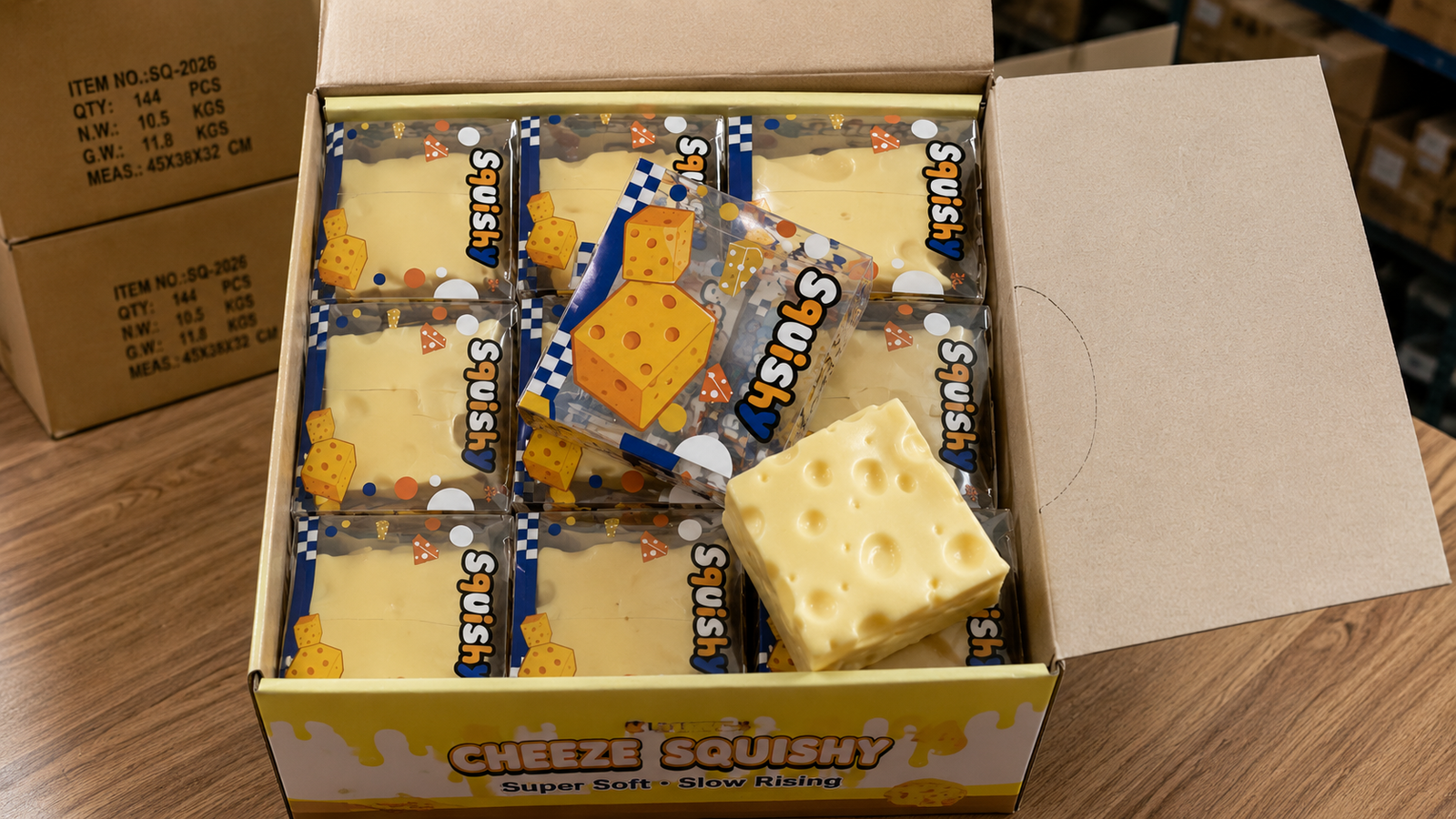
A custom box requires artwork, printing files, material preparation and production. If there is a display carton, the supplier also needs to confirm how many units fit and whether the finished squishies sit correctly inside it.
A current HKTDC listing for customized toy packaging shows a 30-day production lead time, which is a useful reminder that packaging itself can be a manufacturing project rather than an instant add-on.
The best workflow is usually to start packaging development while the product is moving through its final sample stage, provided the product dimensions are stable enough.
Waiting until every squishy is finished before ordering custom packaging can create an avoidable gap.
Production Time Is Not the Same as Arrival Time
This is where buyers often underestimate the calendar.
If a factory says production takes 30 days, that does not mean the buyer receives the goods 30 days later.
After production may come final packing, inspection, balance payment, booking, export handling and transportation.
The correct planning direction is therefore backward.
Start with the date the goods need to be in the warehouse or stores. Subtract freight and receiving time. Then allow time for inspection and shipment preparation. Only after that should the factory production window be placed on the calendar.
For squishy toy lead time, this distinction becomes especially important for Christmas, Halloween, Easter or other products with a short selling window. A two-week delay on an evergreen novelty product is inconvenient. A two-week delay on a seasonal assortment can remove a meaningful part of the selling season.
Factory Holidays Can Change an Otherwise Normal Schedule
The calendar matters as much as the specification.
Chinese New Year is the clearest example for buyers sourcing from China. DHL reported that after the February 2026 holiday, factories reopened gradually and many operations did not return to normal capacity immediately; orders placed during the restart period could see a usual three-week schedule stretch to five or six weeks.
The mistake is assuming that “factory reopened” means “full production resumed.”
Material suppliers, packaging plants and subcontractors may be restarting at different speeds. Existing backlogs also compete for production capacity.
If a delivery falls near a major holiday or peak production period, ask about the factory calendar before placing the PO—not after the quoted ship date begins to slip.
Reorders Usually Follow a Different Clock
A repeat order should often be easier than the first one.
The mold already exists. Color references are approved. Print files are available. Packaging specifications are known.
But buyers should confirm which of those items the supplier actually retains.
If a custom box needs to be printed again from scratch or a special material has a minimum purchasing quantity, a reorder may still require several weeks.
This is why the first squishy toy lead time and the reorder lead time should be discussed separately.
For a proven SKU, reorder speed can become more commercially important than shaving a few cents off the unit price. Running out of the best-selling color while slower designs remain in stock is an inventory problem that a predictable replenishment schedule can help prevent.
Plan From the Delivery Date Backward
A realistic toy calendar is rarely one uninterrupted 30-day block.
It may include sample revision, final approval, packaging production, bulk manufacturing, inspection and freight—some sequential and some overlapping.
Before confirming a squishy toy lead time, buyers should know which steps are already complete and which ones still depend on approval.
That makes the timeline easier to manage and makes supplier promises easier to compare.
The useful question is not simply, “How many days will production take?”
It is: “If I need the goods in my warehouse on this date, when does each decision have to be finished?”
Read More: Buying Guide · Customization Guide · OEM Guide