
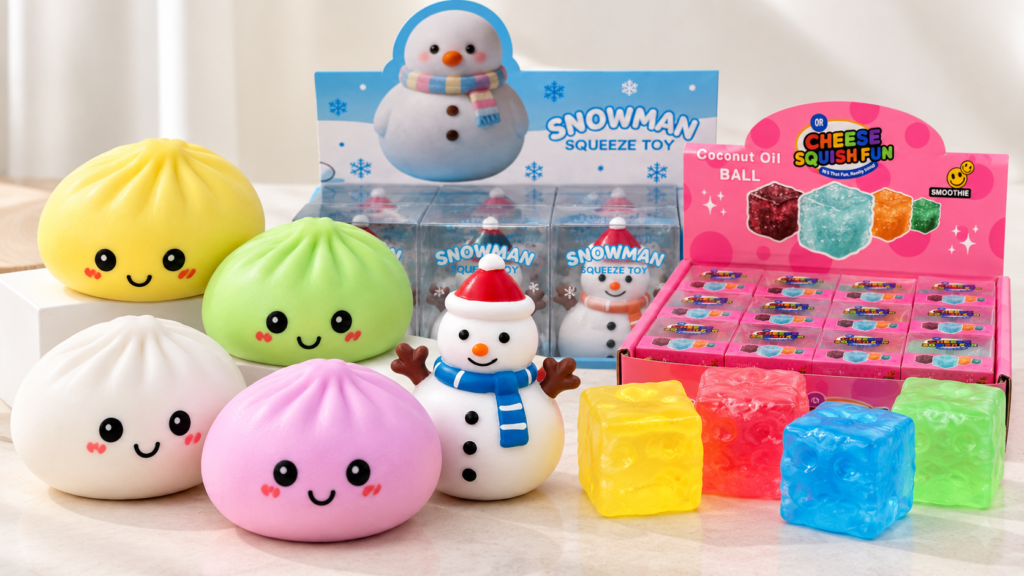
Two squeeze toys can sit beside each other in a catalog and look like close substitutes.
One might be a slow-rising foam toy. Another may have a soft elastic shell around a dense filling. A third shifts under pressure as the material inside moves from one side to another.
They may all be sold under the same broad product name, but they do not behave the same way.
For buyers comparing wholesale squeeze toys, that difference is difficult to judge from a product photo. Shape, color and packaging are easy to compare on a screen. Resistance, recovery and movement are not.
The useful question is not simply, “What is this made from?”
It is:
What happens when someone actually squeezes it?
Table of Contents
Wholesale Squeeze Toys Can Feel Different Before They Look Different
Start with three samples rather than three specification sheets.
Press the first one firmly and release it. Does it stay compressed for a moment before returning?
Now squeeze the second. Does it spring back almost immediately?
With the third, can you feel the filling move inside the outer shell?
Those reactions tell you more about the product experience than the shape alone.
This matters with familiar designs in particular. A dumpling, fruit or cartoon character can be made in constructions that create very different responses in the hand. The silhouette may attract attention, but the squeeze is what separates one product from another once it is picked up.
When wholesale squeeze toys are being compared side by side, appearance is only the first filter.
Slow-Rise Foam Has a Very Specific Payoff
A traditional slow-rise squishy has an interaction shoppers can understand quickly: compress the body, let go and watch it recover.
Flexible polyurethane foam can be produced with a wide range of physical characteristics, including different firmness and recovery behavior. The American Chemistry Council describes flexible polyurethane foam as resilient and able to recover after compression, while also noting the broad range of properties manufacturers can create.
At the buying table, though, the comparison can stay simple.
Squeeze several samples in roughly the same way and place them down.
Watch what happens.
One may recover quickly. Another may take noticeably longer. A third may rise unevenly or hold a crease.
There is no reason every foam product needs exactly the same recovery speed. A jumbo squishy and a smaller design may not behave identically. What matters is whether the response feels intentional and whether several samples from the same SKU behave reasonably consistently.
The finished surface deserves attention too. Paint and printed details are handled every time the body is compressed. Bend the sample. Squeeze the decorated areas. Look at the surface again after repeated use rather than judging it only when the package is first opened.
With foam-based wholesale squeeze toys, the recovery and the finish are experienced together.
Elastic Shells Change the Experience
Move to a soft elastic squeeze toy and the comparison changes.
Instead of waiting for a foam body to rise, the shopper may feel the shell stretch, bulge or rebound as pressure moves through the product. Some feel relatively firm. Others deform with very little pressure.
This is where catalog terminology becomes less useful.
Words such as “squishy,” “stress toy” and “squeeze toy” are used across products with noticeably different constructions. Current wholesale sourcing pages themselves separate products by materials such as PU and TPR while also grouping many of them under the same broad squishy or squeeze categories.
So pick up the finished sample.
How much pressure does it take before the shape changes?
Does the surface stretch smoothly?
What happens when you release it?
Try another piece from the same SKU if one is available.
The specification tells you how the product is described.
Your hand tells you what that description feels like.
Filled Squeeze Toys Add Movement Inside the Product
Filled products introduce another part of the experience: movement beneath the shell.
A dense filling can create more resistance. A softer filling may shift noticeably from one side to another. Other constructions can produce texture as material moves beneath the surface.
That means two products with similar outer shapes can behave very differently once someone picks them up.
For wholesale squeeze toys with a filled construction, one quick press is not enough.
Use the sample repeatedly.
Notice where the filling moves and where pressure collects. Look around the seams and closure points. Check whether the shell stretches evenly and whether the toy returns to a clean resting shape.
Then hand it to someone else.
People naturally grip and squeeze products differently. A second pair of hands can expose something the first test missed.
The closure deserves particular attention because filled products depend on the shell and sealed construction working together. Current manufacturing guidance for filled TPR squeeze products likewise treats filling type and sealing as separate variables that change both hand feel and quality-control priorities.
You do not need to turn sample review into a laboratory exercise.
You do need to test the feature the customer will use most.
Compare Wholesale Squeeze Toys by What Happens in the Hand
Once several samples are on the table, ignore the characters, colors and packaging for a moment.
Squeeze each one.
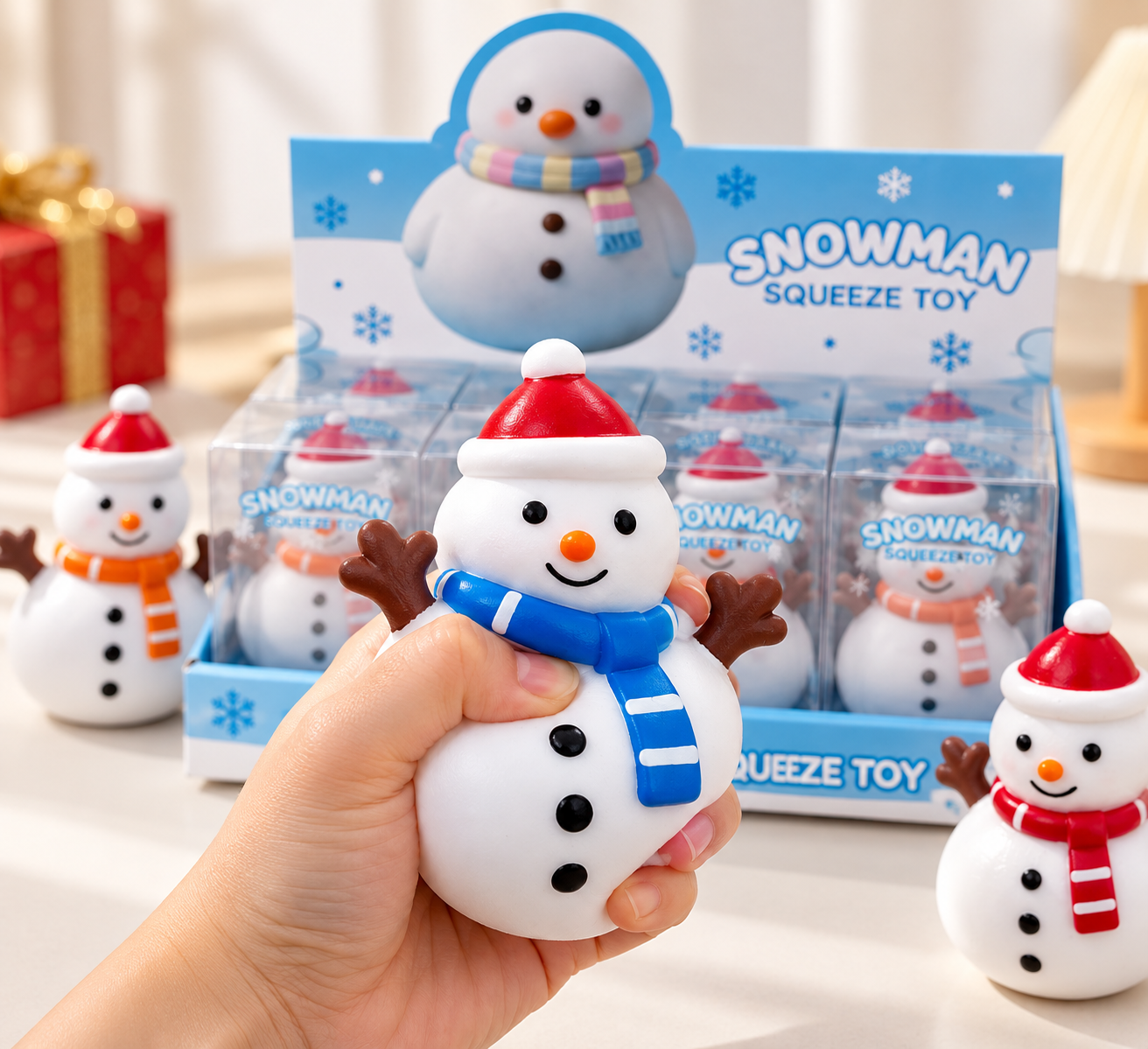
A slow-rise foam product should have a different payoff from an elastic squeeze toy. A filled design may introduce another response again.
Now look at what each SKU is actually adding.
Three characters may make an attractive collection but feel almost identical. Two products may share a similar theme yet deliver noticeably different squeeze experiences.
That difference is difficult to judge from catalog photography alone.
Photos are good at showing shape, decoration and packaging. They cannot fully communicate resistance, recovery, stretch or internal movement.
That is why physical samples carry so much weight when sourcing wholesale squeeze toys.
Product names tell you how an item is being sold. Specifications tell you something about how it is built.
The sample tells you how it actually behaves.
And with a squeeze toy, that behavior is much of the product.
Read More
• Slow-Rise Squishy Wholesale: What Buyers Should Compare Before Ordering
• Food-Shaped Squishy Toys: Why Familiar Shapes Work Across Different Play Styles