
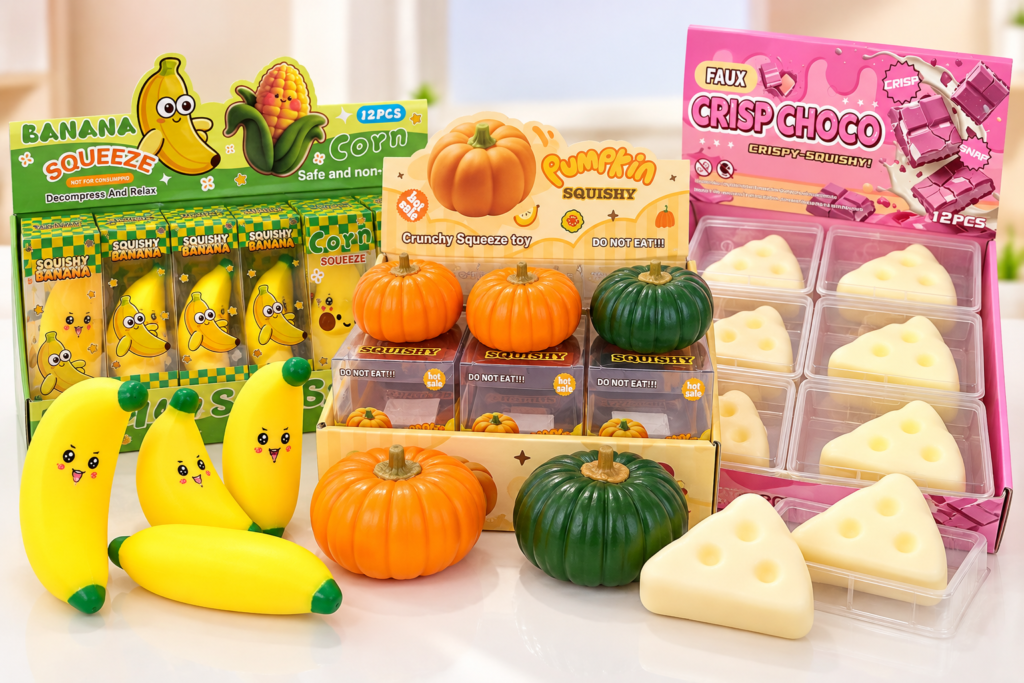
Food-shaped squishy toys are easy to browse but surprisingly tricky to buy in bulk. A catalog might offer dumplings, butter sticks, bread rolls, and hamburgers in several colors and sizes. The challenge is deciding which designs deserve space in your opening order.
A good food squishy toy assortment balances visual variety with manageable inventory. For retailers and distributors, that means choosing the right SKU mix, controlling packaging costs, and making future orders easier to plan.
Table of Contents
Food Squishy Toy Assortment: Build a Focused SKU Mix
More designs don’t necessarily make a stronger assortment. A gift shop with one countertop display may benefit from three distinct styles rather than eight similar-looking products.
Start with your available display space and the customers you serve. A novelty shop might favor colorful designs, while a gift retailer may prefer familiar food shapes in individual retail boxes.
Give each product a purpose. One design can attract attention, another can serve as a core item, and a third can test interest in something new.
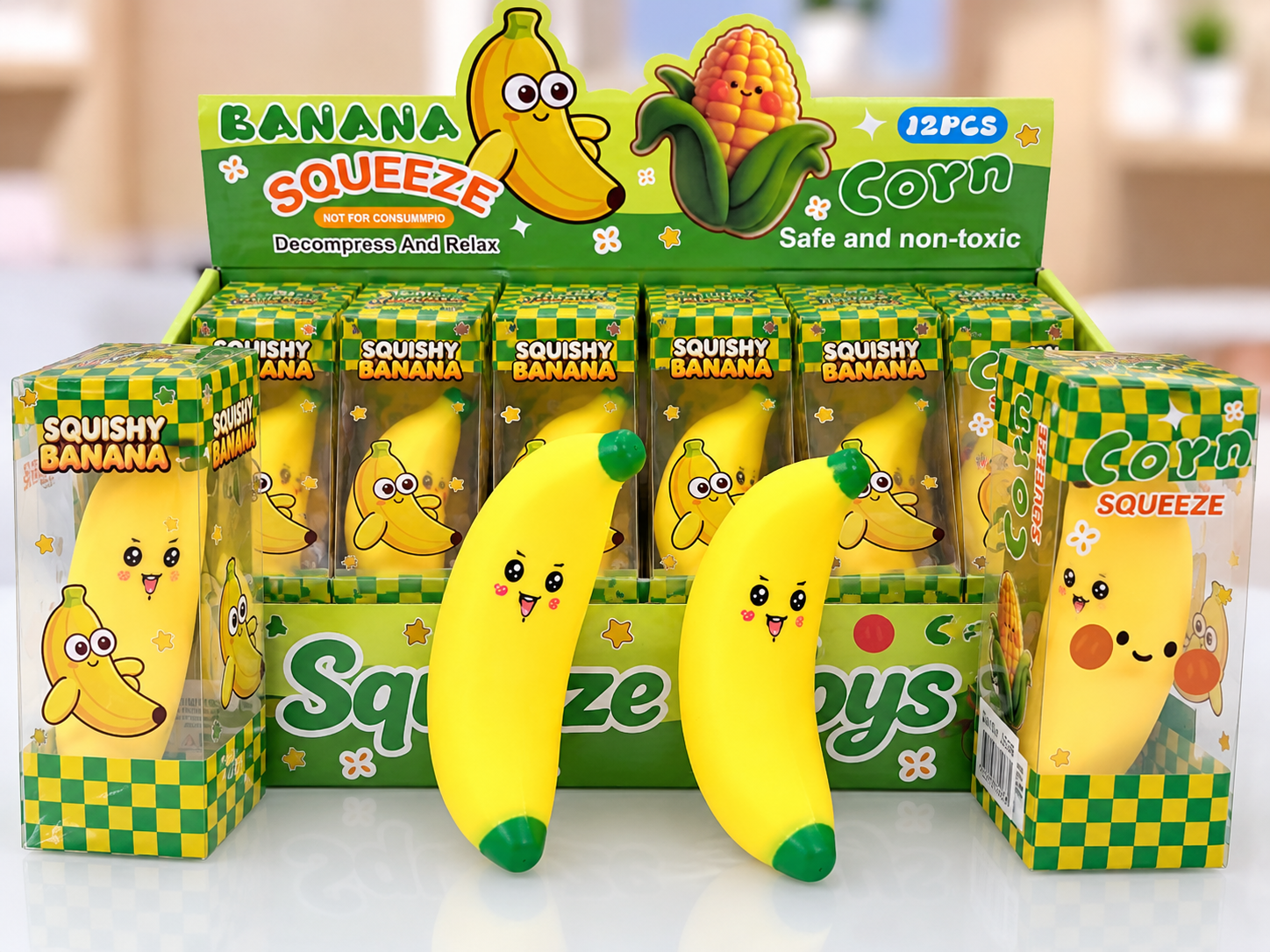
This is the difference between assortment breadth and depth. As Shopify’s assortment planning guide explains, retailers need to balance the number of products they carry with the variations available within each product line.
Texture matters, too. Two squishies may look similar but feel completely different. Buyers can explore our wholesale squishy toy collection to compare product styles before narrowing down their selections.
The goal isn’t to offer everything. It’s to give shoppers meaningful choices without making inventory harder to manage.
Allocate Opening Quantities by Design and Color
Ordering equal quantities of every design sounds simple, but it can leave buyers with too much stock in untested styles.
Consider a hypothetical 240-piece opening order across four designs. Instead of purchasing 60 pieces of each, a retailer might allocate 90 to a familiar design, 60 to a second choice, and 45 each to two newer styles.
This isn’t a guaranteed sales formula. It’s a way to limit exposure while testing demand.
Color options require similar attention. A dumpling available in six colors may appear to be one product family, but those colors can create separate inventory requirements.
Square’s inventory tracking guidance shows how retailers can monitor stock at the product-variation level. That matters when one color sells quickly while another remains on the shelf.
Before ordering, confirm whether mixed colors are available, whether MOQ applies per design or per color, and whether individual variants can be reordered.
For imported products, replenishment also depends on manufacturing and freight schedules. Our guide to squishy toy lead times covers the timing decisions buyers should consider.
Compare Packaging and Total Wholesale Costs
Packaging affects presentation, shipping costs, and retail margins.
An individual retail box may suit a gift shop, while a countertop display can simplify merchandising in a store with limited shelf space. Neither format is automatically better.
When comparing a food squishy toy assortment, request the packaging specifications for each SKU, including individual box dimensions, display quantities, and master-carton details.
Don’t compare factory prices alone. Freight, packaging, import expenses, and distributor margins can change the final cost of bringing a product to market.
Buyers should also confirm the materials, intended age group, and applicable safety documentation for each design. Products that look similar may have different construction and compliance requirements.
A good quotation should make these differences clear before the order is confirmed.
Use Sell-Through to Plan Better Reorders
The first order gives you a starting point. Sales data tells you what to do next.
Track how many units of each design sell during a consistent period. If a store receives 40 units and sells 30, that design has a 75% sell-through rate. Another design selling 10 out of 40 has a 25% rate.
Those figures help identify stronger performers, but context matters. A product that sells out early may have more demand than its final sales total suggests.
Lightspeed’s sell-through reporting guide explains how retailers can compare product performance, review days of inventory remaining, and identify replenishment needs.
Sales aren’t the only consideration. Review packaging damage, customer feedback, and product consistency before increasing order quantities. Our squishy toy inspection guide covers quality checks worth discussing with suppliers.
A successful food squishy toy assortment doesn’t need to be large. It needs enough variety to attract shoppers, reliable product quality, and a practical way to replenish what sells.
Start with a manageable selection, learn from the first sales cycle, and let actual demand shape your next wholesale order.
Read More