Ordering a few cartons of squishies is usually straightforward. Larger orders are different.
Once the quantity moves into the hundreds or thousands, the buyer is no longer deciding only whether the product looks good or feels right. The order also has to work as inventory. That means thinking about assortment depth, carton configuration, storage space, replenishment and what happens if one design sells much faster than the rest.
With squishy toys in bulk, the unit price is only one part of the decision. A cheaper order can still become an expensive one if the mix is wrong or too much stock ends up sitting in the warehouse.
Table of Contents
Start With the Mix, Not the Total Quantity
A buyer may already know that 1,000 pieces fits the budget. The harder question is how those 1,000 pieces should be divided.
If there are five designs, an even split would give 200 pieces of each. That looks neat on a spreadsheet, but retail demand rarely divides itself that evenly.
Some designs have more immediate appeal. Food-shaped squishies, for example, are easy for shoppers to understand at a glance. A more unusual novelty shape may be interesting but less predictable. Seasonal designs create another issue because the selling window is shorter.
Instead of asking only how many units to buy, decide what role each SKU is supposed to play.This is one of the first decisions buyers should make when planning squishy toys in bulk.
One design may be the main volume item. Two or three others may add variety. Another may simply be worth testing in a smaller quantity.
A mix such as 40/20/15/15/10 can sometimes make more sense than ordering every SKU equally. The exact ratio depends on the assortment, but the principle is useful: inventory depth should follow confidence in the product.
Our guide on how to choose the right squishy toys focuses on product selection itself. Bulk planning begins after those products have already made the shortlist.
Case Packs Can Change the Order You Thought You Were Placing
Wholesale orders are usually discussed in pieces. Warehouses receive cartons.
That difference matters more than it seems.
Imagine one style packs 144 pieces per master carton and another packs 96. A buyer asking for roughly 250 units of each may eventually have to choose between carton-based quantities rather than the exact number originally entered into the purchase plan.
For squishy toys in bulk, case-pack information should be requested before the final assortment is locked.
Useful details include units per inner pack, units per master carton, carton dimensions, gross weight and whether mixed designs can be packed together.
Mixed cartons can be practical for smaller retailers because they reduce the amount of inventory tied up in one style. A distributor replenishing proven products may prefer full cartons of a single SKU because they are easier to count, store and ship.
There is no universal best option. The right packing format depends on how the inventory will move after it arrives.
Variety Looks Good Until It Splits the Inventory Too Thin
Large orders create room for more colors, shapes and designs. That does not always mean the assortment should become wider.
Ten colors can look impressive in a catalog, but 1,000 units divided equally across ten colors leaves only 100 units of each.
If two colors quickly become the obvious bestsellers, those may sell out while slower colors are still sitting in stock.
That is one of the risks when buying squishy toys in bulk. More variety can make the assortment look stronger while quietly reducing useful depth behind the products customers actually want.
For a new SKU, a tighter first assortment often produces clearer sales data. Once the buyer sees what moves, the second order can be more aggressive.
This matters especially with novelty products. Two designs that look equally promising in a sample room can perform very differently once they reach stores.
A Good Sample Does Not Prove a Large Batch Will Be Consistent
One approved sample tells the buyer what the product can look and feel like.
It does not tell the buyer whether 2,000 pieces will all arrive that way.
As order size grows, consistency becomes more important. Shape, color, surface finish, printing, softness and recovery should be checked across multiple units, not only against the original approval sample.
Random inspection is useful because it gives a better picture of the actual production batch.
Take units from different cartons or different parts of the production run and compare them side by side. Small variation may be normal with soft products, but obvious differences in color, print position, recovery or shape deserve attention.
Intertek’s toy and children’s product services include mechanical, physical, chemical, endurance and performance testing, which illustrates an important distinction for buyers: regulatory testing and broader product-quality evaluation are related, but they are not the same job.
For larger orders, the practical question is not only “Did the sample pass?” It is also “Does the production run still match what we approved?”
Reorder Speed Can Matter More Than Saving a Few Cents
Bulk buying naturally turns into a price discussion.
That is reasonable. Saving even a small amount per unit can matter across several thousand pieces.
But there is another number that deserves attention: how quickly can the winning SKU be reordered?
Suppose Product A is slightly cheaper, but replenishment takes much longer. Product B costs a little more, but the supplier can reproduce it quickly because the material, mold and packaging setup are already established.
If Product B starts selling faster than expected, the difference in reorder speed may be worth far more than the original unit-price saving.
This is where novelty toy MOQ connects to inventory planning. MOQ tells the buyer how low an order can go. Reorder flexibility tells the buyer how easily one successful SKU can be replenished without rebuilding the entire assortment.
The first bulk order often tests the market. The second order is where the buying strategy becomes much clearer.
Squishy Toys in Bulk: Translate Units Into Cartons Before You Approve the PO
A purchase order can look perfectly manageable until the shipment arrives.
The easiest way to avoid surprises is to translate the order into cartons before final approval.
If 1,440 units pack 144 pieces per carton, that is ten master cartons. If a larger product packs only 48 pieces per carton, the same 1,440 units become thirty cartons.
The unit count is identical. The physical inventory is not.
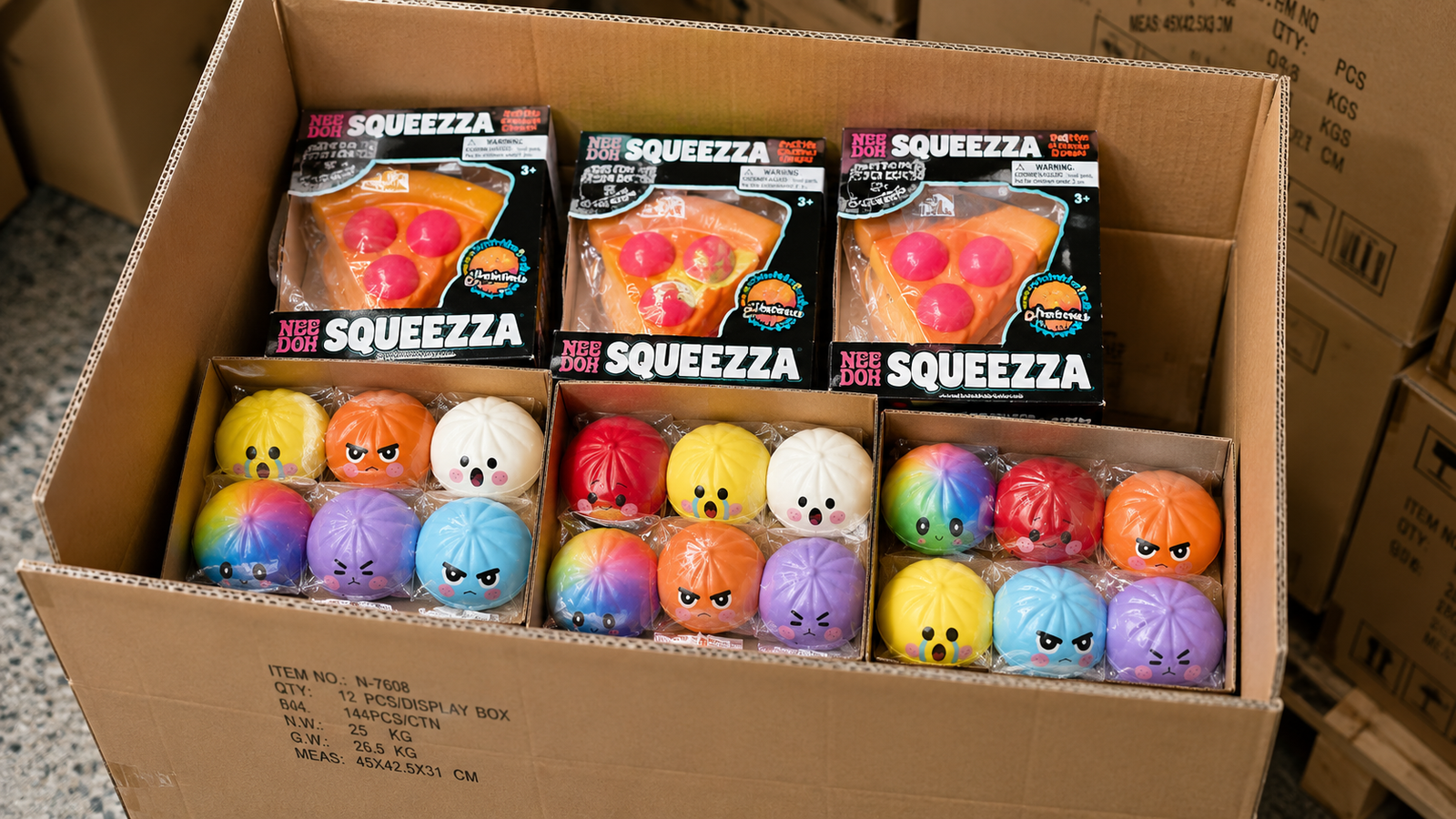
That difference affects receiving, storage, pallet space and often freight.
It becomes even more important when the order includes multiple product sizes. Small squishies, standard items and jumbo products should not be treated as though 1,000 units of each require the same amount of warehouse space.
Packaging changes the calculation too. Individual boxes, countertop display packs and simple bulk packing can create very different carton volumes.
Our novelty toy packaging guide goes deeper into those format choices, but for a bulk order the buyer should at least know the final packing configuration before confirming quantity.
Keep Enough Production Information to Trace a Problem Later
The larger and more repeatable the program becomes, the more useful traceability becomes.
For children’s products sold in the U.S., CPSC tracking-label requirements are built around this idea. Identifying information is generally intended to make it possible to determine the manufacturer or private labeler, production location and date, and batch or run information.
Even outside the compliance requirement itself, this is practical for buyers.
If the same SKU is ordered several times during the year and one shipment develops a problem, batch information helps narrow the issue to a particular production run instead of forcing the buyer to question every unit of that product.
That matters once squishy toys in bulk stop being a one-time purchase and become a repeat program.
The Best First Bulk Order Makes the Second Order Easier
A first large order does not need to predict demand perfectly.
It needs to produce useful information.
After the order sells through, the buyer should be able to see which SKUs deserved more depth, which colors were weaker, whether carton sizes worked operationally and which products are worth replenishing.
That is a better outcome than simply buying the largest quantity available at the lowest price.
A well-planned order of squishy toys in bulk leaves the buyer with fewer surprises and a much clearer next move.
Read More: Buying Guide · Customization Guide · OEM Guide