Minimum order quantity is often one of the first numbers buyers ask for when sourcing novelty toys. It is also one of the easiest numbers to misunderstand. Two suppliers may both offer the same type of product, yet quote very different minimums because the product, packaging, color assortment or level of customization is not actually the same.
For buyers comparing novelty toy MOQ requirements, the useful question is therefore not simply, “What is your minimum?” It is what the minimum applies to. A factory may calculate MOQ by product, color, design, packaging run or custom process, and those details can change the real size of an order quickly.
Understanding how MOQ works before requesting a final quote can help retailers, importers and private-label brands avoid unnecessary inventory while still giving the supplier enough volume to produce the order efficiently.
Table of Contents
Why Novelty Toy MOQ Varies From Product to Product
There is no single standard novelty toy MOQ that applies across the category. A simple existing product may be available by carton or in relatively small quantities, while a custom design involving new tooling, printing or packaging can require a much larger production run.
That difference usually comes down to setup. Manufacturing a custom product can involve mold preparation, color matching, printing setup, packaging production and assembly before the first finished unit is produced. Those fixed costs have to be spread across the order, which is one reason minimum quantities tend to rise as customization becomes more complex.
Current toy suppliers illustrate how wide the range can be. Some suppliers list stock-product minimums by carton while quoting custom or OEM projects at substantially higher quantities. Others set different minimums by design or colorway rather than treating the entire order as one combined quantity.
That is why buyers should compare the actual sourcing route rather than the headline MOQ alone. The same principle applies when evaluating a novelty toy supplier: the supplier should be able to explain what is driving the minimum and which changes would increase or reduce it.
Buyers should also confirm pricing, technical requirements and minimum order quantity directly with the supplier, since these details depend on the specific product and sourcing program.
Ask What the Novelty Toy MOQ Applies To
A quoted MOQ may apply to the entire product, but it can also apply separately to each SKU, color or packaging design. Buyers should confirm that point before assuming several variations can be combined into one production minimum.
For example, an order of 1,000 units does not necessarily mean a buyer can divide the quantity into five colors at 200 pieces each. The factory may have a minimum color run, and custom packaging may have its own printing minimum as well. Mixed assortments are possible in some programs, but the rules should be confirmed in writing rather than assumed.
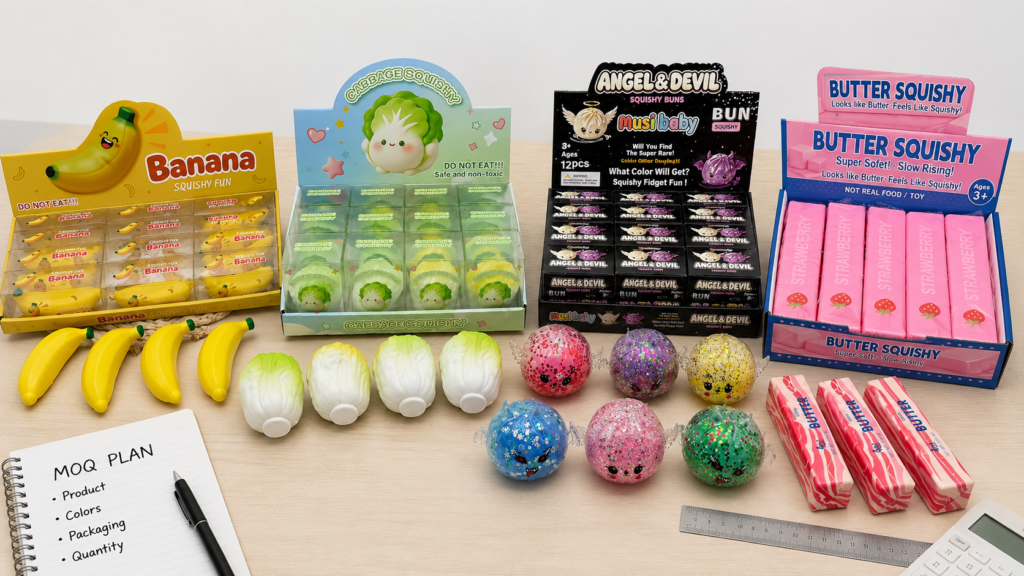
This is particularly important for novelty and fidget products because buyers often want several colors within the same assortment. Current B2B sourcing guidance for fidget toys specifically notes that MOQ can vary by model, color, branding process and packaging run, and that mixed-SKU arrangements should be defined clearly before ordering.
Buyers sourcing wholesale spinning toys, for example, may find that an existing multi-color assortment can be ordered differently from a private-label version requiring custom artwork or individual retail boxes.
Customization Can Change the MOQ Quickly
One of the biggest changes to novelty toy MOQ usually comes from customization. Adding a logo to an existing product may require relatively little production setup, while changing the product structure or creating a new mold is a very different project.
Packaging is another common source of higher minimums. A supplier may be able to sell an existing toy in standard packaging at one MOQ, but custom printed boxes, display cartons or inserts may have separate production requirements from the toy itself. In some cases, the packaging minimum can become the limiting factor even when the product could technically be produced in a smaller quantity.
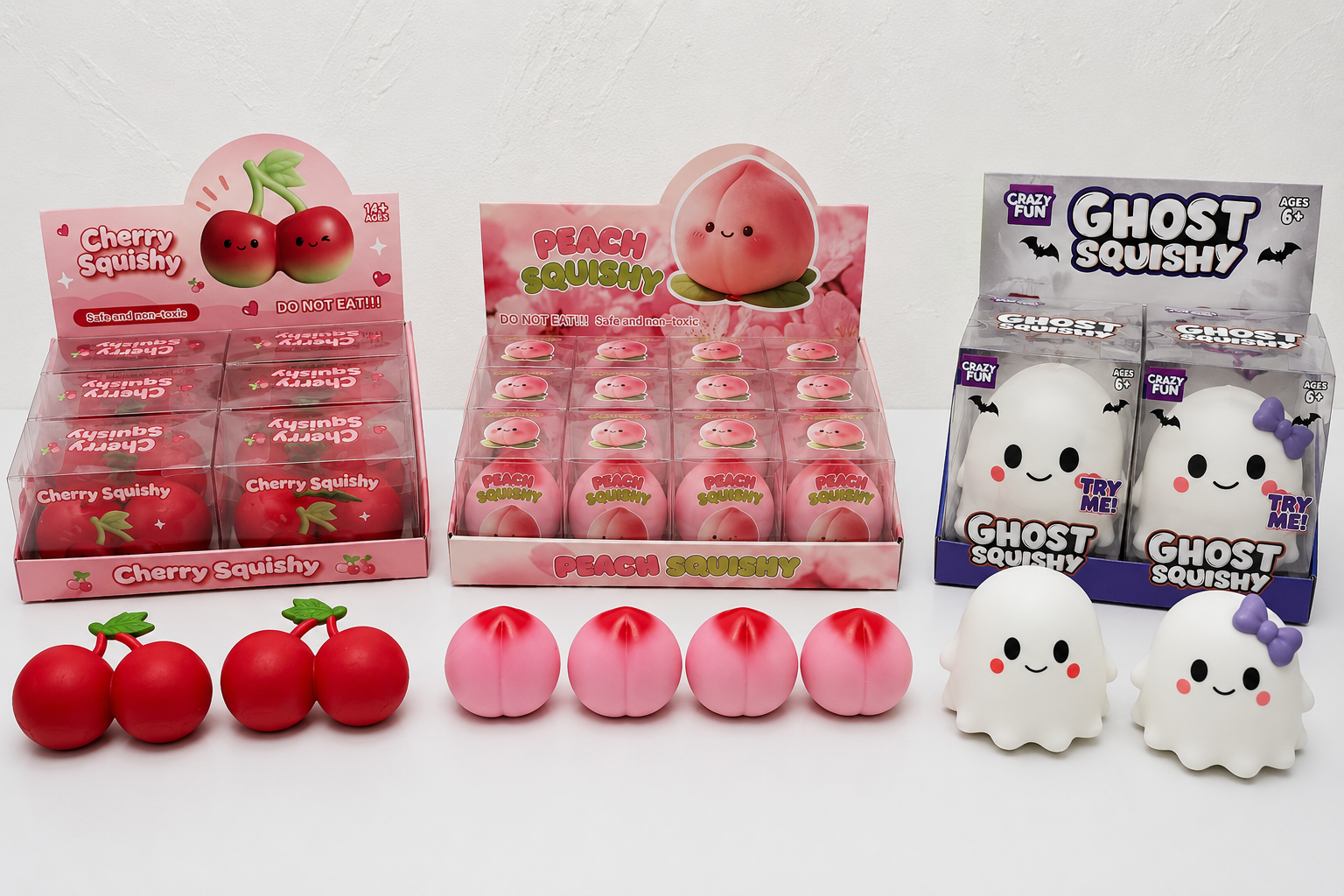
This is why buyers should decide how much customization is actually necessary for the first order. A retailer testing a new product may get more useful information from an existing design with a custom label or simple branded package than from committing immediately to completely new tooling.
The same logic applies to broader OEM development. Existing molds, private-label changes and fully custom products should be treated as separate sourcing routes because they carry different costs, timelines and minimums.
A Lower MOQ Is Not Always the Better Deal
Buyers often look for the lowest possible MOQ because it reduces inventory risk, especially when testing a new novelty product. That can be useful, but a low minimum should not be evaluated separately from unit price, packaging, freight and the quality of the final product.
Short runs usually spread setup costs across fewer units. As a result, the unit price can be noticeably higher even when the total order value is lower. A buyer may therefore discover that ordering slightly above the minimum produces a better overall cost structure without creating dramatically more inventory.
The opposite problem can also occur. A very low unit price may only apply at a much larger volume than the buyer actually needs. Committing to several thousand pieces simply to reduce the unit cost can create storage and sell-through problems if the product has not yet been tested at retail.
For a new item, a practical novelty toy MOQ should balance manufacturing efficiency with the buyer’s ability to test demand. The objective is not necessarily to order the fewest possible units, but to avoid buying substantially more inventory than the sales plan can support.
Use Samples and Packaging Decisions Before Finalizing Quantity
MOQ discussions become much more useful once the buyer has confirmed the product specification. Before committing to volume, buyers should understand the product dimensions, materials, colors, mechanism and packaging format they actually intend to purchase.
A physical sample can also change the order plan. A buyer may decide that one color is stronger than another, that the package needs to be smaller or that a mechanism should be adjusted before production. Those decisions are much easier to make before thousands of units have been ordered.
This is why the sample stage should come before the final quantity decision for custom programs. Once the product and packaging are approved, the supplier can give a much clearer explanation of what the final novelty toy MOQ represents and whether different variations can share any part of the production run.
For buyers already comparing wholesale novelty toys, this also makes assortment planning more realistic because product testing, packaging and quantity are being evaluated together instead of as separate decisions.
The Right MOQ Depends on the Buying Plan
There is no ideal quantity that works for every novelty toy program. A small retailer testing one SKU, a distributor building a mixed assortment and a private-label brand developing custom packaging will naturally have different requirements.
A better RFQ gives the supplier enough information to explain the relevant minimum. Buyers should include the product reference, expected quantity, number of colors, destination market, packaging preference and required customization rather than asking for MOQ as an isolated number.
The supplier can then clarify whether the minimum applies by product, color, packaging style or production process. That information makes it much easier to compare quotations fairly and understand where additional volume is actually required.
For buyers evaluating novelty toy MOQ, the most useful number is not necessarily the lowest one. It is the minimum that matches the final product specification, the retail plan and the amount of inventory the buyer is realistically prepared to sell.
Read More:Buying Guide · OEM Guide · Customization Guide