Novelty toys designed for pulling, stretching, and launching rely on thermoplastic rubber (TPR) to deform dramatically and snap back into shape. While soft TPR provides enjoyable elasticity, low-grade compounds or poorly trimmed mold lines can fail prematurely when subjected to repetitive stretching.
Evaluating tpr stretchy toy tear resistance before approving bulk production helps commercial buyers identify potential tear initiation points before production. Approaching tpr stretchy toy tear resistance with clear physical benchmarks gives buyers a documented basis for comparing formulations and molded parts.
Table of Contents
Understand Notch Sensitivity in Thermoplastic Elastomers
In polymer engineering, thermoplastic rubber behaves very differently from rigid plastics under mechanical tension.
When reviewing tpr stretchy toy tear resistance, product developers must account for notch propagation:
Surface Nicks and Trim Marks: Even a tiny razor nick or rough parting line along the edge of a stretchy toy acts as a stress concentrator. A nick can concentrate strain and may initiate a tear; actual failure depends on the compound, geometry and loading.
Polymer Compound Formulations: TPR compounds vary widely depending on base styrene block copolymers and plasticizing oil ratios. Plasticizer levels and compound formulation can affect softness and mechanical performance; the relationship must be established from material data rather than inferred from touch.
Temperature Effects: Temperature may change the response of a given elastomer formulation. Agree on conditioning temperatures when comparing specimens.
Inspecting mold parting lines and trim quality on physical samples is the first practical step in verifying tpr stretchy toy tear resistance.
Inspect Stress Concentration Points on Sculpted Designs
Character novelty toys rarely feature uniform cross-sections, creating localized weak points where thickness transitions abruptly.
When auditing samples for tpr stretchy toy tear resistance, quality teams examine high-stress geometric zones:
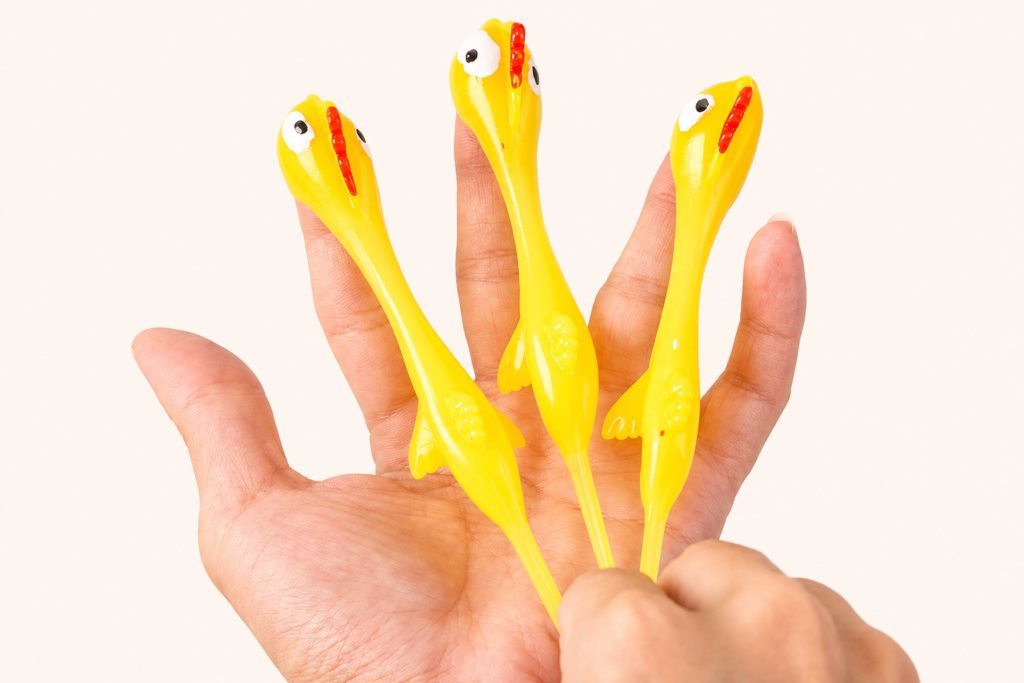
Elongated Necks and Limbs: In launching novelties like our Stretchy Chicken Finger Flingers, users grip the tail and pull the neck back repeatedly. Buyers should inspect the transition where the hollow finger pocket meets the solid body to confirm smooth wall thickness without sharp internal corners.

Thin Decorative Strands: On multi-strand characters such as our Silly Hair Monster Squishy, individual noodle-like strands experience concentrated tension when pulled individually. Check that strand bases flare smoothly into the head rather than meeting at sharp 90-degree angles.
Molded Surface Textures: Deeply embossed patterns or decorative grooves can act as tear initiation lines if stretched aggressively across the grain.
Document the critical geometries and relevant mold revisions, then evaluate finished parts against an approved reference.
Establish Repeatable Elongation and Tear-Resistance Checks
Rather than relying on informal hand pulling, commercial buyers should establish structured physical evaluation methods with their suppliers.
To assess tpr stretchy toy tear resistance consistently across sample revisions, procurement teams can reference recognized industry frameworks:
Standardized Tear Test Methods: In polymer laboratories, test procedures such as ASTM D624 for Tear Strength of Conventional Vulcanized Rubber and Thermoplastic Elastomers measure the force required to propagate a tear in standardized die-cut specimens. While die-cut lab plaques differ from molded novelty shapes, referencing standardized test concepts helps buyers discuss compound durability objectively with resin suppliers.
Finished-Product Cyclic Pull Checks: For actual finished toys, buyers and suppliers can agree on a practical benchtop check—such as stretching a defined section to a target extension for an agreed number of cycles—and recording any permanent elongation, surface whitening, or tearing.
Retain Physical Reference Samples: Keep signed, dated reference pieces from the approved lot so future reorders can be compared directly against original elasticity.
Combining standardized material data with a defined finished-part pull check provides complementary evidence for of this TPR tear assessment.
Connect Material Verification to Toy Safety Testing
Mechanical durability directly intersects with statutory child safety obligations for novelty toys entering U.S. retail channels.
Under federal regulations overseen by the Consumer Product Safety Commission (CPSC), children’s toys undergo standardized tension and torque abuse testing under ASTM F963. If a component detaches during applicable tests, determine whether the result is prohibited for the intended age group. Labels cannot substitute for compliance with requirements applicable to that group. Buyers building stretchy assortments from our novelty toys catalog should ensure third-party laboratory test reports cover the exact finished SKU.
For a related product or sourcing reference, see squishy toy material declarations.
To discuss material durability, request evaluation samples, or review custom development options for this TPR tear assessment, contact Vilora Toys with your product specifications and target order quantities.
For standardized specimen testing concepts, see ASTM D624 tear-strength standard. The applicability of any external guidance to a particular finished SKU must be checked separately.
Read More