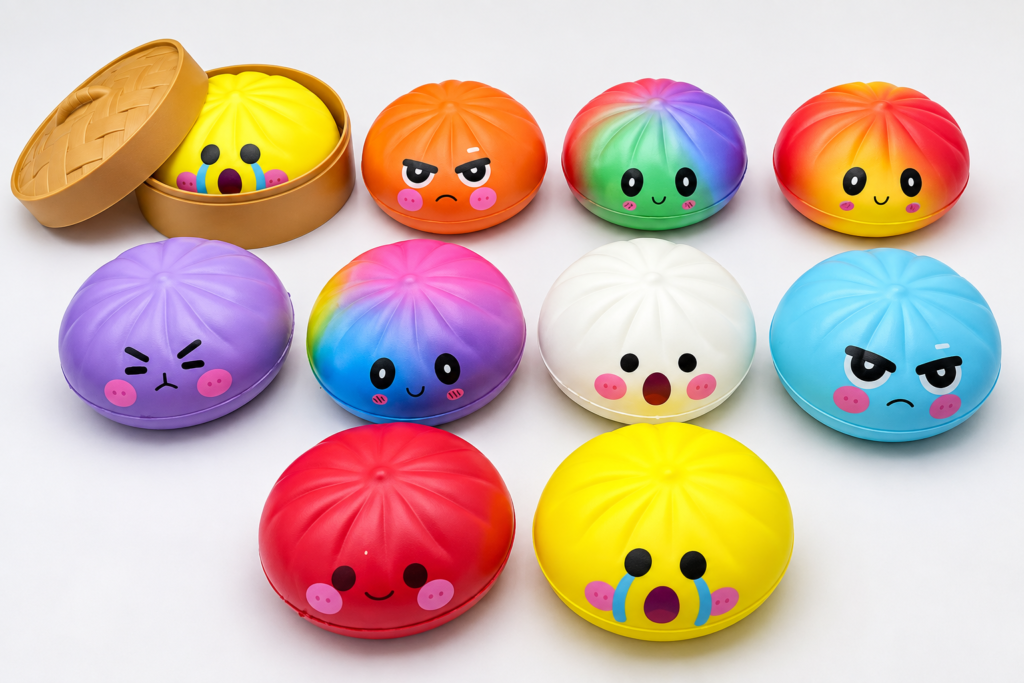
A squishy sitting beside the register in a gift shop and 300 sensory toys packed for a school program may start with the same product. After that, almost everything about the order can change.
The store wants something customers will notice, pick up and buy on impulse. The school may care more about age range, individual packing and how easily the products can be handed out. A promotional buyer could take that same basic squeeze toy and ask for a brand color, logo or custom package.
That is what makes bulk sensory toys an interesting category right now. The products are familiar. The buyers are becoming much less predictable.
Faire’s 2026 wholesale data gives a good example. Among retailers on its marketplace that carry children’s products, squishies now account for 73% of kids-item orders at hardware stores, 67% at convenience stores, 65% at pharmacies and 63% at grocery stores. A year earlier, the share was only 1% to 4% across those store types.
These stores are not suddenly building full toy departments. Small tactile products simply happen to work in places where a large toy assortment would not.
Table of Contents
Retail Buyers Need the Product to Sell From a Small Space
For an independent retailer, a sensory item may get only a few inches of counter space. The product has to make sense quickly.
Food-shaped squishies do that particularly well. A dumpling, piece of butter or fruit shape is recognizable before the customer ever squeezes it. Several colors can make a small display feel varied without requiring a large number of SKUs.
Packaging has a real job here. A clear box lets shoppers see the product. A countertop display keeps small pieces together and gives the assortment some presence. If the product has a visible filling or unusual texture, the package can show that off instead of hiding it.
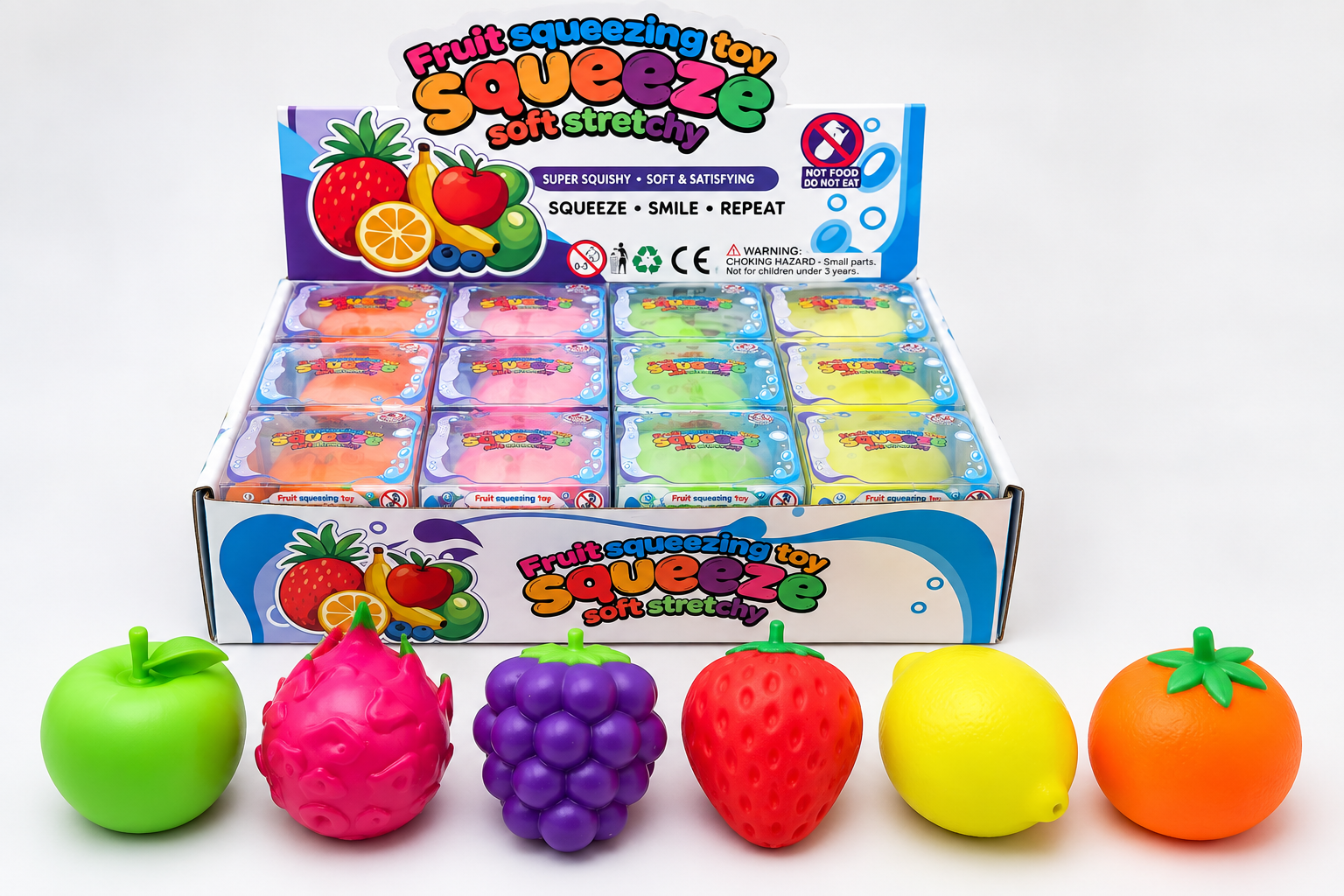
Small orders are common in the bulk sensory toys market.Faire says the average squishy order on its marketplace is about 25 units, compared with roughly six units for other children’s items. Faire
That is enough inventory for a small shop to try a design without committing much shelf space. If the dumplings move and another shape does not, the next order can look different.
For retail buyers, bulk sensory toys do not always have to mean thousands of pieces. Sometimes the first useful order is simply large enough to see what customers actually pick up.
A School Program Is Buying for a Different Reason
Now take the retail shelf out of the picture.
A school, after-school program or youth organization ordering bulk sensory toys may never display the products at all. Staff could open the carton and distribute them as classroom rewards, activity items or part of an event.
Faire reported that searches for squishy toys on its marketplace rose 1,733% from February through April 2026. Searches for fidgets increased 91% from February. Its back-to-school reporting also points to prize bins and sensory-focused classroom spaces as places where these products are showing up.
A 12-piece retail display is not especially useful if somebody is going to open it immediately.
For a program order, case quantity, intended age range and individual packing can matter more. A buyer may also prefer a straightforward mix of colors or designs rather than the broader assortment a gift shop would choose.
This is also where unnecessary packaging starts showing up in the price. If 300 pieces are being handed directly to participants, paying for 300 printed retail boxes may solve a problem the buyer never had.
The product still needs suitable protection during storage and shipping. It just does not necessarily need to arrive dressed for a store shelf.
Shape Is Only One Way to Build an Assortment
Sensory catalogs can get crowded quickly: animals, desserts, fruit, characters, balls, seasonal shapes and dozens of colors.
But two toys that look different can feel almost identical.
A slow-rise foam squishy behaves differently from a filled TPR toy. A transparent shell makes the movement of the filling part of the experience. Texture changes what happens in the hand. Fidget products add completely different movements—spinning, clicking, sliding or wobbling—without needing another character design.
That gives a buyer another way to build variety.
Instead of choosing ten shapes with nearly the same squeeze, an assortment can mix a few different interactions, sizes and price points. A small piece might work as a prize or inexpensive impulse item. A more detailed filled toy can sit at another price point. A jumbo product has a different visual role again.
For buyers comparing bulk sensory toys, the useful question is not always, “How many designs can I get?”
Sometimes it is simply, “Do these products actually feel different?”
The Same Dumpling Can End Up in a Promotional Order
A food-shaped squishy also has uses that have little to do with a toy shelf.
Say a restaurant group wants 1,000 dumpling-shaped giveaways for an opening or promotion. If an existing dumpling mold already works, there may be no reason to develop a completely new toy. The project could be mostly about color, branding and packaging.
That sounds simple until the artwork reaches the product.
A soft, curved surface does not give a logo the same printable area as a flat package. Wide artwork may wrap farther around the toy than expected. Fine lettering that looks good on a computer screen may not reproduce cleanly at a small size.
In some cases, branding the package makes more sense than forcing a complicated print onto the toy itself. In others, a simple logo on the product is exactly what the project needs.
This is where an existing product can do another commercial job without being redesigned from scratch. Vilora’s OEM & ODM development process covers existing-product customization as well as new product development.
For bulk sensory toys going into an event or promotional program, the deadline can also matter as much as the design. A great custom idea arriving two weeks after the event is not a successful order.
Bulk Packaging Should Match What Happens Next
Packaging for bulk sensory toys gets easier to evaluate once the destination is clear.
A retailer may want a display box that can go straight onto the counter. A school program may prefer simple individual packs inside a master carton. A promotional buyer might need branding on the package but have no use for a retail display.
The same SKU can be packed differently for each order.
There are practical limits. Soft products should not spend shipping and storage compressed unnecessarily. Clear packaging can be useful when the filling or surface is visually important. Larger boxes increase carton volume, which can matter quickly once an order moves into the hundreds or thousands.
For children’s products, packaging decisions also sit alongside the actual product requirements. In the United States, toys intended primarily for children 12 and under must be third-party tested to applicable requirements by a CPSC-accepted laboratory and certified in a Children’s Product Certificate. CPSC states that ASTM F963-23 applies to children’s toys manufactured on or after April 20, 2024.
For a school or other children’s program, that documentation should be checked against the actual SKU being purchased rather than assumed from a similar product.
One Category, Very Different Buyers
The useful thing about bulk sensory toys is not that every possible buyer suddenly wants the same squishy.
They do not.
A retailer may care about presentation and sell-through. A school or community program can care more about quantity, age range and distribution. A promotional buyer may start with branding and a fixed event date.
Even when they choose the same basic product, they are buying it for different jobs.
Before deciding on the assortment, package or customization, it helps to know what happens after the carton arrives. That one detail can change an order more than adding another five colors ever will.
Read More