

Run a fingertip over a bumpy ball, then roll it across your palm. The same surface feels different as the contact moves. Add a bounce or a flashing light, and the activity changes again.
Textured sensory balls give buyers several features to consider beyond color. Start with what you want someone to do: explore the surface, pass the ball, squeeze it, or watch it bounce. That choice helps narrow the options before you build an assortment.
Table of Contents
Explore Textured Sensory Balls Before Squeezing
Start by holding the ball loosely. Move a fingertip over the raised areas, turn it slightly, and try another section. Small, closely spaced bumps feel different under your fingers from larger bumps spread farther apart. Ridges give the finger a path to follow; scattered bumps interrupt that path.
When comparing textured sensory balls, describe what the surface actually offers. “Rounded bumps spaced around the ball” tells a buyer more than “interesting texture.” A close-up photograph can show the spacing, but handling a sample reveals how prominent those features feel.
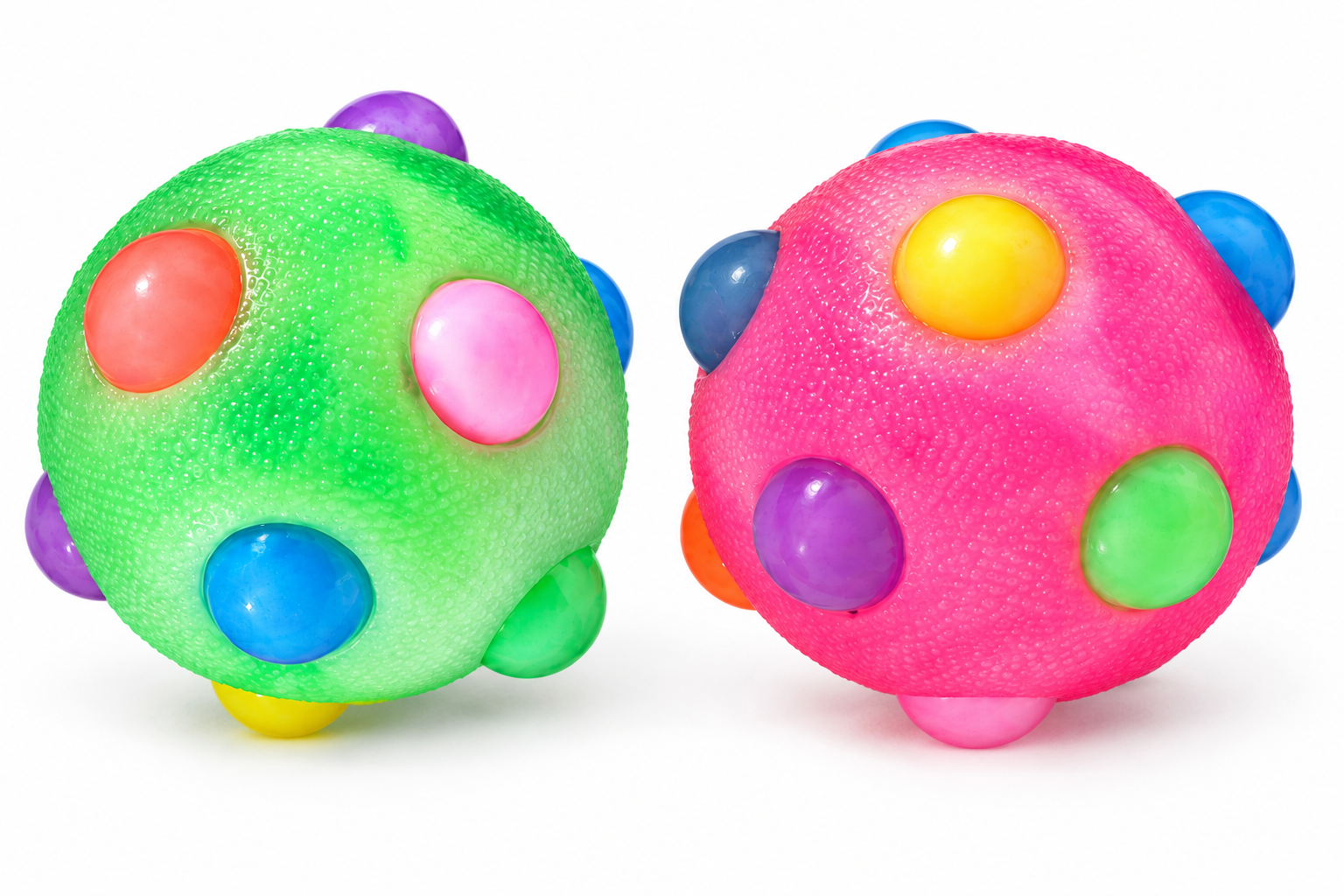
Lakeshore’s sensory play range includes bumpy balls presented for tactile exploration. That provides an example of how the surface can become part of the activity. Materials, dimensions, and age recommendations still need to be checked for each product.
A simple demonstration is to trace one raised feature, turn the ball, and find another. There is no need to introduce a timed challenge. Let the person decide whether to continue, try another surface, or put the ball down.
Separate Surface Texture From Squeeze Resistance
A ball can have noticeable bumps and still resist compression. Another can feel smooth but flatten easily. The exterior pattern and the way the body yields are separate characteristics.
For textured sensory balls, check them separately. First explore the outside without pressing hard. Then apply a comfortable squeeze and release. Notice whether the body deforms, how it returns, and whether the raised details change shape along with it.
This distinction also matters when reading a product name. “Sensory” does not specify firmness, and “soft” does not establish slow recovery. A buyer looking for a ball to compress in the palm may want a different construction from someone choosing one to roll and pass.
Avoid describing every item in an assortment as “super soft.” If two samples feel different, record that difference in ordinary words. Keep dimensions alongside those notes: a larger ball changes how much of the palm touches its surface, even when the pattern looks similar.
Try Holding, Rolling, and Bouncing as Separate Activities
Textured sensory balls can invite several movements, but each product should be used according to its stated design. Start with a small action and see whether it fits the setting.
Hold and turn. Rotate the ball between the hands to explore different areas. This keeps the activity contained and makes the surface the main feature.
Roll and return. Where the product permits rolling, use a clear, level surface and a short distance. Try a gentle roll to another person. Notice whether the raised areas affect its path rather than assuming every textured ball will roll straight.
Bounce when intended. A ball designed for bouncing adds impact and movement. That can suit active play, but it changes the sound and space needed compared with holding it at a desk.
Our LED Light-Up Bumpy Bouncy Ball combines raised bumps with an impact-activated flashing effect. It illustrates why textured sensory balls should be considered as complete products: someone may enjoy the surface while preferring an activity without flashing lights. Consider both the intended users and the setting when choosing that combination.
Choose the Version You Can Explain Clearly
For retailers, a short demonstration can help distinguish textured sensory balls from nearby squeeze toys. Show the surface first, then demonstrate the additional action the exact product supports. Avoid promising that every ball bounces, flashes, stretches, or recovers slowly.
For a school or activity program, begin with the planned interaction and the product’s age guidance. Confirm care instructions before choosing a shared item, too. A textured surface alone does not tell staff whether a toy can be immersed, disinfected with a particular cleaner, or used by every participant.
When asking Vilora Toys about textured sensory balls, send a reference showing the surface pattern and explain whether the priority is holding, squeezing, rolling, or bouncing. Include the intended age group, quantity, destination market, and whether a light-up feature is wanted.
For an OEM or private-label project, those details give the sampling discussion a clear starting point. From there, we can discuss suitable samples and packaging for the way you plan to use or sell the ball.
Read More