
“It just needs to fit in a stocking.”
That was the first brief from a gift-shop buyer planning Christmas displays for three stores. She wanted inexpensive toys near the register—nothing that needed a sales pitch.
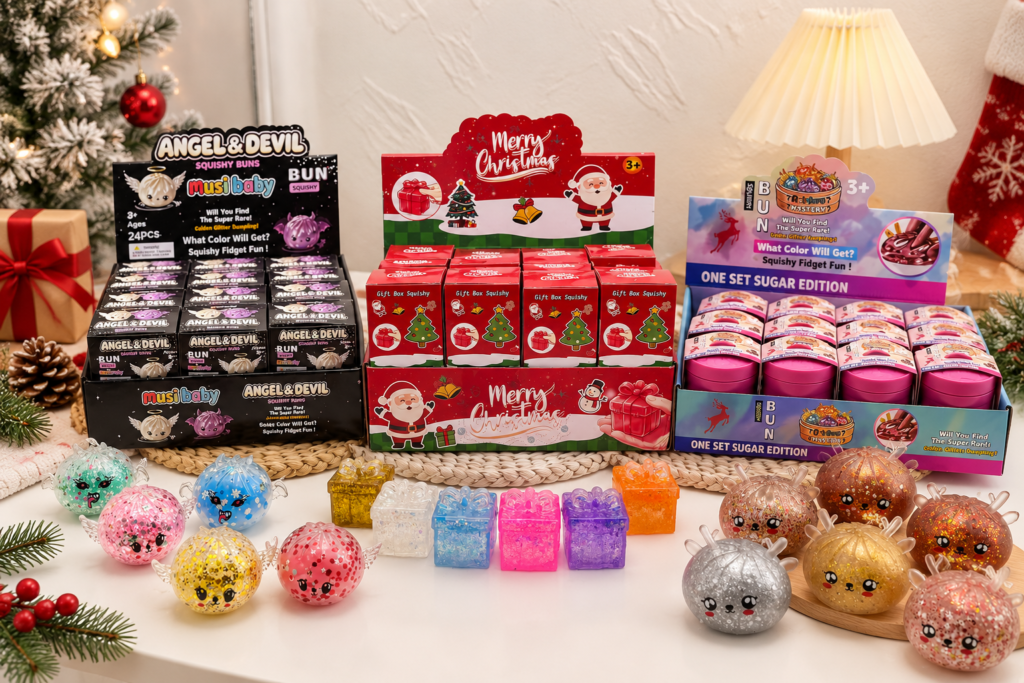
The sample box looked promising: mini squishies, squeeze balls, a surprise toy and several Christmas characters. Then we measured the packages.
One small toy came in a box nearly seven inches wide. The surprise toy lacked a unit barcode. The Christmas mix had six characters, but nobody could define “assorted” for 432 pieces.
The toys fit in a stocking. The order did not yet fit the stores.
Table of Contents
Five Seconds at the Register
Nobody came into the shop specifically looking for one of these toys. They found them while waiting to pay. Pick it up, give it a squeeze, yes or no—usually in less time than it took the line to move.
For wholesale stocking stuffers, the strongest samples explained themselves. People pressed the fidget button and squeezed the soft toy without instructions. Another item made sense only after someone read the back panel. It went back into the sample carton.
The wide box made a cheap toy look like a larger gift, which sounded useful until it occupied half the counter. It also fit awkwardly in the shop’s stockings. The buyer chose a tighter clear box.
“Stocking Stuffer” Is Not a Display Plan
The buyer assumed the toys would go into baskets. The store managers had other ideas.
One wanted peg hooks. Another pointed to a strip of counter beside the card reader that was barely wider than a receipt printer. The third manager had room for twelve pieces, but she pulled the front row from the sample display and watched the tray lean forward. That settled the question of whether the standard box would work.
Two packaging options for the wholesale stocking stuffers came out of that store walk. Basket and counter units kept a barcode on every clear box. The hanging version got a sturdier header card. Same toy, but no pretending that three stores would handle it the same way.
Buyers sourcing wholesale stocking stuffers often start with the size of the gift. In this order, the missing measurement belonged to the store. Peg, tray or basket had to be written into the brief before anyone could finish the packaging.
Wholesale Stocking Stuffers Do Not Disappear on December 26
The Christmas characters were the favorites in the sample meeting. Reindeer, snowmen and gingerbread people looked right for the display. They were also the products nobody wanted in January.

The Christmas characters stayed, but in a smaller run. The deeper buy went to food-shaped squishies in red, green and white. They looked at home beside the reindeer in December. Come January, the unopened pieces could return to the regular toy section without looking stranded there.
For one of the standard items, a paper sleeve supplied all the Christmas it needed. The sleeve could come off; the toy did not have to change. The buyer was more comfortable putting permanent holiday artwork on the proven character than on a first-year item with no sales history.
A Christmas-only SKU may get six good weeks. Fine. The opening quantity should be based on those six weeks, not on what the same shelf might sell over a full quarter.
What Does “Assorted” Mean in a Master Carton?
The proposed master carton held 144 toys. The packing note said “mixed colors.” That was not enough information for three stores sharing one promotion.
Nobody planned to count out exactly 24 of every color. The buyer did ask for the three stores to receive roughly the same-looking mix. The purchase order named the designs and gave a range instead of a rigid count. A color could change if stock ran short. The toy itself could not.
Red in place of green would not surprise a store manager opening the carton. A clicking fidget in a box that was supposed to contain quiet squeeze toys certainly would.
The inner pack changed to twelve pieces, matching the display. One sealed pack refilled the tray. No sales-floor sorting or half-open master carton behind the register.
For wholesale stocking stuffers, packing decisions show up in places the factory never sees. A neat ratio on a purchase order can become a much easier Saturday afternoon for the person running the store.
The Price Tag Does Not Cover the Whole Assortment
A $5 retail price did not make the product file optional.
The buyer asked for the age grade, materials, warnings and applicable test records by product number. Three differently built toys happened to share a holiday carton; that did not turn them into one SKU. A PDF titled “holiday toys” was not enough to show which report belonged to which item.
The smaller pieces needed a closer look. U.S. Consumer Product Safety Commission rules do not allow a toy intended for children under three to contain a small part—or release one during the applicable testing. Some products for older children must carry a choking-hazard warning. The retail price has no bearing on either requirement.
So the warning and tracking copy went onto the dieline first. Snowflakes came later. It saved an artwork revision and avoided the tiny, squeezed-in type that appears when required text is treated as an afterthought.
Thanksgiving Was Too Late for Plan B
The displays were due on the floor in early November. The original idea was to see what sold, choose a winner after Thanksgiving and place a reorder.
That could work for a product already sitting in stock. It would not leave enough time for another production run and international freight. The buyer therefore marked the Christmas characters as a one-time buy. Two year-round items were approved for possible replenishment from available inventory.
Wholesale stocking stuffers have an unforgiving delivery window. A carton arriving a few days after Christmas has not suffered a minor delay. It has missed the reason it was ordered.
The purchase order used two dates: warehouse arrival and the store-display date. They were not treated as one deadline.
The Order Looked Different by the End
The phrase “small assorted Christmas toys” never appeared on the final order.
Instead, it listed product numbers, package dimensions, twelve-piece inner packs, approved color ranges, display quantities and the allocation for each store. Christmas-only items were identified separately from products eligible for a quick restock.
That may sound like a lot of detail for a low-priced toy. It was still easier than opening the cartons in November and discovering that the assortment did not fit the counter, the stockings or the store’s receiving process.
Wholesale stocking stuffers do not need an elaborate gift box or a new holiday mold. They do need a clear job in the store. Before requesting a quote from Vilora Toys, include the target price, age range, package style, display location, store count and required warehouse date. “Small and Christmas-themed” is a start, but it is not enough to pack the order correctly.
Read More
• Seasonal Toys: How Buyers Should Plan the Selling Window
• Wholesale Novelty Toys: How to Build an Assortment That Does Not Feel Random
• Custom Squishy Toy Packaging: What Buyers Should Decide Before Artwork Begins