A jumbo squishy is not simply a regular squishy made bigger.
Once the product moves into the 15 cm range, buyers start dealing with a different set of practical questions. The toy takes up more shelf space, needs a larger package, fills cartons much faster and can behave differently after being compressed for several weeks.
That changes the way jumbo squishy wholesale orders should be evaluated. A sample still has to look good and feel right, but the buyer also needs to understand what that larger size means for display, storage and freight.
Table of Contents
Bigger Size Changes the Product
A design that works well at 8 or 9 cm may feel noticeably different when it is scaled up.
The larger version can be heavier, softer through the center or slower to regain its shape. Uneven recovery is also easier to notice because there is simply more surface area. On a small squishy, a slightly flattened corner may go unnoticed. On a jumbo piece, it can be obvious.
When reviewing jumbo squishy wholesale samples, squeeze more than the center. Press the sides, corners and any raised features separately. Then let the product sit on a flat surface and see whether the shape returns evenly.
Two 15 cm samples can look almost identical in photos and still behave very differently in the hand. That is why the stated size alone does not tell you enough.
If you are already comparing slow-rise squishy wholesale products, the same idea applies here: recovery behavior should be judged from the actual sample, not from a product description.
Jumbo Squishy Wholesale Needs Exact Measurements
“Large” and “XL” are useful marketing words. They are poor production specifications.
If the approved product is 15 cm, that measurement should appear in the order details. For irregular shapes, confirm height, width and depth rather than relying on a single number.
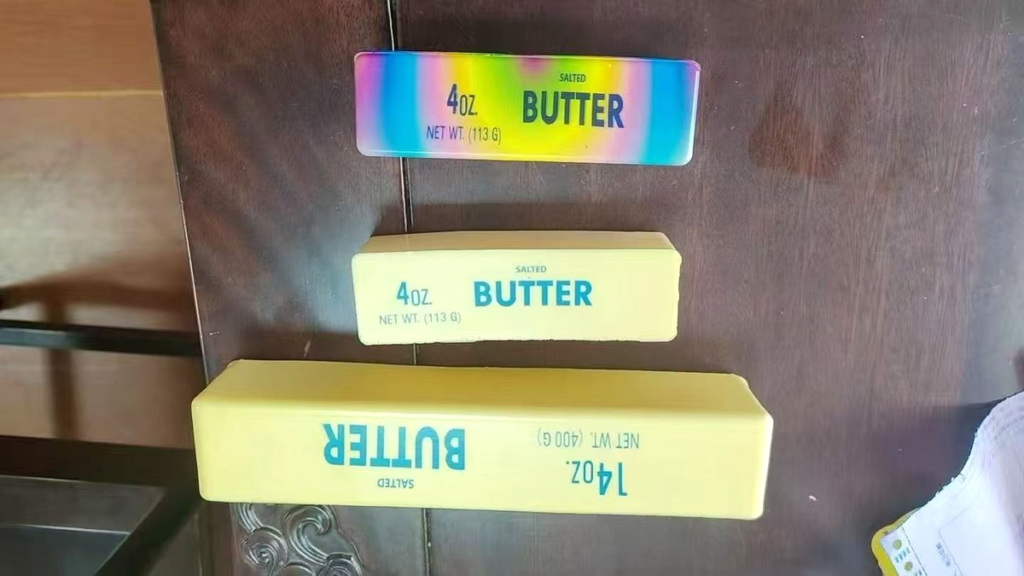
A small difference can become surprisingly important. Imagine one product is 15 cm wide and another is 17 cm. That extra 2 cm may change the retail box, the number of units that fit across a shelf and the number of pieces that can be packed into a master carton.
The same applies to accessories. If the jumbo toy includes a tray, basket or display base, the full set needs to be measured—not just the soft toy itself.
For jumbo squishy wholesale, I would always compare the physical sample against the stated dimensions before approving production.
Shelf Space Is Part of the Product Cost
Jumbo squishies are good at getting attention. That is part of their appeal.
They are also good at taking up space.
A shelf that can hold twenty small squishies might only hold five or six jumbo pieces. That does not automatically make the larger product less attractive, but it changes the merchandising math.
A retailer needs to know how many units can sit face-out, whether the product can be stacked, and whether the packaging helps or hurts visibility. In some stores, a jumbo item may work better as a visual anchor than as a high-volume SKU.
For jumbo squishy wholesale, the question is not simply, “How many pieces do I want to buy?” It is also, “Where are these pieces going to sit once they arrive?”
That is especially relevant for gift shops, specialty toy stores and novelty retailers where display space is limited.
Freight Can Change the Real Cost of the Order
Jumbo squishies are often light for their size. That sounds like an advantage until the cartons are calculated.
Freight is not based only on how much the product weighs. Large, low-density items can use a lot of space, and carton volume becomes part of the shipping cost.
Consider two similar jumbo products. One packs 24 pieces per carton. The other packs 16 because its retail box is wider. If the unit prices are close, the second product may still cost more to land simply because the order requires more cartons.
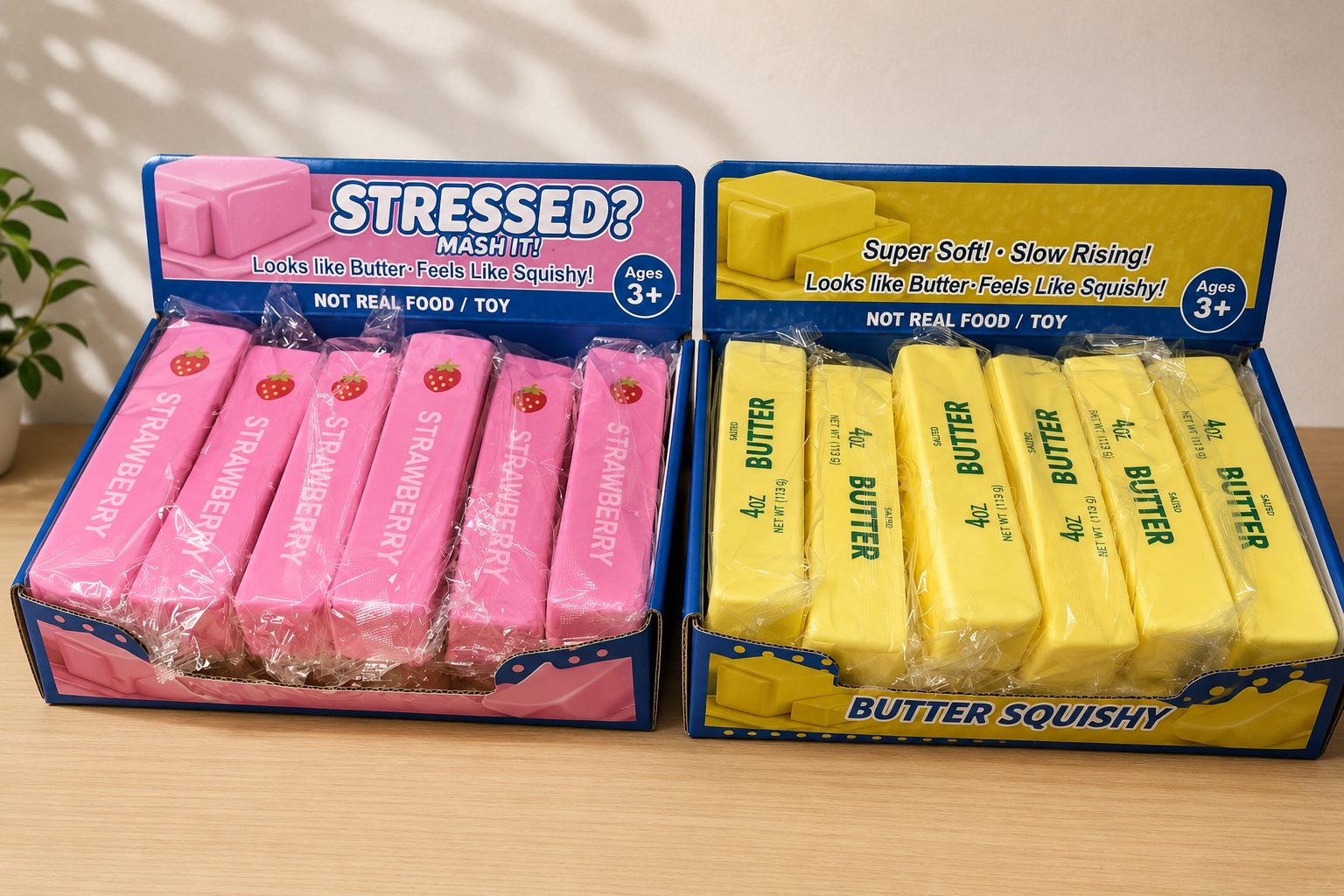
That is why carton information matters when comparing jumbo squishy wholesale quotes. Ask for units per carton and master-carton dimensions before treating the unit price as the full cost picture.
Packaging can widen that difference. A rigid retail box may look better on the shelf, but it also takes up more space in transit. A compact package may improve freight efficiency if the product can be packed without staying under too much pressure.
This is where novelty toy packaging matters for reasons that have nothing to do with branding.
Check the Product After It Has Been Packed
A jumbo squishy may look perfect when it is sitting loose on a sample table.
That does not tell you how it will look after several weeks inside a package.
If the box or inner packing keeps the toy compressed, remove the sample after a realistic storage period and see what happens. Does it regain its original shape? Are the corners still flattened? Does the surface show pressure marks?
For a jumbo squishy wholesale program, this check is worth doing before mass production because larger products have more area that can be affected by pressure.
The recovery does not have to be instant. What matters is whether the product returns to a condition that looks acceptable for retail.
It is also useful to handle the sample a little more aggressively than you would a small squishy. Move it in and out of the package several times. Set it on different sides. Check areas that carry more weight. The larger scale can expose weaknesses that are easy to miss on a smaller version.
MOQ Looks Different When the Product Is Jumbo
MOQ sounds like a number until the cartons show up.
Five hundred small novelty toys may fit into a relatively compact space. Five hundred jumbo squishies can take over a large section of a warehouse or stockroom.
That is why jumbo squishy wholesale quantity should be considered together with carton count and storage space.
Ask how many cartons the full order will create. If the retailer has a small backroom or the distributor is already carrying several bulky products, that information may be more useful than the MOQ by itself.
This is also why novelty toy MOQ should not always be compared product to product without context. A lower minimum on a bulky item can still be a larger physical inventory commitment than a higher minimum on something compact.
Approve the Full-Size Sample, Not Just the Idea
Scale is difficult to judge from a photo.
A jumbo squishy may look proportional online and feel much larger than expected once it is sitting on a desk or shelf. Before approving production, place the sample next to other products in the assortment. Check the actual retail footprint. Measure it again. Put it into the proposed package.
If the product is intended primarily for children 12 and under in the U.S., applicable toy safety requirements should also be confirmed before production. CPSC guidance explains that those toys generally require third-party testing and certification for applicable requirements, while the specific ASTM F963 sections depend on the individual product.
For jumbo squishy wholesale, the best sample does more than show whether the design is cute. It should tell the buyer how the product feels at full size, how much space it takes, how it behaves after packing and whether the logistics still make sense.
Read More: Buying Guide · Customization Guide · OEM Guide